
Free Safe Operating Procedure (Portable Ramp Setup) Template
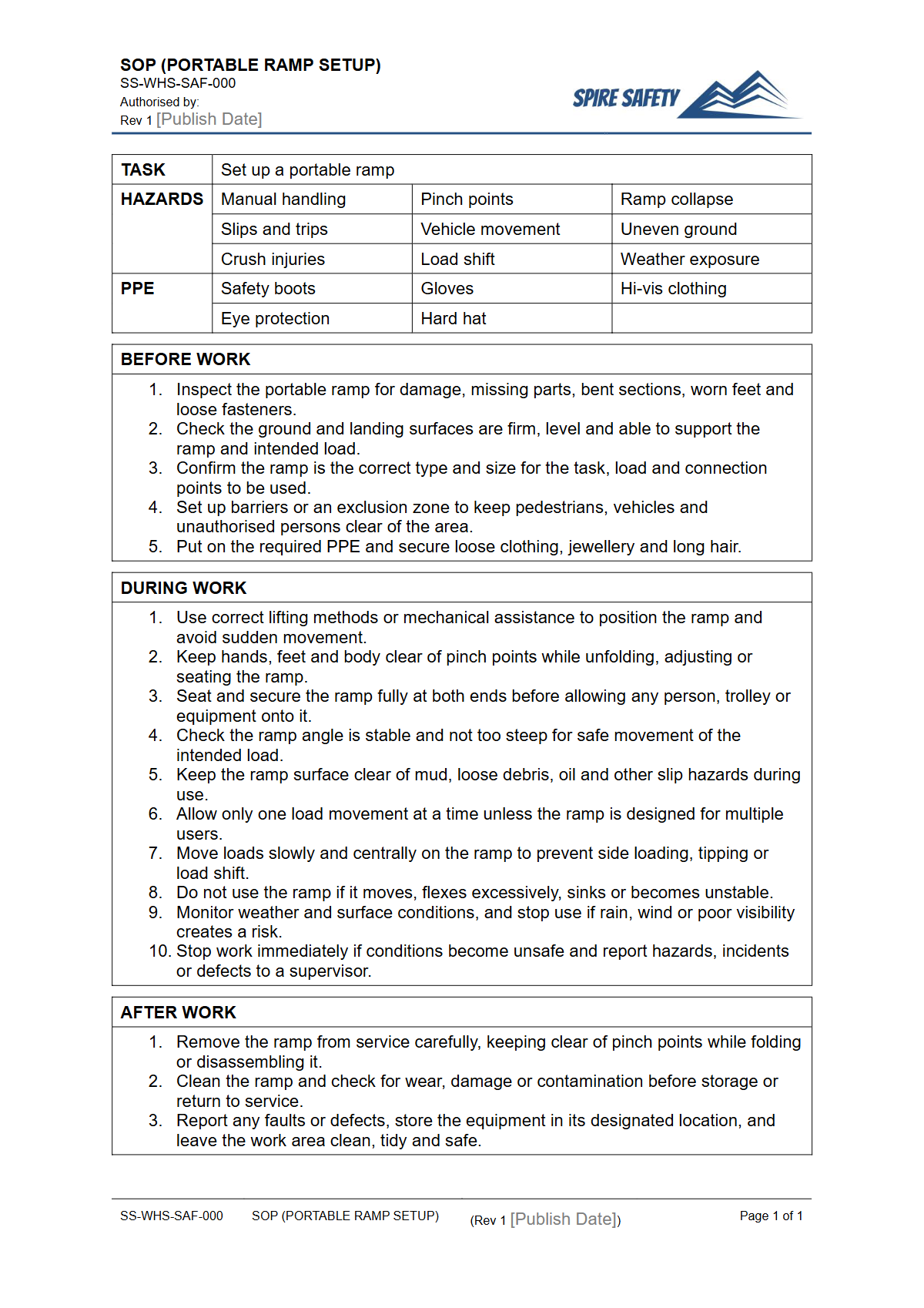
Establish clear, safe work instructions for setting up and using portable ramps in your workplace.
Free Safe Operating Procedure (Portable Ramp Setup) Template
DOCX • 126 KB + PDF
Updated Oct 2026
No signup required
Purpose of the Free Safe Operating Procedure (Portable Ramp Setup) Template
Using portable ramps is a common task in many industries, from logistics and transport to construction and events. While they offer a practical solution for moving equipment and goods over changes in elevation, they also introduce significant risks if not managed correctly.
This Free Safe Operating Procedure (Portable Ramp Setup) Template provides a structured framework for documenting the safe use of portable ramps, helping your organisation minimise the risk of incidents. The primary goal is to prevent injuries such as slips, trips, falls, and musculoskeletal disorders that can result from incorrect ramp selection, placement, or use.
By standardising the process, you create a clear, repeatable, and trainable system of work.
A documented SOP ensures that all workers understand the required steps for pre-use inspection, positioning the ramp on a stable surface, ensuring the correct gradient, securing the ramp against movement, and observing load capacity limits. It forms a critical component of your site safety documentation and demonstrates a commitment to managing workplace hazards.
Integrating such procedures is a cornerstone of effective and comprehensive WHS management systems, providing tangible proof of your risk control measures.
What is a Safe Operating Procedure?
A Safe Operating Procedure (SOP) is a written document that provides step-by-step instructions on how to perform a specific task safely and efficiently. It identifies potential hazards associated with the task and outlines the control measures required to eliminate or minimise them.
For portable ramp setup, this includes risks like the ramp slipping, collapsing under load, or being too steep, leading to uncontrolled movement of goods or people. Well-developed SOPs are not just for compliance; they are essential training tools that empower workers to perform their duties with confidence and safety.
If your team requires tailored guidance on developing these documents, consider seeking expert WHS consulting to ensure your procedures are robust and practical.
Video walkthrough
How to use the Free Safe Operating Procedure (Portable Ramp Setup) Template
This template is designed as a foundational document, aligned with Australian WHS principles, that you can adapt for your specific operational needs. It is available in both DOCX and PDF formats for your convenience.
The DOCX version is fully editable, allowing for complete customisation.
To get the most out of this resource, follow these steps:
- Download: Choose the DOCX file to begin customisation.
- Customise: Systematically review each section. Add or remove steps to accurately reflect the specific types of portable ramps used at your site, the environments they are used in (e.g., loading docks, construction sites), and the loads they will bear.
- Consult: Engage with the workers and supervisors who will be using the procedure. Their hands-on experience is invaluable for identifying practical challenges and effective controls. Consultation is a key requirement of workplace health and safety legislation.
- Approve and Train: Once finalised, have the SOP formally approved by a manager or supervisor. Use the document as a central part of your training program for all relevant personnel, ensuring everyone understands their responsibilities.
Important: This is a template only. It is your responsibility to ensure it is adapted to the unique context of your workplace, equipment, and legal obligations.
We have a wide range of other templates available in our free WHS resources library to support your safety management efforts.
When to use it
An SOP for portable ramp setup should be a living document that is integrated into your daily operations. It is most effective when used consistently in several key situations.
Refer to the SOP before any task involving the setup and use of portable ramps, especially for non-routine operations. It should be a core resource during worker training, induction, and refresher courses to establish a baseline of safe behaviour.
The procedure also serves as an excellent guide for pre-start meetings or toolbox talks, allowing teams to quickly review risks and controls before work begins.
Furthermore, this document is a critical reference during safety inspections and formal audits. It provides a clear benchmark against which actual work practices can be measured.
You can use it as part of your regular WHS compliance auditing to verify that controls are being implemented correctly. In the unfortunate event of an incident or near-miss involving a ramp, the SOP becomes an essential tool for investigation, helping to identify any procedural gaps or deviations that may have contributed to the event.
Who should use it
This Safe Operating Procedure is intended for all personnel involved with the use of portable ramps. This includes frontline workers responsible for transporting, setting up, using, and packing away the ramps.
Their direct use of the SOP ensures that safety checks and procedural steps are followed consistently for every task. Supervisors and managers must also be familiar with the procedure to effectively oversee work, enforce safety standards, and provide guidance to their teams.
They are responsible for ensuring workers are trained and competent in its application.
WHS managers and safety officers will use this SOP as part of the broader safety management system to monitor compliance, conduct risk assessments, and deliver training. It serves as a key piece of evidence demonstrating how the organisation is managing specific manual handling and equipment-related risks.
The principles within this SOP can be applied alongside other equipment-specific procedures, such as an Air Compressor SOP when moving portable machinery. Similarly, teams using ramps to load and unload goods may also need to refer to a conveyer system SOP as part of a larger logistics process.
The document can also be a useful reference for procurement staff when selecting and purchasing new ramps to ensure they meet operational safety requirements.
Common mistakes
Common mistakes to avoid
- Using a ramp with a load capacity lower than the weight of the equipment or person crossing it.
- Failing to secure the ramp to the upper surface (e.g., truck bed or landing), allowing it to slip during use.
- Setting the ramp at too steep an angle, making it difficult to control loads and increasing the risk of slips.
- Neglecting to inspect the ramp for cracks, bends, or other structural damage before setting it up.
Legal references
Legal considerations
The following legal requirements may be relevant to this type of work.
- Work Health and Safety Act (Harmonised) — Provides the primary duties for protecting workers and other people from work health and safety risks.
- Work Health and Safety Regulations (Harmonised) — Sets out requirements supporting the management of workplace hazards and risks.
The following codes may be relevant to this type of work.
- Managing WHS Risks Code of Practice — Provides practical guidance on identifying hazards, assessing risks and applying effective controls.
- Work Health and Safety Consultation, Cooperation and Coordination Code of Practice — Provides practical guidance on consulting workers and coordinating with other duty holders.
- Managing the Work Environment and Facilities Code of Practice — Provides practical guidance on safe work environments, workplace facilities and related controls.
Did you know
The Gradient Rule
For safe manual handling, a ramp's gradient should ideally be no steeper than 1:8 (a 1-metre rise over an 8-metre length). For wheelchair access, Australian Standards (AS 1428.1) mandate an even gentler maximum gradient of 1:14.
Slips, Trips and Falls
Slips, trips and falls are a leading cause of workplace injury in Australia. Using unsecured or damaged ramps is a common contributor to these preventable incidents, particularly in the transport, postal, and warehousing industries.
FAQ
Frequently asked questions
01What should be included in an SOP for portable ramps?
02How often should portable ramps be inspected?
03What is the biggest risk when using a portable ramp?
04Can this SOP template be used for fixed ramps?
Share this resource
Free Safe Operating Procedure (Portable Ramp Setup) Template
Browse Categories
How To Use It
- 1Download and open in Word or PDF.
- 2Replace the placeholders with your business details.
- 3Get it reviewed by a WHS specialist before rollout.
Need it customised?
Our WHS consultants can adapt this template to your site, run a gap analysis, or audit what you already have in place.
Book a Free Consultation WHS consulting servicesor call 1300 156 382
Related templates
- Free Safe Operating Procedure (Portable Sawmill) Template
- Free Safe Operating Procedure (Portal Crane) Template
- Free Safe Operating Procedure (Post Driver) Template
- Free Safe Operating Procedure (Post Hole Digger) Template
- Free Safe Operating Procedure (Potable Water Cart) Template
- Free Safe Operating Procedure (Potato Peeler) Template