
Free Safe Operating Procedure (Portable Hoist Check) Template
Formalise your equipment safety checks with our Free Safe Operating Procedure (Portable Hoist Check) Template. Download the customisable DOCX and PDF now.
Free Safe Operating Procedure (Portable Hoist Check) Template
DOCX • 126 KB + PDF
Updated Oct 2026
No signup required
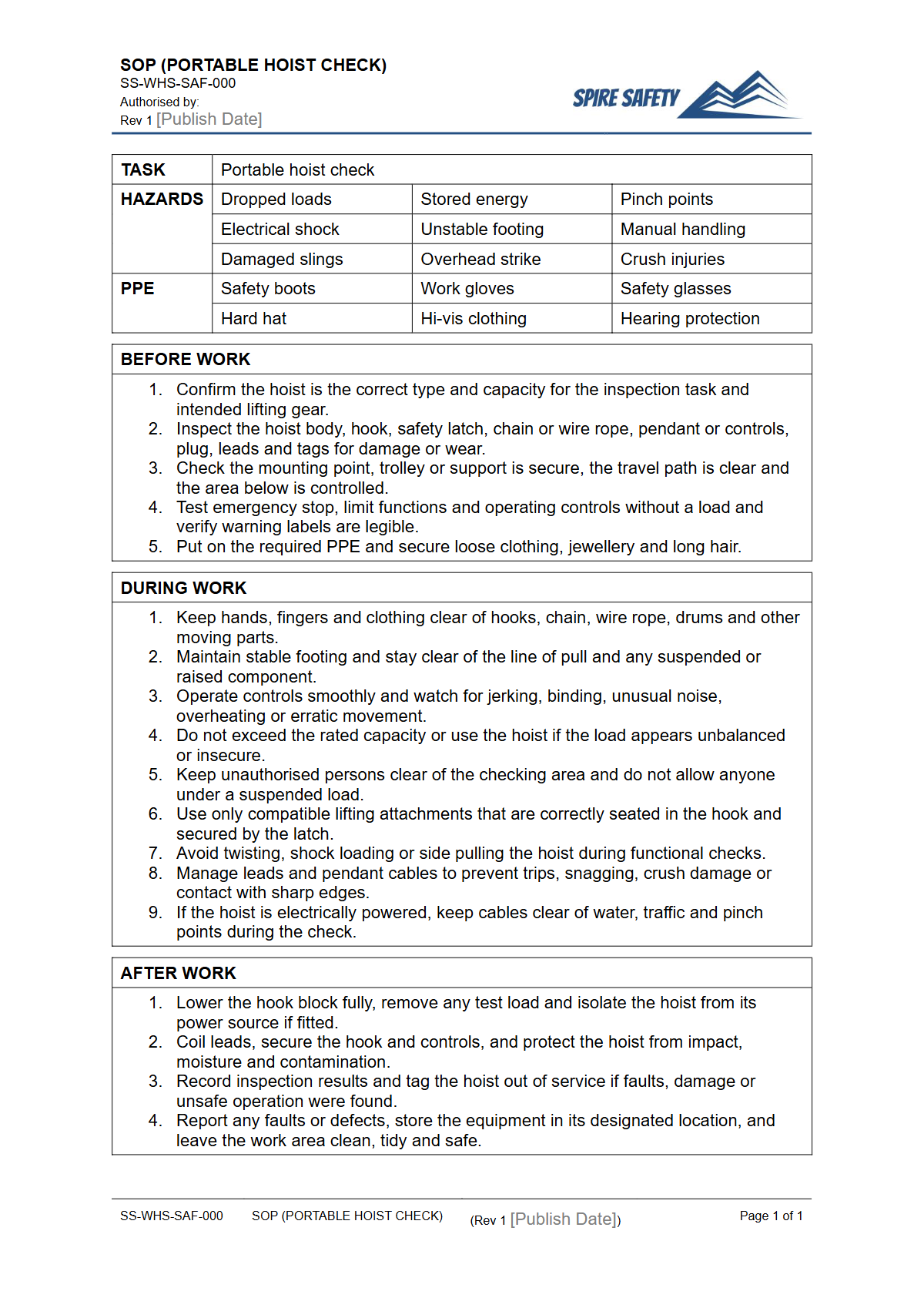
Purpose of the Free Safe Operating Procedure (Portable Hoist Check) Template
Operating a portable hoist without rigorous, documented checks presents a significant risk to workers and workplace safety. This Free Safe Operating Procedure (Portable Hoist Check) Template provides a structured starting point for creating a formalised process for your business.
It is designed to guide workers through essential pre-use inspections, safe operational steps, and post-use procedures, helping to ensure the equipment is fit for use every time. Implementing a clear SOP is a fundamental part of identifying hazards associated with lifting operations and establishing effective risk controls.
Consistent application of this procedure helps prevent equipment failure, property damage, and serious injuries.
This document is aligned with the principles of the model WHS framework, encouraging a systematic approach to high-risk tasks. By documenting every step, from checking hooks and chains to confirming the Safe Working Load (SWL), you create a clear standard of behaviour and an auditable record of your safety practices.
This is similar in principle to the checks outlined in our Free Telehandler SOP Template, where routine inspection is key to managing high-risk plant. Ultimately, this SOP helps embed a culture of safety and accountability in all lifting operations.
Video walkthrough
How to use the Free Safe Operating Procedure (Portable Hoist Check) Template
This resource is available for immediate download as a DOCX file for easy editing, or as a PDF for quick printing. To use it effectively, you must adapt it to your specific operational context.
A generic template cannot account for the unique variables of every workplace, such as the specific models of hoists in use, the environment they are operated in, or the types of loads being lifted. Integrating customised SOPs like this one is a critical component of a comprehensive WHS management system.
IMPORTANT: This is a template, not a finished document. We have designed it to be a strong starting point, but you must customise it with your specific workplace details, hoist models, site-specific hazards, and control measures.
Review each section and add, remove, or modify content to ensure it accurately reflects your work processes. This includes specifying the exact Personal Protective Equipment (PPE) required, detailing your internal procedure for reporting faults, and listing emergency contacts.
When to use this Safe Operating Procedure
A Safe Operating Procedure for a portable hoist check should be a constant reference point, not just a document that sits on a shelf. It should be used consistently in several key situations to maintain the highest level of safety and compliance.
It should be consulted before the start of any shift where a portable hoist will be used, guiding the operator through the mandatory pre-use inspection. It also serves as a critical training document for new employees during their induction and for existing workers undergoing refresher training on lifting equipment.
Following an incident or a near-miss involving a hoist, the SOP should be reviewed as part of the investigation to identify any gaps or areas for improvement. Furthermore, these documents are essential evidence during internal WHS compliance audits to demonstrate that formal safety processes are in place and being followed.
Who should use this Safe Operating Procedure
This SOP is intended for a range of personnel within an organisation. The primary users are the workers and operators who have been trained and authorised to use portable hoists.
For them, it is a practical, step-by-step guide to performing their tasks safely. Supervisors and line managers are also key users, as it provides them with a clear benchmark for monitoring worker performance, conducting safety observations, and enforcing safe work standards.
Finally, WHS managers, safety officers, and anyone responsible for the development and implementation of the site's safety management system will use this template as a foundation for building robust, site-specific documentation. For businesses needing assistance in tailoring these documents, engaging expert WHS consulting support can help ensure procedures are practical and effective.
Key Checks for a Portable Hoist
While your customised SOP will contain specific details, a thorough check generally includes inspecting:
- Hooks: Check for any stretching, cracks, or twisting. The safety latch must be present and functioning correctly.
- Load Chain or Wire Rope: Inspect for signs of wear, corrosion, kinks, broken strands, or stretching. Ensure it is properly lubricated according to manufacturer specifications.
- Control Pendant: Verify that all buttons or controls function correctly, including the emergency stop. The casing should be free from damage.
- Housing and Structure: Look for any cracks, deformation, or loose bolts on the main body of the hoist.
- Markings: Confirm that the Safe Working Load (SWL) and any identification numbers are clearly visible and legible.
These principles of mechanical inspection are common across many types of workshop equipment, as seen in our free Air Compressor SOP, which also relies on pre-use checks for safe operation.
A well-drafted SOP ensures these checks become second nature, turning a procedural requirement into a life-saving habit. It is just as important as the procedure for using hazardous hand tools, which is why we also provide resources like our free Circular Saw SOP. You can explore our complete collection of document templates in our free WHS resources library to support all areas of your safety system.
Common mistakes
Common mistakes to avoid
- Skipping the pre-use inspection to save time.
- Using a hoist for a purpose it was not designed for (e.g., side-pulling a load).
- Failing to report minor damage or malfunctions immediately.
- Operating the hoist without confirming the load weight is below the SWL.
Legal references
Legal considerations
The following legal requirements may be relevant to this type of work.
- Work Health and Safety Act (Harmonised) — Provides the primary duties for protecting workers and other people from work health and safety risks.
- Work Health and Safety Regulations (Harmonised) — Sets out requirements supporting the management of workplace hazards and risks.
The following codes may be relevant to this type of work.
- Managing WHS Risks Code of Practice — Provides practical guidance on identifying hazards, assessing risks and applying effective controls.
- Work Health and Safety Consultation, Cooperation and Coordination Code of Practice — Provides practical guidance on consulting workers and coordinating with other duty holders.
- Managing the Work Environment and Facilities Code of Practice — Provides practical guidance on safe work environments, workplace facilities and related controls.
Did you know
Safe Working Load (SWL)
The Safe Working Load (SWL) marked on a hoist is the maximum load it can safely lift. Exceeding the SWL, even briefly, can cause catastrophic failure and is a major breach of safety regulations.
Chain vs. Wire Rope
Hoists can use either chain or wire rope. Each has different inspection criteria; chains must be checked for stretching, nicks, and gouges, while wire ropes are inspected for broken strands, corrosion, and kinks.
FAQ
Frequently asked questions
01What is a Safe Operating Procedure (SOP) for a portable hoist?
02Is this portable hoist check SOP template suitable for all types of hoists?
03How often should portable hoists be inspected?
04Who is a 'competent person' for inspecting a hoist?
Share this resource
Free Safe Operating Procedure (Portable Hoist Check) Template
Browse Categories
How To Use It
- 1Download and open in Word or PDF.
- 2Replace the placeholders with your business details.
- 3Get it reviewed by a WHS specialist before rollout.
Need it customised?
Our WHS consultants can adapt this template to your site, run a gap analysis, or audit what you already have in place.
Book a Free Consultation WHS consulting servicesor call 1300 156 382
Related templates
- Free 3D Printer SOP (Safe Operating Procedure) Template
- FREE Agricultural Equipment SOP (Safe Operating Procedure) Template
- Free Air Compressor SOP (Safe Operating Procedure) Template
- Free Angle Grinder SOP (Safe Operating Procedure) Template
- FREE Backhoe SOP (Safe Operating Procedure) Template
- FREE Baler SOP (Safe Operating Procedure) Template