
Free Safe Operating Procedure (Portable Appliance Test) Template
Manage electrical risks with our structured Safe Operating Procedure for portable appliance testing. Download your free, customisable template to get started.
Free Safe Operating Procedure (Portable Appliance Test) Template
DOCX • 126 KB + PDF
Updated Oct 2026
No signup required
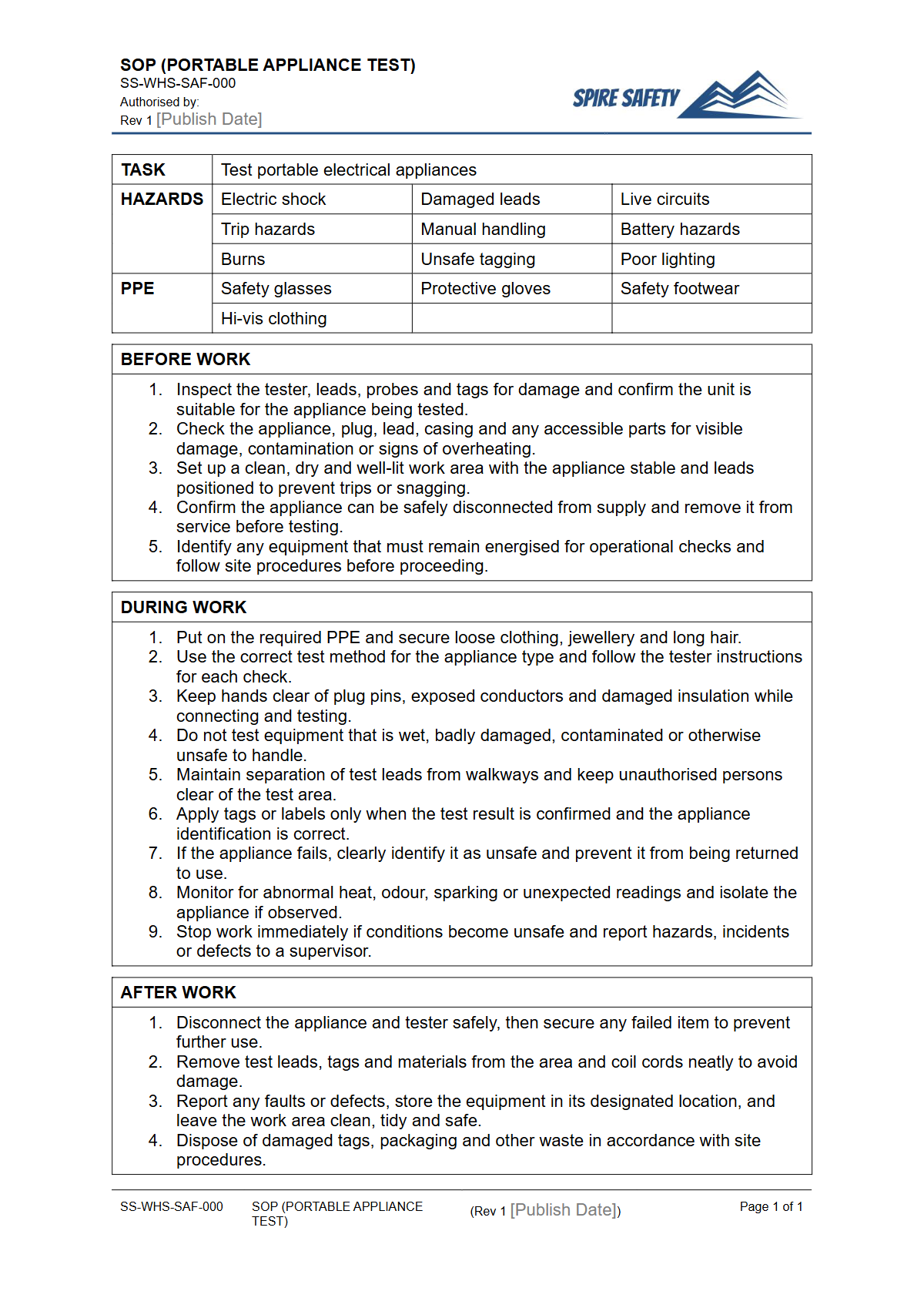
Purpose of the Free Safe Operating Procedure (Portable Appliance Test) Template
Effectively managing electrical safety is a critical WHS responsibility in any Australian workplace. Portable electrical appliances, common in almost every setting from offices to construction sites, can pose significant risks of electric shock, burns, and fire if not properly maintained.
Our free Safe Operating Procedure (Portable Appliance Test) Template provides a structured framework to help your organisation implement and document a systematic process for testing and tagging. This resource, aligned with Australian WHS practice, helps formalise procedures to keep your workers safe from electrical hazards.
The primary purpose of this Safe Operating Procedure is to provide a clear, step-by-step guide for competent persons performing in-service inspection and testing of portable electrical equipment. It formalises a safe system of work to minimise electrical risks. Using this template helps your business to:
- Systematically identify hazards associated with portable appliances.
- Outline control measures, including pre-use checks, visual inspections, and electrical testing.
- Provide a consistent training document for workers assigned to conduct testing.
- Establish clear requirements for tagging appliances and recording test results.
A well-defined SOP is a fundamental component of proactive safety management, similar to the structured approach found in our circular saw SOP template for managing high-risk tools.
Video walkthrough
How to use the Free Safe Operating Procedure (Portable Appliance Test) Template
Begin by downloading the template in your preferred format (DOCX for easy editing or PDF). The document is structured with key sections that you will need to review and populate with information specific to your operational context, equipment, and workforce.
IMPORTANT NOTE: This is a template only. We have designed it to be a starting point that you must adapt to the specific equipment, environment, legislation, and Australian Standards applicable to your workplace.
You must consult the relevant codes of practice and conduct a risk assessment to ensure the final procedure is comprehensive.
Key sections for customisation include:
- Personal Protective Equipment (PPE) requirements.
- The sequence of testing (e.g., visual inspection, insulation resistance, earth continuity).
- Specific pass/fail criteria based on equipment class.
- Procedure for dealing with failed items (e.g., quarantine and 'DANGER' tagging).
- Record-keeping requirements.
Integrating this SOP into a comprehensive WHS management system ensures that it is part of a holistic approach to workplace safety, rather than a standalone document.
When to Use This SOP
This Safe Operating Procedure should be implemented as the standard process for all portable appliance testing conducted at your workplace. It is a live document that should be used and referenced during several key activities:
- Initial Implementation: When first establishing a formal testing and tagging program.
- Worker Training: As the core training material for any person deemed competent to perform testing.
- Refresher Training: During periodic reviews to ensure procedures are being followed correctly.
- Audits and Reviews: As a benchmark document during internal or external safety audits.
Regularly reviewing procedures like this is a key activity verified during WHS compliance auditing to ensure ongoing effectiveness and adherence to safety standards.
Who Should Use This Procedure
This SOP is intended for several key roles within an organisation to ensure electrical safety is managed effectively:
- Persons Conducting a Business or Undertaking (PCBUs): To meet their primary duty of care to provide a safe working environment free from electrical risks.
- Managers and Supervisors: To ensure that a formal, safe process is in place and that only competent persons perform the work.
- Competent Persons: The individual workers who have the appropriate training, knowledge, and experience to carry out the inspection and testing tasks as detailed in the procedure.
- WHS/HSE Personnel: To integrate the procedure into the broader safety management system and use it for training and compliance verification.
For complex worksites with a wide range of machinery, engaging specialist WHS consulting can help ensure your testing regime is robust and risk-based.
Understanding the Testing and Tagging Process
A compliant testing and tagging process, guided by AS/NZS 3760, involves more than just plugging in a tester. This SOP guides the user through critical steps including a thorough pre-test visual inspection to check for damage to plugs, leads, and casings.
Following this, electrical tests are performed to verify earth continuity, insulation resistance, and polarity. Documenting these steps is as crucial as performing them, a principle that applies to all equipment SOPs, including our Air Compressor SOP.
Determining Test Frequency
A common point of confusion is how often to test. While the standard provides a table with recommended intervals, this should be used as a guide only.
A risk management approach is required. You must consider the nature of the equipment and the hostility of its operating environment.
For example, a power tool on a construction site will require much more frequent testing than a computer in an office. A similar risk-based approach is necessary when developing procedures for other electrical items, like the one detailed in our deep fryer SOP.
By implementing a robust procedure based on this template, you can streamline your electrical safety management. Explore our full free WHS resources library for more templates to support your safety systems.
Common mistakes
Common mistakes to avoid
- Relying on a visual inspection alone without performing required electrical tests.
- Failing to test the RCD or safety switch that protects the power circuit being used.
- Using default test intervals from the standard without conducting a proper risk assessment.
- Not keeping accurate, complete, and accessible records of all tests performed.
Legal references
Legal considerations
The following legal requirements may be relevant to this type of work.
- Work Health and Safety Act (Harmonised) — Provides the primary duties for protecting workers and other people from work health and safety risks.
- Work Health and Safety Regulations (Harmonised) — Sets out requirements supporting the management of workplace hazards and risks.
The following codes may be relevant to this type of work.
- Managing WHS Risks Code of Practice — Provides practical guidance on identifying hazards, assessing risks and applying effective controls.
- Work Health and Safety Consultation, Cooperation and Coordination Code of Practice — Provides practical guidance on consulting workers and coordinating with other duty holders.
- Managing the Work Environment and Facilities Code of Practice — Provides practical guidance on safe work environments, workplace facilities and related controls.
Did you know
The Colour Code Myth
Contrary to popular belief, there is no mandatory national colour code for test and tag labels in Australia. While some industries use a colour system by convention, AS/NZS 3760 only specifies the minimum information required on the tag.
RCDs Save Lives
A correctly functioning safety switch or Residual Current Device (RCD) can cut power in as little as 30 milliseconds, preventing a potentially fatal electric shock. They are a critical layer of protection but do not replace the need for regular appliance testing.
FAQ
Frequently asked questions
01What is a 'competent person' for portable appliance testing?
02How often do I need to test and tag electrical equipment?
03Does this SOP cover fixed electrical equipment?
04Is testing and tagging mandatory in Australia?
Share this resource
Free Safe Operating Procedure (Portable Appliance Test) Template
Browse Categories
How To Use It
- 1Download and open in Word or PDF.
- 2Replace the placeholders with your business details.
- 3Get it reviewed by a WHS specialist before rollout.
Need it customised?
Our WHS consultants can adapt this template to your site, run a gap analysis, or audit what you already have in place.
Book a Free Consultation WHS consulting servicesor call 1300 156 382
Related templates
- Free Safe Operating Procedure (Portable Bandsaw) Template
- Free Safe Operating Procedure (Portable Heater) Template
- Free Safe Operating Procedure (Portable Hoist Check) Template
- Free Safe Operating Procedure (Portable Ramp Setup) Template
- Free Safe Operating Procedure (Portable Sawmill) Template
- Free Safe Operating Procedure (Portal Crane) Template