
Free Safe Operating Procedure (Port Shed Cleaning) Template
Download our free Safe Operating Procedure for port shed cleaning to formalise your safety processes. This template helps you outline hazards and controls.
Free Safe Operating Procedure (Port Shed Cleaning) Template
DOCX • 126 KB + PDF
Updated Oct 2026
No signup required
Purpose of the Free Safe Operating Procedure (Port Shed Cleaning) Template
This Free Safe Operating Procedure (Port Shed Cleaning) Template provides a structured framework for documenting the required safety steps for cleaning operations within port sheds and similar large-scale industrial environments. Port sheds are dynamic and often high-risk workplaces, containing hazards such as moving vehicles, heavy machinery, dust, spills, and potentially hazardous substances.
Using a formal SOP helps standardise cleaning tasks, ensuring they are performed consistently and safely by all personnel. The primary purpose is to identify potential hazards associated with the cleaning process and outline effective control measures to mitigate the risk of injury or illness.
By documenting a step-by-step process, organisations can meet their duty of care obligations to provide a safe system of work. A well-developed SOP is a crucial training tool, forming the basis for worker inductions, toolbox talks, and competency assessments.
It helps ensure that everyone, from new starters to experienced operators, understands the expected safety standards, required personal protective equipment (PPE), and emergency protocols specific to port shed cleaning. This process formalises safe work practices, moving them from assumed knowledge to a documented, reviewable standard.
Video walkthrough
How to use the Free Safe Operating Procedure (Port Shed Cleaning) Template
Our template is available as a fully editable DOCX file, with a PDF version also provided for easy distribution and printing. To use this Free Safe Operating Procedure (Port Shed cleaning) Template, download the file and open it in your preferred word processor.
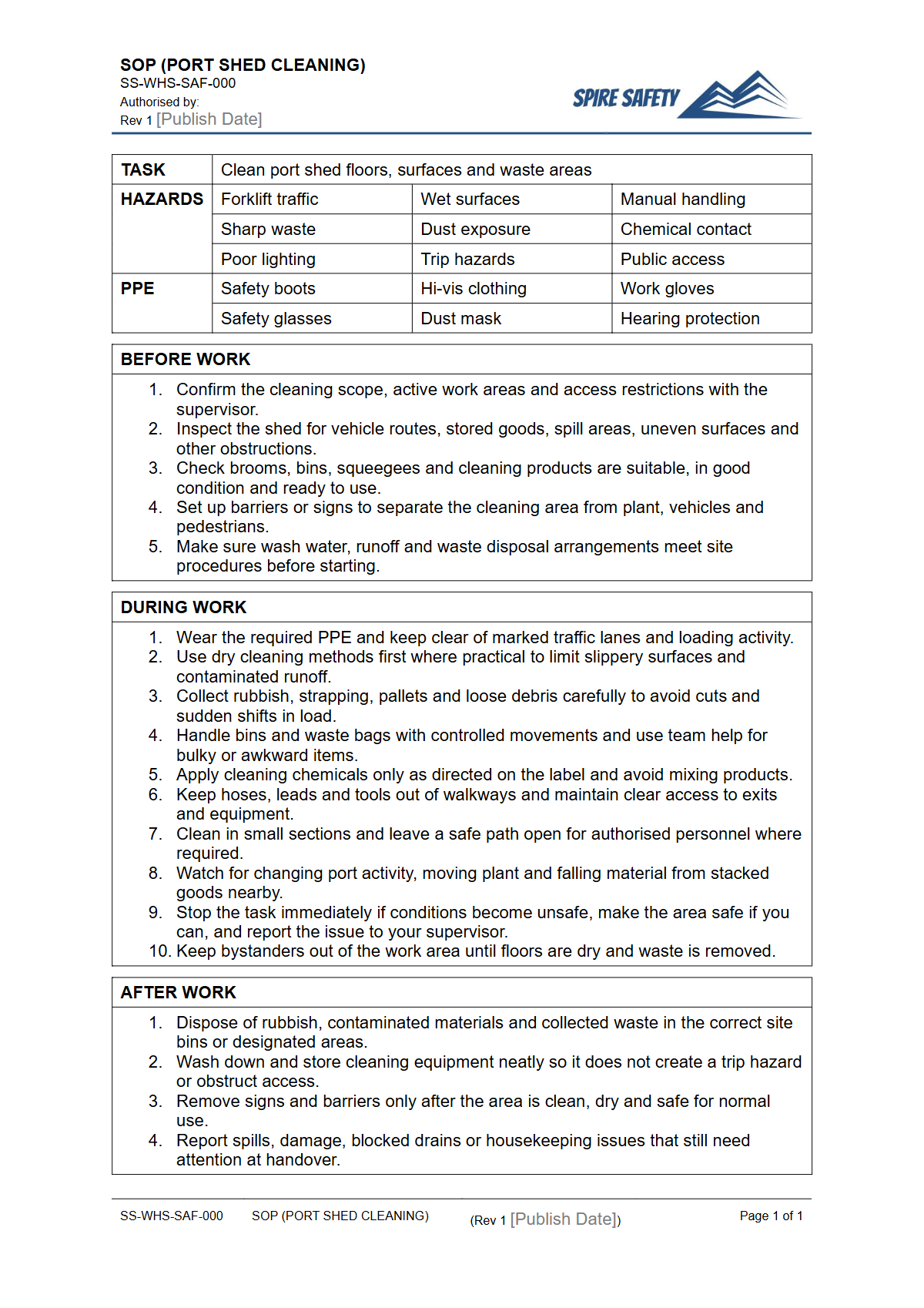
The document is structured with key sections that you must populate with information specific to your workplace and the tasks being performed. These sections include details on required PPE, potential hazards, risk controls, a step-by-step work procedure, and emergency actions.
It is critical to recognise that this document is a template, not a finished product. We strongly advise that you customise this template to reflect the specific hazards, equipment, chemicals, and layout of your port shed.
Conduct a thorough risk assessment of the cleaning tasks at your site and consult with the workers who will be performing the job. Their direct input is invaluable for identifying practical hazards and effective controls.
Once customised, the SOP should be approved by a competent person within your organisation before being implemented.
What is included in the Safe Operating Procedure template?
The template provides a comprehensive starting point aligned with Australian WHS practice. It includes dedicated sections for:
- Hazard Identification: Prompts to list potential dangers like slips, trips, falls, chemical exposure, electrical hazards, and interaction with mobile plant.
- Personal Protective Equipment (PPE): A checklist to specify required PPE such as gloves, safety glasses, respiratory protection, and high-visibility clothing.
- Pre-Operational Checks: Steps to ensure equipment is safe to use and the work area is clear before commencing the task. This includes inspecting cleaning machinery and checking for unexpected obstructions.
- Step-by-Step Operating Procedure: A numbered sequence where you detail the cleaning process from start to finish in a logical, safe order. For complex sites, you might reference procedures for specific equipment, like the process outlined in a conveyer system SOP.
- Emergency Procedures: Clear instructions on what to do in case of a chemical spill, injury, fire, or other emergency.
These sections guide you in building a procedure that forms a key part of your broader WHS management system, helping to systematically manage operational risks.
When to use this Safe Operating Procedure
An SOP for port shed cleaning should be used consistently as a reference and training document. It is not a document to be filed away and forgotten.
It should be actively used during worker training and inductions to establish a baseline for safe behaviour. Supervisors can use it for pre-start meetings or toolbox talks to refresh workers on the key risks before a cleaning shift begins.
It should also be readily available in the work area for operators to reference as needed.
Furthermore, the SOP is a critical document during safety reviews and audits. It serves as the benchmark against which actual work practices are measured.
If an incident or near-miss occurs during cleaning operations, the SOP should be one of the first documents reviewed to determine if the procedure was followed and whether it needs to be updated to prevent a recurrence. Similar to task-specific documents like a telehandler SOP, it must be treated as a live document that evolves with your operations.
Who should use it
This Safe Operating Procedure template is designed for use by multiple roles within an organisation. Primarily, Persons Conducting a Business or Undertaking (PCBUs), site managers, and WHS advisors are responsible for developing, customising, and implementing the SOP.
They must ensure it accurately reflects site-specific risks and complies with relevant WHS regulations.
Supervisors and team leaders are key users, responsible for training their teams on the procedure and ensuring it is followed correctly on the ground. They use the SOP to enforce safe work standards and monitor compliance.
Most importantly, the workers who perform the port shed cleaning are the ultimate end-users. The document must be written in clear, simple language that is easy for them to understand and apply.
For organisations needing support in developing and integrating such documents, professional WHS consulting can provide valuable expertise and ensure best practices are followed.
Engaging a third party to conduct regular safety checks can also ensure these procedures are being implemented effectively. A thorough WHS compliance audit will verify that the documented procedures match the reality of work being performed on site.
This verification is a key step in ensuring the system is working as intended. In industrial settings, it's also common to have procedures for specific tools, such as those found in a free Air Compressor SOP template, which complement the overall cleaning procedure.
Common mistakes
Common mistakes to avoid
- Failing to customise the template with site-specific equipment, chemicals, and hazards.
- Writing the procedure in overly technical language that workers cannot easily understand.
- Not training workers on the finalised SOP or verifying their understanding.
- Forgetting to review and update the SOP after a process change or an incident.
Legal references
Legal considerations
The following legal requirements may be relevant to this type of work.
- Work Health and Safety Act (Harmonised) — Provides the primary duties for protecting workers and other people from work health and safety risks.
- Work Health and Safety Regulations (Harmonised) — Sets out requirements supporting the management of workplace hazards and risks.
The following codes may be relevant to this type of work.
- Managing WHS Risks Code of Practice — Provides practical guidance on identifying hazards, assessing risks and applying effective controls.
- Work Health and Safety Consultation, Cooperation and Coordination Code of Practice — Provides practical guidance on consulting workers and coordinating with other duty holders.
- Managing the Work Environment and Facilities Code of Practice — Provides practical guidance on safe work environments, workplace facilities and related controls.
Did you know
Slips, Trips, and Falls
Slips, trips, and falls are one of the leading causes of serious, preventable injuries in Australian workplaces, accounting for a significant portion of workers' compensation claims each year. Industrial cleaning environments are particularly high-risk.
Worker Consultation
Under Australian model WHS laws, PCBUs have a mandatory duty to consult with workers on matters that directly affect their health and safety. Developing and reviewing SOPs is a key opportunity for this consultation.
FAQ
Frequently asked questions
01What is the difference between an SOP and a Safe Work Method Statement (SWMS)?
02How often should a Safe Operating Procedure for port shed cleaning be reviewed?
03Do I need a separate Safety Data Sheet (SDS) if I have an SOP for cleaning?
04Can this template be used for other industrial cleaning tasks?
Share this resource
Free Safe Operating Procedure (Port Shed Cleaning) Template
Browse Categories
How To Use It
- 1Download and open in Word or PDF.
- 2Replace the placeholders with your business details.
- 3Get it reviewed by a WHS specialist before rollout.
Need it customised?
Our WHS consultants can adapt this template to your site, run a gap analysis, or audit what you already have in place.
Book a Free Consultation WHS consulting servicesor call 1300 156 382
Related templates
- Free Safe Operating Procedure (Port Waste Handling) Template
- Free Safe Operating Procedure (Portable Appliance Test) Template
- Free Safe Operating Procedure (Portable Bandsaw) Template
- Free Safe Operating Procedure (Portable Heater) Template
- Free Safe Operating Procedure (Portable Hoist Check) Template
- Free Safe Operating Procedure (Portable Ramp Setup) Template