
Free Safe Operating Procedure (Port Gate Check) Template
Streamline your port access procedures with our free Safe Operating Procedure (Port Gate Check) Template. Download the customisable DOCX and PDF today.
Free Safe Operating Procedure (Port Gate Check) Template
DOCX • 126 KB + PDF
Updated Oct 2026
No signup required
Purpose of the Free Safe Operating Procedure (Port Gate Check) Template
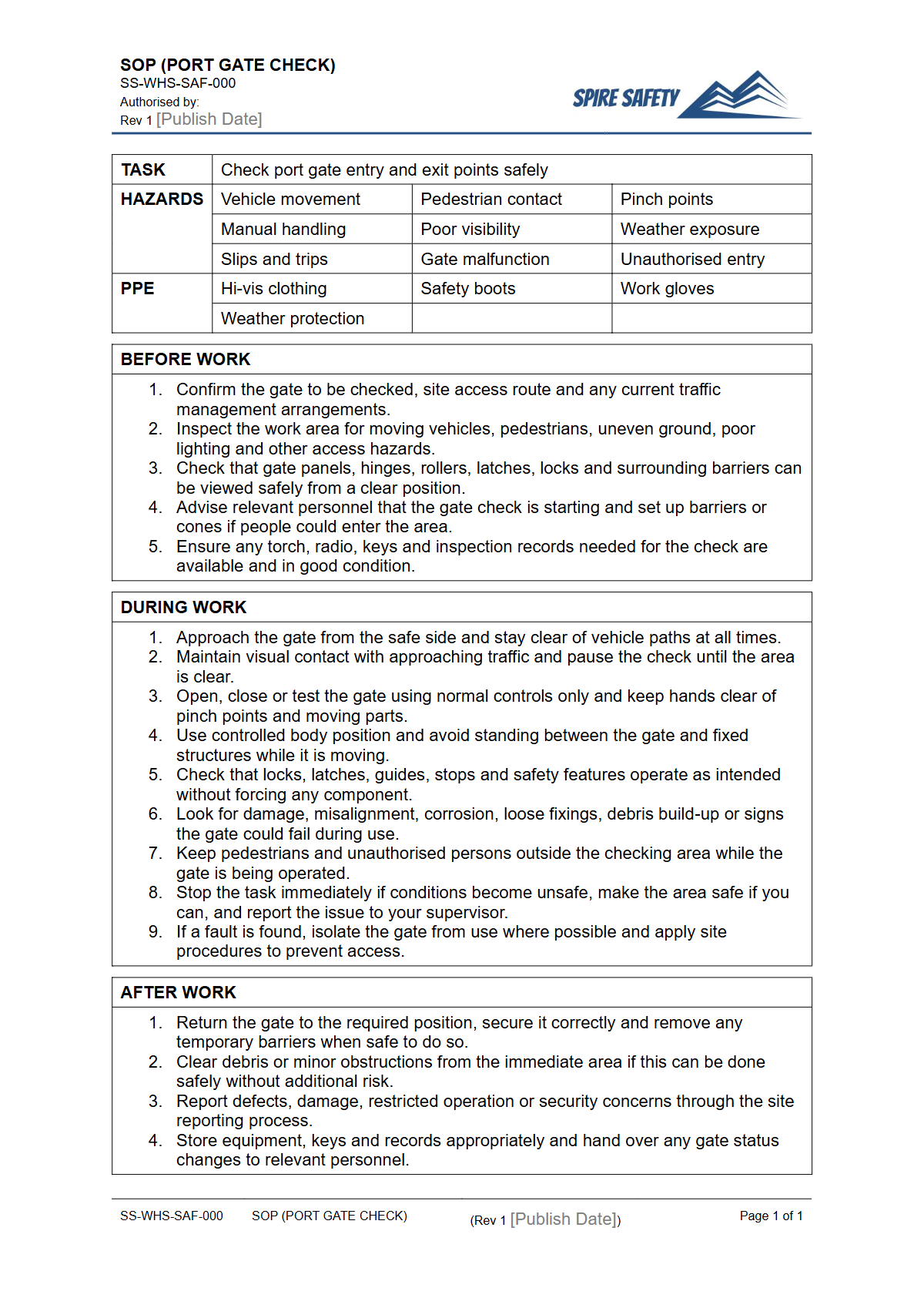
Managing the movement of vehicles, plant, and personnel at a port gate is a critical WHS function. This free Safe Operating Procedure (Port Gate Check) Template provides a structured starting point for developing your site-specific procedures.
A well-implemented SOP for gate checks helps control access, manage traffic flow, and reduce the risk of incidents in a high-traffic, dynamic environment. The goal is to create a clear, repeatable process that ensures every vehicle and person entering the secure area of the port meets established safety and security requirements.
Using a standardised procedure helps your organisation verify driver credentials, check vehicle roadworthiness, communicate site-specific rules, and manage potential hazards before they enter the main operational area. This is essential in environments where various types of heavy machinery, such as those covered by our free Telehandler SOP template, are in constant use.
A formal SOP ensures consistency across all shifts and among all security personnel, forming a key part of your risk management strategy.
Video walkthrough
How to use the Free Safe Operating Procedure (Port Gate Check) Template
This document is provided in both DOCX and PDF formats for your convenience. The DOCX file is fully editable, allowing you to tailor the content to the unique layout, traffic patterns, and risks of your specific port or terminal.
We recommend a collaborative approach to customisation, involving gate staff, security supervisors, truck drivers, and WHS representatives to ensure the procedure is practical and comprehensive.
It's important to remember that this is a template, not a finished document. We've designed it as a starting point, but you must customise it to reflect the specific hazards, equipment, and procedures at your workplace.
Once customised, this SOP should be integrated into your WHS management system, with all relevant personnel receiving training on its contents. The procedure should be made easily accessible to all workers who perform or are affected by gate check operations.
When to use a Port Gate Check Safe Operating Procedure
A Safe Operating Procedure for port gate checks should be applied consistently for all inbound and outbound traffic at every controlled access point. It is not an optional or occasional process; it is a fundamental daily operational control.
The SOP should be referenced during the induction of new security personnel and used as a basis for regular refresher training. It becomes the authoritative guide for performing pre-entry safety verifications, managing queues, and directing vehicles safely away from the gate area.
This procedure is particularly vital during peak traffic periods, periods of poor visibility, or when handling non-standard loads or oversized vehicles. It provides a clear framework that helps gate operators remain focused and systematic under pressure.
The process is a critical link in the chain of site-wide safety protocols, working alongside other procedural documents like our free Conveyer System SOP template that govern specific equipment within the port.
Who should use this Safe Operating Procedure
This SOP is primarily intended for use by personnel directly responsible for controlling site access. This includes:
- Security Guards and Gate Officers
- Traffic Controllers
- Logistics Coordinators
- Gate House Supervisors and Managers
Additionally, other groups should be familiarised with its contents to ensure smooth and safe operations. This includes transport company managers, truck drivers, and any other contractors or visitors who frequently access the site.
Ensuring drivers understand the entry requirements before they arrive can significantly improve efficiency and reduce potential conflicts at the gate. Regular WHS compliance auditing can help verify that the procedures are being consistently followed by all relevant parties and are effective in controlling risks. You can find more helpful documents like this in our free WHS resources library.
Common mistakes
Common mistakes to avoid
- Failing to conduct thorough vehicle safety checks, focusing only on paperwork.
- Inadequate separation of pedestrians and heavy vehicles at gate areas.
- Poor communication protocols between gate operators, drivers, and internal traffic controllers.
- Not updating the SOP after a near miss, incident, or change in port layout.
Legal references
Legal considerations
The following legal requirements may be relevant to this type of work.
- Work Health and Safety Act (Harmonised) — Provides the primary duties for protecting workers and other people from work health and safety risks.
- Work Health and Safety Regulations (Harmonised) — Sets out requirements supporting the management of workplace hazards and risks.
The following codes may be relevant to this type of work.
- Managing WHS Risks Code of Practice — Provides practical guidance on identifying hazards, assessing risks and applying effective controls.
- Work Health and Safety Consultation, Cooperation and Coordination Code of Practice — Provides practical guidance on consulting workers and coordinating with other duty holders.
- Managing the Work Environment and Facilities Code of Practice — Provides practical guidance on safe work environments, workplace facilities and related controls.
Did you know
Traffic Management Complexity
According to Safe Work Australia, traffic management is a major concern in ports. Incidents involving moving plant are a leading cause of fatalities and serious injuries in the transport and logistics industry.
FAQ
Frequently asked questions
01What is a Safe Operating Procedure for a port gate check?
02Why are gate checks so critical for port safety?
03Who is responsible for enforcing a Port Gate Check SOP?
04How often should an SOP for port gate checks be reviewed?
Share this resource
Free Safe Operating Procedure (Port Gate Check) Template
Browse Categories
How To Use It
- 1Download and open in Word or PDF.
- 2Replace the placeholders with your business details.
- 3Get it reviewed by a WHS specialist before rollout.
Need it customised?
Our WHS consultants can adapt this template to your site, run a gap analysis, or audit what you already have in place.
Book a Free Consultation WHS consulting servicesor call 1300 156 382
Related templates
- Free Safe Operating Procedure (Port Litter Cleanup) Template
- Free Safe Operating Procedure (Port Shed Cleaning) Template
- Free Safe Operating Procedure (Port Waste Handling) Template
- Free Safe Operating Procedure (Portable Appliance Test) Template
- Free Safe Operating Procedure (Portable Bandsaw) Template
- Free Safe Operating Procedure (Portable Heater) Template