
Free Safe Operating Procedure (Pool Water Log Check) Template
Download our free Safe Operating Procedure (Pool Water Log Check) Template to formalise your water quality testing process.
Free Safe Operating Procedure (Pool Water Log Check) Template
DOCX • 126 KB + PDF
Updated Oct 2026
No signup required
Purpose of the Free Safe Operating Procedure (Pool Water Log Check) Template
Maintaining the water quality of a swimming pool is a critical task that involves more than just hygiene. It's a key health and safety function that requires consistent and accurate execution.
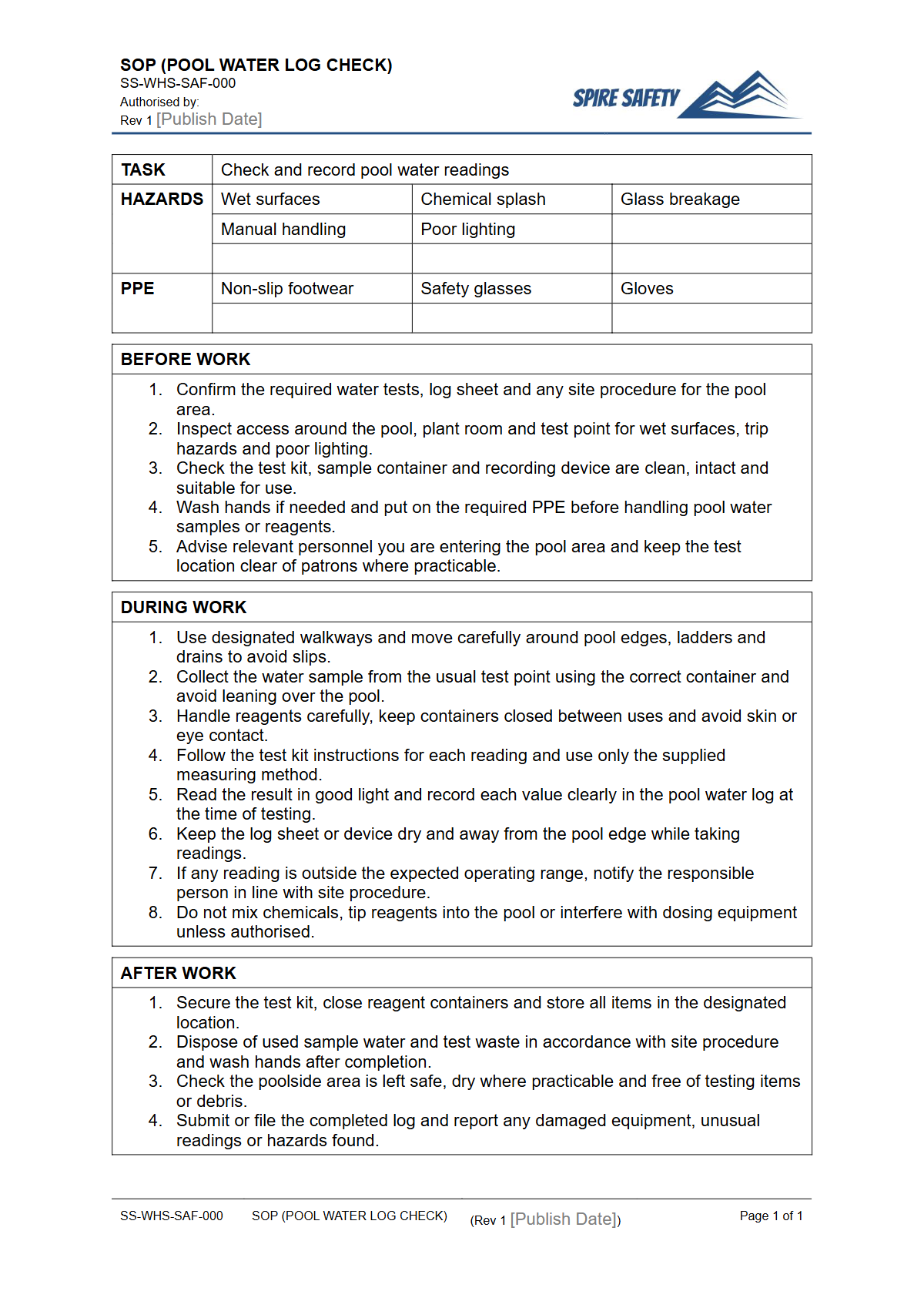
This free Safe Operating Procedure (Pool Water Log Check) Template provides a structured framework for documenting the step-by-step process of testing pool water and logging the results. Using a formal SOP helps ensure every check is performed correctly, minimising risks associated with chemical imbalances, biological contaminants, and improper chemical handling.
It standardises the procedure across all staff, which is essential for training, consistency, and demonstrating due diligence.
A documented procedure is a fundamental part of any robust safety framework. It formalises risk control measures identified during a risk assessment, covering hazards such as skin and eye irritation from incorrect pH levels, respiratory issues from chloramine inhalation, and the dangers of handling concentrated pool chemicals.
Integrating this SOP into your broader WHS management systems establishes a clear, auditable record of your commitment to providing a safe environment for both patrons and employees. In a hospitality setting, this level of procedural rigour is as important for pool maintenance as it is for kitchen tasks covered by our Free Safe Operating Procedure (Deep Fryer - Standard Operation) template.
What is a Safe Operating Procedure for Pool Water Log Checks?
A Safe Operating Procedure (SOP) for a pool water log check is a formal document that outlines the authorised, step-by-step method for testing and recording pool water parameters. It details the required personal protective equipment (PPE), the specific equipment to be used, the sequence of tasks, and the correct chemical levels to maintain.
The procedure covers pre-operational checks on testing equipment, the water sampling process, the testing itself, and the steps for accurately recording results in a logbook. It also includes emergency procedures for chemical spills or adverse test results, ensuring workers can respond safely and effectively.
Video walkthrough
How to use the Free Safe Operating Procedure (Pool Water Log Check) Template
This resource is provided as a fully editable DOCX file and a ready-to-print PDF. The template is designed as a comprehensive starting point, aligned with Australian WHS principles, which you can adapt for your specific workplace.
It includes sections for outlining responsibilities, required PPE, procedural steps, and emergency actions. To ensure it is effective, you must customise it with your site-specific information.
Important: This is a template and must be customised to your specific workplace. We are not responsible for the outcomes of its use.
You must add details relevant to your facility, including the specific types of testing kits, chemical brands, pool dimensions, emergency contact numbers, and unique site hazards. Regular review is also crucial; consider incorporating a review schedule as part of your internal WHS compliance auditing program to keep the procedure current.
When to use it
This SOP should be used every time a routine pool water quality check is scheduled, whether it's daily, twice daily, or weekly, as per your organisation's policy and state health regulations. It serves as a direct guide for the person performing the task, ensuring no steps are missed.
It is also an invaluable tool for training new employees, providing them with a clear, authoritative guide to follow. Furthermore, the SOP should be readily available during maintenance activities and referenced during safety audits or incident investigations to verify that correct procedures were established and accessible.
Documenting procedures is vital for all potentially hazardous maintenance tasks, not just water testing. For instance, maintenance teams in larger facilities may also require formal guides like a Free Air Compressor SOP (Safe Operating Procedure) Template for other workshop equipment.
Who should use it
This template is designed for any Person Conducting a Business or Undertaking (PCBU) that manages a commercial or public swimming pool. This includes hotels, motels, aquatic centres, gyms, schools, and strata-managed residential complexes. The procedure should be actively used by:
- Pool Technicians
- Lifeguards with maintenance duties
- Facility Maintenance Staff
- Groundskeepers
- Operations Managers
Ultimately, anyone tasked with testing and maintaining pool water quality should be trained on and have access to this Safe Operating Procedure. For businesses needing assistance in developing and implementing such safety documentation, engaging external WHS consulting services can provide expert guidance and support. You can also explore our complete free WHS resources library for other templates to support your safety management system.
Common mistakes
Common mistakes to avoid
- Testing water taken from the surface or near a return jet, which doesn't give a representative sample.
- Failing to regularly clean and calibrate digital testing equipment, leading to inaccurate readings.
- Adding chemicals, especially granular types, directly into the skimmer basket instead of pre-dissolving them.
- Not wearing appropriate PPE, such as gloves and safety glasses, when handling and dosing concentrated pool chemicals.
Legal references
Legal considerations
The following legal requirements may be relevant to this type of work.
- Work Health and Safety Act (Harmonised) — Provides the primary duties for protecting workers and other people from work health and safety risks.
- Work Health and Safety Regulations (Harmonised) — Sets out requirements supporting the management of workplace hazards and risks.
The following codes may be relevant to this type of work.
- Managing WHS Risks Code of Practice — Provides practical guidance on identifying hazards, assessing risks and applying effective controls.
- Work Health and Safety Consultation, Cooperation and Coordination Code of Practice — Provides practical guidance on consulting workers and coordinating with other duty holders.
- Managing the Work Environment and Facilities Code of Practice — Provides practical guidance on safe work environments, workplace facilities and related controls.
Did you know
The 'Chlorine' Smell
That strong 'chlorine' smell at a pool isn't actually from chlorine itself. It's the scent of chloramines, which are chemical compounds that build up when chlorine reacts with sweat, oils, and urine from swimmers. A well-balanced pool has very little odour.
Alkalinity is a Buffer
Total Alkalinity (TA) acts as a buffer that helps prevent rapid shifts in the pool's pH level. If your TA is too low, the pH can swing wildly, making it difficult to maintain safe and comfortable water.
FAQ
Frequently asked questions
01What key parameters should be included in a pool water testing log?
02How often should commercial pool water be tested in Australia?
03Is a Safe Operating Procedure a legal requirement for pool maintenance?
04What are the main hazards of handling pool chemicals?
Share this resource
Free Safe Operating Procedure (Pool Water Log Check) Template
Browse Categories
How To Use It
- 1Download and open in Word or PDF.
- 2Replace the placeholders with your business details.
- 3Get it reviewed by a WHS specialist before rollout.
Need it customised?
Our WHS consultants can adapt this template to your site, run a gap analysis, or audit what you already have in place.
Book a Free Consultation WHS consulting servicesor call 1300 156 382
Related templates
- Free Safe Operating Procedure (Poolside Furniture Move) Template
- Free Safe Operating Procedure (Port Gate Check) Template
- Free Safe Operating Procedure (Port Litter Cleanup) Template
- Free Safe Operating Procedure (Port Shed Cleaning) Template
- Free Safe Operating Procedure (Port Waste Handling) Template
- Free Safe Operating Procedure (Portable Appliance Test) Template