
Free Safe Operating Procedure (Pool Lane Setup) Template
Download our free Safe Operating Procedure (Pool Lane Setup) Template to manage risks in aquatic centres. Customise this structured DOCX or PDF today.
Free Safe Operating Procedure (Pool Lane Setup) Template
DOCX • 126 KB + PDF
Updated Oct 2026
No signup required
Purpose of the Free Safe Operating Procedure (Pool Lane Setup) Template
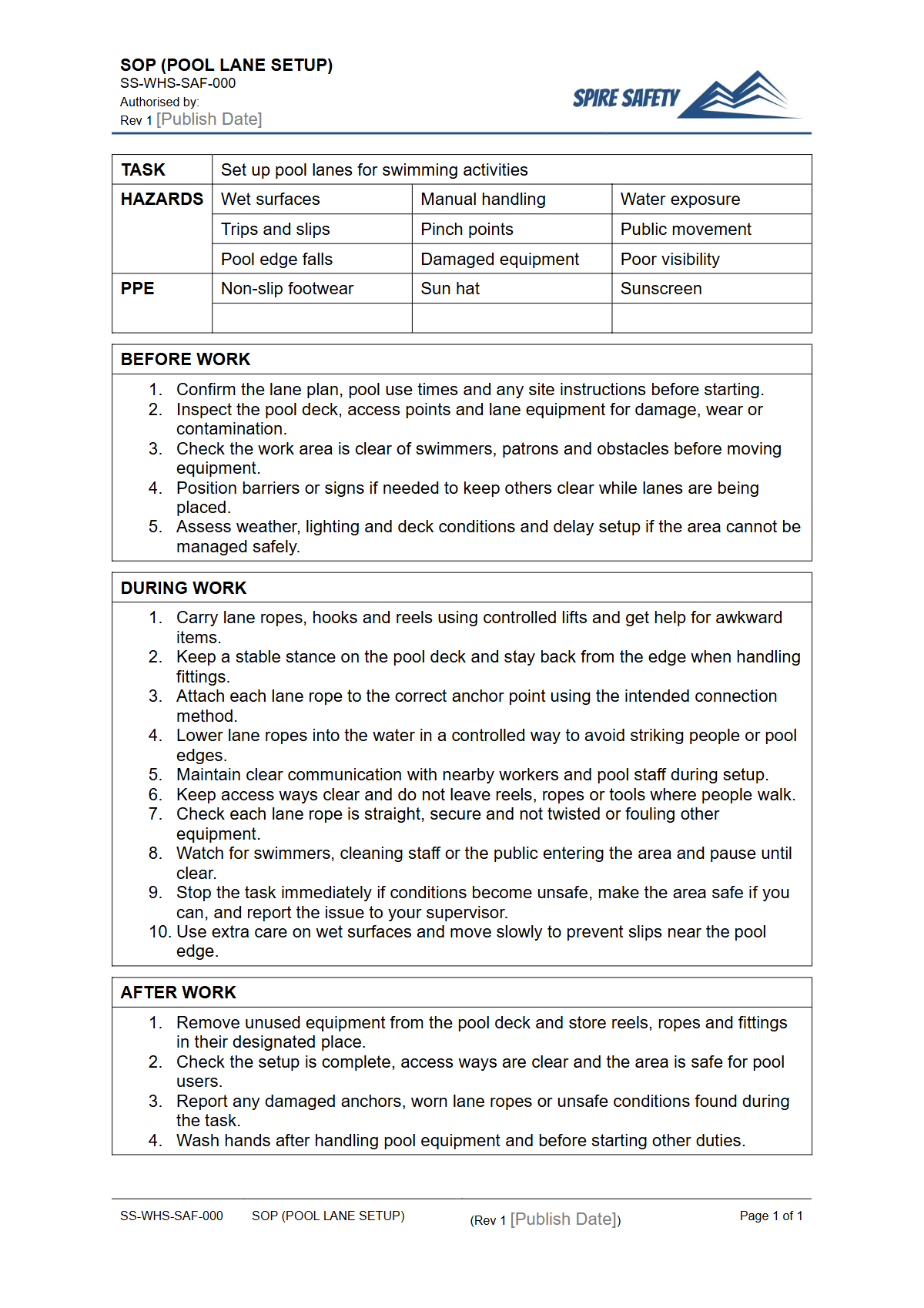
Setting up and dismantling pool lanes is a common task in aquatic facilities, but it carries inherent risks, including manual handling injuries, slips, and trips. This Free Safe Operating Procedure (Pool Lane Setup) Template provides a structured framework to document the safest method for completing this task.
It helps organisations meet their duty of care by outlining step-by-step instructions, identifying necessary personal protective equipment (PPE), and detailing pre-operational checks and post-task cleanup. Using a standardised procedure ensures consistency, reduces the likelihood of incidents, and provides a clear reference for training and supervision.
A documented SOP is a practical tool for risk control. It translates the findings of a risk assessment into clear, actionable steps that workers can follow.
Implementing robust SOPs across all operational tasks is a cornerstone of effective WHS management systems, demonstrating a proactive commitment to health and safety in the workplace.
Video walkthrough
How to use the Free Safe Operating Procedure (Pool Lane Setup) Template
This resource is provided as a downloadable DOCX file, allowing for full customisation, and a PDF for easy viewing. It is designed as a comprehensive starting point, aligned with Australian WHS principles.
To implement it correctly, you must adapt it to your specific environment. This involves conducting a site-specific risk assessment for pool lane setup at your facility and incorporating the findings into the template.
Identify the exact types of lane ropes, tensioning devices, and storage reels your team uses, and detail the procedures for them.
Note: This template provides a solid foundation based on common industry practice. However, to make it effective, we stress that you must customise it to reflect the specific equipment, layout, and staffing arrangements of your aquatic facility.
Consultation with the workers who perform the task is a critical part of this process to ensure the procedure is practical and reflects how the work is actually done.
If you require assistance in tailoring safety documentation or conducting risk assessments, engaging professional WHS consulting can provide expert guidance and ensure your procedures are robust and fit for purpose.
To customise the template:
- Download the DOCX version.
- Insert your company name, logo, and specific site details.
- Review each section and modify the content to match your pool's layout, equipment (e.g., anti-wave lanes, standard lines), and storage solutions.
- Clearly define roles and responsibilities for the task.
- Add any site-specific hazards, such as unusual floor surfaces, pool depths, or lighting conditions.
- Consult with your team to get their feedback before finalising the document.
- Train all relevant workers on the final, approved SOP and schedule regular refresher training.
When to use a Pool Lane Setup SOP
A Safe Operating Procedure for pool lane setup should be used consistently whenever the task is performed. This includes routine daily or session-based changes, as well as less frequent setups for specific events. Key times to use the SOP include:
- Daily Operations: For setting up lanes for morning squads, aqua aerobics, and general public swimming sessions.
- Events and Carnivals: When configuring the pool for swimming competitions, school carnivals, or other special events which may involve different layouts or more intensive activity.
- Staff Training: As a primary training document for new lifeguards, pool attendants, or operations staff to ensure they learn the safe and correct method from day one.
- Incident Investigation: As a benchmark to review actions and identify procedural gaps following any incident or near miss related to the task.
- Audits and Reviews: Procedures should be reviewed periodically (e.g., annually) or after any changes to equipment or processes. This can be integrated into your WHS compliance auditing schedule to ensure ongoing effectiveness.
Who Should Use This SOP Template?
This SOP is intended for use by multiple roles within an aquatic or recreational facility. While the primary users are the workers performing the task, managers and supervisors also have a key role.
- Pool Attendants and Lifeguards: These workers will follow the step-by-step procedure to safely handle the lane ropes and associated equipment. They are the frontline users of the document.
- Facility and Operations Managers: Managers are responsible for ensuring the SOP is correctly implemented, customised, and reviewed. They use it to structure training, supervise work, and maintain safety standards across the facility.
- WHS Officers and Coordinators: Safety professionals use this template as part of the broader safety management system to ensure risks for this specific task are formally controlled and documented.
- Swim Coaches and Event Coordinators: These individuals should be aware of the procedure to understand the time and safety requirements for setting up the pool for their sessions or events.
A specific, documented procedure is essential for any recurring manual task. Just as our Free Safe Operating Procedure (Deep Fryer) is vital for kitchen staff, this SOP is crucial for ensuring the safety of your poolside team. For more tools to help manage workplace safety, explore our complete free WHS resources library.
Common mistakes
Common mistakes to avoid
- Failing to customise the template for the specific pool environment and equipment.
- Not providing practical training to workers on the finalised SOP.
- Using damaged or poorly maintained equipment, such as frayed ropes or faulty tensioners.
- Neglecting to enforce clear exclusion zones on the pool deck during setup and pack-down.
Legal references
Legal considerations
The following legal requirements may be relevant to this type of work.
- Work Health and Safety Act (Harmonised) — Provides the primary duties for protecting workers and other people from work health and safety risks.
- Work Health and Safety Regulations (Harmonised) — Sets out requirements supporting the management of workplace hazards and risks.
The following codes may be relevant to this type of work.
- Managing WHS Risks Code of Practice — Provides practical guidance on identifying hazards, assessing risks and applying effective controls.
- Work Health and Safety Consultation, Cooperation and Coordination Code of Practice — Provides practical guidance on consulting workers and coordinating with other duty holders.
- Managing the Work Environment and Facilities Code of Practice — Provides practical guidance on safe work environments, workplace facilities and related controls.
Did you know
Weighty Matter
A modern, FINA-compliant 50-metre competition swimming lane rope can weigh over 100 kilograms, making correct manual handling techniques and team lifting essential for preventing injuries.
Slips and Trips
Slips, trips, and falls are a leading cause of workplace injury in Australia, and the risk is significantly heightened on the wet, hard surfaces of a pool deck.
FAQ
Frequently asked questions
01What are the main hazards associated with setting up pool lanes?
02Is a written SOP a legal requirement for pool lane setup in Australia?
03How often should our pool lane setup SOP be reviewed?
04Can this template be used for setting up for large swimming carnivals?
Share this resource
Free Safe Operating Procedure (Pool Lane Setup) Template
Browse Categories
How To Use It
- 1Download and open in Word or PDF.
- 2Replace the placeholders with your business details.
- 3Get it reviewed by a WHS specialist before rollout.
Need it customised?
Our WHS consultants can adapt this template to your site, run a gap analysis, or audit what you already have in place.
Book a Free Consultation WHS consulting servicesor call 1300 156 382
Related templates
- Free Safe Operating Procedure (Pool Leaf Skimming) Template
- Free Safe Operating Procedure (Pool Rescue Gear Check) Template
- Free Safe Operating Procedure (Pool Safety Sign Check) Template
- Free Safe Operating Procedure (Pool Test Kit Handling) Template
- Free Safe Operating Procedure (Pool Tile Cleaning) Template
- Free Safe Operating Procedure (Pool Vacuuming) Template