
Free Safe Operating Procedure (Pool Lane Rope Handling) Template
Ensure the safety of your team with our customisable template for pool lane rope handling. Download our free Safe Operating Procedure to get started today.
Free Safe Operating Procedure (Pool Lane Rope Handling) Template
DOCX • 126 KB + PDF
Updated Oct 2026
No signup required
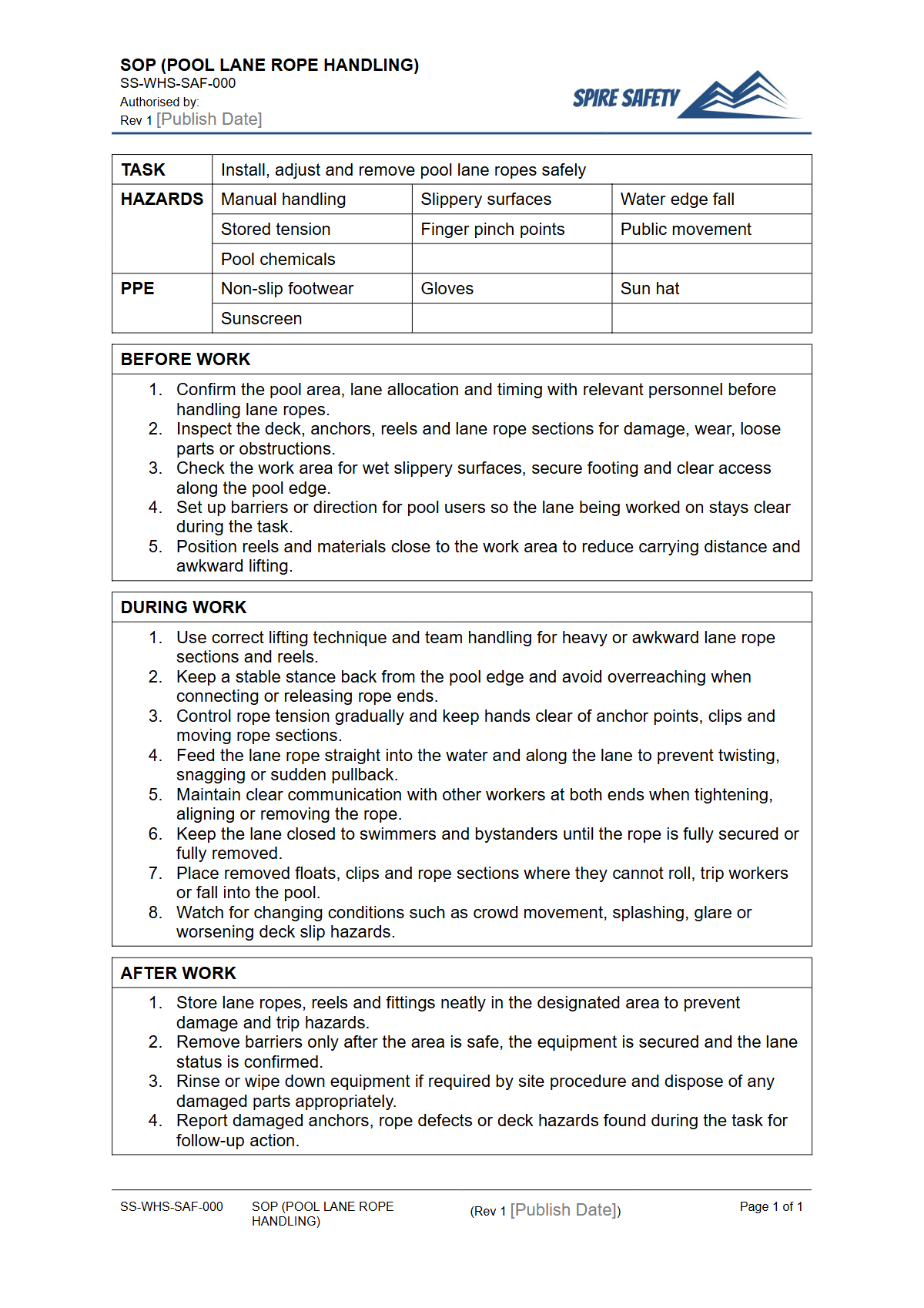
Purpose of the Free Safe Operating Procedure (Pool Lane Rope Handling) Template
Handling pool lane ropes is a frequent task in aquatic centres, schools, and clubs. While it may seem routine, it carries significant risks of musculoskeletal injury if not performed correctly.
This Free Safe Operating Procedure (Pool Lane Rope Handling) Template provides a structured framework to document the safest, most efficient method for this task. Using a standardised procedure helps your organisation meet its duty of care under WHS legislation by minimising manual handling risks, ensuring all workers use the same safe method, and providing a clear resource for training and supervision.
It formalises pre-operational checks, correct handling techniques, and post-task storage requirements, creating a safer environment for both staff and patrons.
Video walkthrough
How to use the Free Safe Operating Procedure (Pool Lane Rope Handling) Template
This template is provided as a fully editable DOCX file and a print-ready PDF. It is designed as a comprehensive starting point, aligned with Australian WHS principles.
To be effective, you must adapt it to the specific context of your workplace. This includes adding details about your specific lane rope types, tensioning mechanisms, storage reels, pool deck layout, and any site-specific hazards.
Integrating photos of your equipment and facility can greatly improve clarity for workers. This document is a foundational tool; a cornerstone of a safe system of work, not the entire system itself.
Important: This is a template and must be customised to your workplace. The information contained within should be reviewed and approved by a competent person.
We recommend consulting with your team, including the workers who perform the task, to ensure the procedure is practical and reflects the realities of the job.
Key Hazards in Pool Lane Rope Handling
The primary hazard associated with handling pool lane ropes is manual handling. The awkward postures, forces required for pulling and tensioning, and repetitive nature of the task can lead to serious musculoskeletal disorders (MSDs), including sprains and strains to the back, shoulders, and arms. Other significant risks include:
- Slips, trips, and falls: Wet and often sloped pool decks create a high-risk environment. Hoses, storage reels, and the ropes themselves can become major trip hazards.
- Entanglement and crush injuries: Fingers, hands, or clothing can become caught in the winding mechanism of storage reels or between the rope and the tensioner.
- Impact injuries: The ratchet or tensioning lever can release unexpectedly, striking the operator.
Identifying and controlling these hazards requires a systematic approach to risk management. If you need assistance with developing robust safety protocols, our specialist WHS consulting services can provide expert guidance tailored to your facility's needs.
Essential Steps for Safe Handling
A comprehensive SOP for this task should detail several critical stages. It should begin with pre-operational checks, ensuring the rope, floaters, and tensioning mechanism are in good working order and free from damage.
The procedure should specify whether it is a one or two-person task based on a risk assessment. Key steps to include are the correct methods for unreeling the lane rope, attaching it to the anchor point, and applying the correct tension without over-exertion.
Documenting the process for both installation and removal is crucial. The procedure must also cover the safe removal and winding of the rope onto its reel, and the proper storage of the equipment to prevent it from becoming a hazard.
Just as procedures are vital for operating static equipment, as outlined in our Safe Operating Procedure for air compressors, they are equally important for dynamic manual tasks.
When to Use This Safe Operating Procedure
This SOP is a multi-purpose document that forms a key part of your safety management system. Its primary use is for the induction and training of new lifeguards, pool attendants, or maintenance staff, ensuring they learn the correct, safe method from day one.
It should also be used as a reference for regular refresher training and as the basis for toolbox talks on manual handling. Following an incident or a near-miss involving lane ropes, the SOP should be reviewed as part of the investigation to identify any gaps or areas for improvement.
Regular WHS compliance audits should also verify that the documented procedure is being followed in practice.
Who Should Use It
This Safe Operating Procedure is intended for all personnel involved in the setup and pack-down of swimming pools. This includes lifeguards, pool operations staff, swim coaches, and facility maintenance teams.
Supervisors and managers should use the document to train staff and to monitor that the agreed-upon procedures are being consistently followed. Health and Safety Representatives (HSRs) and WHS managers can use the template as a tool for consultation and to ensure that controls for identified manual handling risks are documented and implemented.
Integrating SOPs like this one into broader effective WHS management systems ensures a consistent and proactive approach to safety across all operational tasks.
This is just one of many templates available. You can browse our complete free WHS resources library for more tools to support your safety management efforts.
Common mistakes
Common mistakes to avoid
- Assigning the task to one person when a two-person team is safer and more efficient.
- Using poor manual handling techniques, like twisting the back while pulling or lifting.
- Leaving lane rope reels or loose ropes in walkways, creating serious trip hazards.
- Failing to inspect the tensioner ratchet and rope condition before use, leading to equipment failure.
Legal references
Legal considerations
The following legal requirements may be relevant to this type of work.
- Work Health and Safety Act (Harmonised) — Provides the primary duties for protecting workers and other people from work health and safety risks.
- Work Health and Safety Regulations (Harmonised) — Sets out requirements supporting the management of workplace hazards and risks.
The following codes may be relevant to this type of work.
- Managing WHS Risks Code of Practice — Provides practical guidance on identifying hazards, assessing risks and applying effective controls.
- Work Health and Safety Consultation, Cooperation and Coordination Code of Practice — Provides practical guidance on consulting workers and coordinating with other duty holders.
- Managing the Work Environment and Facilities Code of Practice — Provides practical guidance on safe work environments, workplace facilities and related controls.
Did you know
Manual Handling Impact
According to Safe Work Australia, musculoskeletal disorders, often stemming from hazardous manual tasks, account for a significant portion of serious workers' compensation claims.
Competition Tension
For competitive swimming, FINA (World Aquatics) regulations require lane ropes to be stretched taut, contributing to the high forces workers must manage during setup.
FAQ
Frequently asked questions
01What are the main risks of handling pool lane ropes?
02Is a Safe Operating Procedure a legal requirement for handling pool lane ropes?
03How often should we review our Pool Lane Rope Handling SOP?
04Can I use this template for other manual handling tasks around the pool?
Share this resource
Free Safe Operating Procedure (Pool Lane Rope Handling) Template
Browse Categories
How To Use It
- 1Download and open in Word or PDF.
- 2Replace the placeholders with your business details.
- 3Get it reviewed by a WHS specialist before rollout.
Need it customised?
Our WHS consultants can adapt this template to your site, run a gap analysis, or audit what you already have in place.
Book a Free Consultation WHS consulting servicesor call 1300 156 382
Related templates
- Free Safe Operating Procedure (Pool Lane Setup) Template
- Free Safe Operating Procedure (Pool Leaf Skimming) Template
- Free Safe Operating Procedure (Pool Rescue Gear Check) Template
- Free Safe Operating Procedure (Pool Safety Sign Check) Template
- Free Safe Operating Procedure (Pool Test Kit Handling) Template
- Free Safe Operating Procedure (Pool Tile Cleaning) Template