
Free Safe Operating Procedure (Pool Gate Inspection) Template
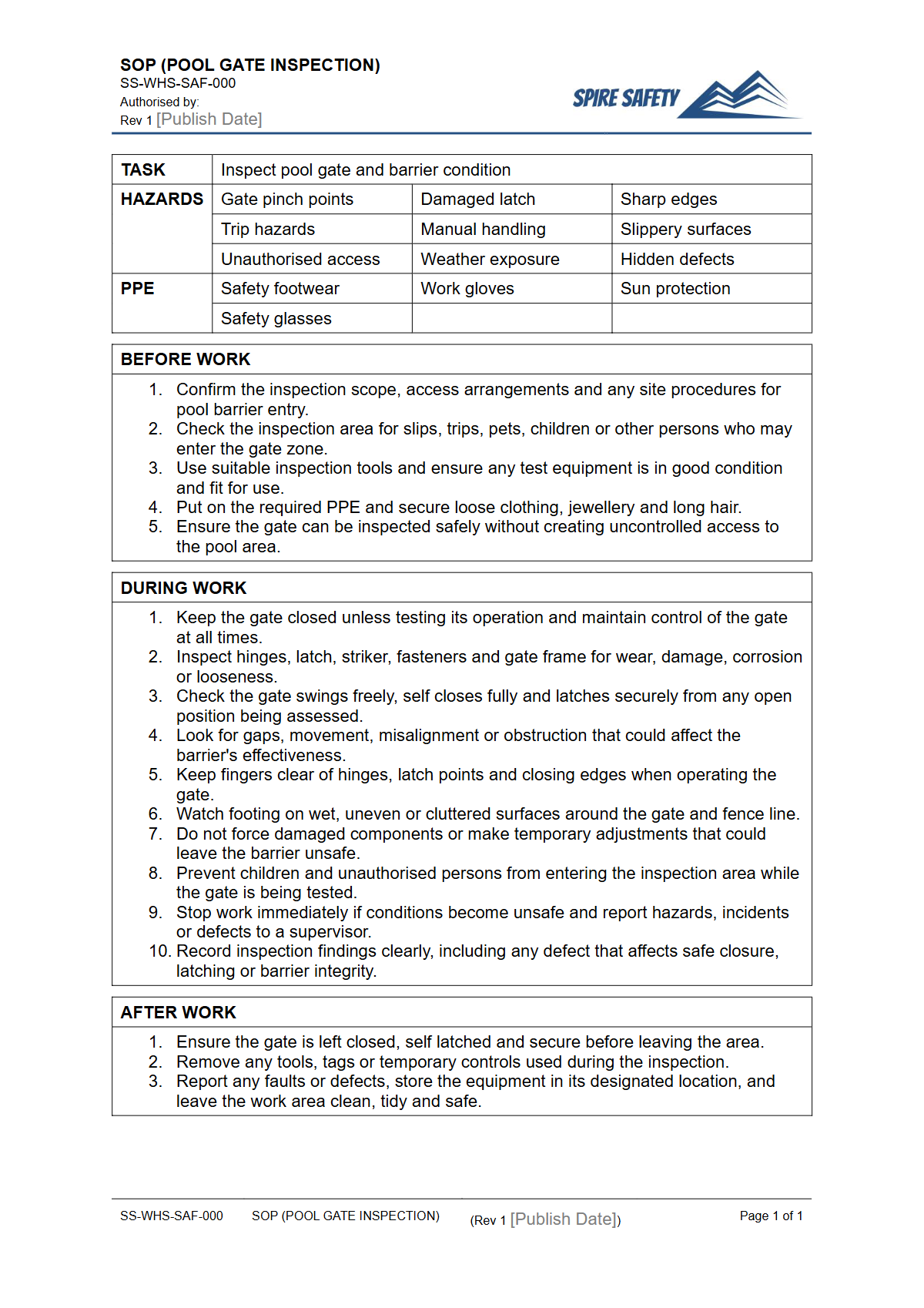
Ensure your pool area is safe with our free Safe Operating Procedure. This template helps standardise gate inspections. Download your copy today.
Free Safe Operating Procedure (Pool Gate Inspection) Template
DOCX • 126 KB + PDF
Updated Oct 2026
No signup required
Purpose of the Free Safe Operating Procedure (Pool Gate Inspection) Template
Drowning is a leading cause of accidental death in young children in Australia, and a non-compliant pool gate is a common contributing factor. This Free Safe Operating Procedure (Pool Gate Inspection) Template provides a structured framework for systematically inspecting pool gates to ensure they function correctly and serve as an effective safety barrier.
The primary purpose of this SOP is to prevent unauthorised or unsupervised access to the pool area by establishing a clear, repeatable process for verifying that gate mechanisms are in good working order. Using a formal procedure helps identify hazards like faulty latches, slow closing speeds, or environmental obstructions before they lead to a tragedy.
By implementing this Safe Operating Procedure, your organisation can demonstrate a proactive approach to safety and risk management. It formalises an essential maintenance task, creating clear records of inspections and any corrective actions taken.
Integrating this procedure is a key step in developing comprehensive WHS management systems that protect both patrons and your business.
Video walkthrough
How to use the Free Safe Operating Procedure (Pool Gate Inspection) Template
This template is designed as a robust starting point, available in both DOCX for easy editing and a ready-to-use PDF. To use it effectively, begin by downloading your preferred format.
The next critical step is customisation. You must adapt the document to suit the specific details of your facility, including the type of pool gate, the latching and closing hardware installed, and the unique environmental conditions of your site.
Ensure you incorporate site-specific information, such as the location of the pool, the name of the responsible person conducting the inspection, and the frequency of checks determined by your risk assessment. Add or remove steps to accurately reflect your operational requirements and local council regulations.
Important: This is a template, not a finished document. We have provided a structured foundation aligned with Australian WHS principles, but you must customise it to reflect the specific equipment, environment, and legal obligations applicable to your workplace to ensure its effectiveness.
When should a Safe Operating Procedure for Pool Gate Inspection be used?
The frequency of pool gate inspections should be determined by a risk assessment, considering factors like the level of pool use, the age of the equipment, and environmental impacts like salt corrosion or leaf litter. As a general guide:
- High-traffic commercial pools (e.g., hotels, public swimming centres): Daily inspections before opening are recommended.
- Strata and body corporate properties: Weekly or fortnightly inspections are a common practice.
- Seasonal or private pools: Inspections should be conducted before the start of the swimming season and regularly thereafter.
The SOP should also be used immediately following any maintenance work on the fence or gate, or after extreme weather events that could have caused damage. If maintenance requires repairs to the fence structure, ensure workers follow relevant procedures, such as a circular saw SOP for timber work.
Who should use this template?
This Safe Operating Procedure is intended for any person or organisation responsible for the safety and maintenance of a swimming pool area. This includes:
- Property Managers and Body Corporate Managers
- Hotel, Motel, and Caravan Park Operators
- Public Pool Plant Operators and Lifeguards
- Maintenance and Facilities Management Staff
- Childcare Centre Managers with on-site pools
The person assigned to conduct the inspection must be deemed competent to do so. This means they should be trained on the procedure, understand how the gate mechanism works, know what to look for, and be aware of the steps to take if a fault is identified.
If you need assistance developing training programs or customising safety documentation, our specialist WHS consulting team can help.
Documenting every inspection is as important as the check itself. Diligent record-keeping of completed checklists and any resulting maintenance reports provides a verifiable history of due diligence.
These records are invaluable during regular WHS compliance auditing and can be crucial in the event of an incident.
Sometimes debris can obstruct gate mechanisms, requiring cleaning. If your maintenance team uses powered equipment for this, ensure they follow relevant safety documents like an air compressor SOP to manage associated risks.
This document forms one part of a total pool safety strategy. For broader safety planning, explore our complete free WHS resources library for other useful templates and guides.
Common mistakes
Common mistakes to avoid
- Only testing the latch from a fully open position, not from a resting position.
- Forgetting to check for climbable objects (e.g., pot plants, chairs) within the 900mm non-climbable zone around the fence.
- Ignoring gates that have been propped open, normalising unsafe behaviour.
- Failing to document inspections, leaving no record of due diligence.
Legal references
Legal considerations
The following legal requirements may be relevant to this type of work.
- Work Health and Safety Act (Harmonised) — Provides the primary duties for protecting workers and other people from work health and safety risks.
- Work Health and Safety Regulations (Harmonised) — Sets out requirements supporting the management of workplace hazards and risks.
The following codes may be relevant to this type of work.
- Managing WHS Risks Code of Practice — Provides practical guidance on identifying hazards, assessing risks and applying effective controls.
- Work Health and Safety Consultation, Cooperation and Coordination Code of Practice — Provides practical guidance on consulting workers and coordinating with other duty holders.
- Managing the Work Environment and Facilities Code of Practice — Provides practical guidance on safe work environments, workplace facilities and related controls.
Did you know
Australian Standard Requirements
Australian Standard AS 1926.1 specifies that a pool gate must be self-closing and self-latching from any position, including when it is resting on the latch.
A Preventable Tragedy
On average, 15 young children drown in private swimming pools in Australia each year. Faulty or propped-open gates are a significant factor in many of these tragic incidents.
FAQ
Frequently asked questions
01How often should a pool gate be inspected using this SOP?
02Is this pool gate inspection template suitable for commercial and residential pools?
03What should I do if the pool gate fails an inspection?
04Does this SOP cover all legal requirements for pool fencing in Australia?
Share this resource
Free Safe Operating Procedure (Pool Gate Inspection) Template
Browse Categories
How To Use It
- 1Download and open in Word or PDF.
- 2Replace the placeholders with your business details.
- 3Get it reviewed by a WHS specialist before rollout.
Need it customised?
Our WHS consultants can adapt this template to your site, run a gap analysis, or audit what you already have in place.
Book a Free Consultation WHS consulting servicesor call 1300 156 382
Related templates
- Free Safe Operating Procedure (Pool Lane Rope Handling) Template
- Free Safe Operating Procedure (Pool Lane Setup) Template
- Free Safe Operating Procedure (Pool Leaf Skimming) Template
- Free Safe Operating Procedure (Pool Rescue Gear Check) Template
- Free Safe Operating Procedure (Pool Safety Sign Check) Template
- Free Safe Operating Procedure (Pool Test Kit Handling) Template