
Free Safe Operating Procedure (Pool Cover Handling) Template
Download our free Safe Operating Procedure template for pool cover handling. This resource provides a structured starting point for your workplace safety documents.
Free Safe Operating Procedure (Pool Cover Handling) Template
DOCX • 126 KB + PDF
Updated Oct 2026
No signup required
Purpose of the Free Safe Operating Procedure (Pool Cover Handling) Template
Handling large or heavy pool covers presents a unique set of workplace hazards. This free Safe Operating Procedure (Pool Cover Handling) Template provides a framework for documenting safe work practices, helping your organisation manage risks and meet its duty of care.
Properly used, an SOP is a vital tool for preventing injuries and ensuring consistent, safe behaviour among all workers involved in the task.
The primary risks associated with handling pool covers include musculoskeletal injuries from hazardous manual tasks, slips and falls on wet surfaces, and the severe risk of drowning if a person becomes trapped. Mechanical winders or rollers can also introduce risks of entanglement or crushing.
This SOP template is designed to help you identify these hazards and document the specific control measures for your worksite.
A documented SOP is a key administrative control within the hierarchy of controls. It formalises the safest method for performing a task after higher-level controls, such as elimination or engineering solutions, have been implemented. Integrating this procedure into your daily operations is a practical step towards building a comprehensive WHS management system.
Video walkthrough
How to use the Free Safe Operating Procedure (Pool Cover Handling) Template
This resource is available for download as a DOCX file for easy editing and a PDF for quick reference. The template is structured based on Australian WHS principles and common industry practice, providing a solid foundation for your site-specific procedure.
Important: This is a template, not a finished document. To be effective, you must customise it to your specific circumstances.
Our template provides a guide, but only you can assess the unique factors of your workplace. You must review and adapt every section to reflect the actual pool, cover type, handling equipment, environment, and personnel at your site.
Failure to conduct a site-specific risk assessment and customise this document accordingly could undermine your safety efforts.
During customisation, consult with the workers who actually perform the task. Their input is invaluable for creating a practical and effective procedure.
Pay close attention to details such as the specific type of cover (e.g., thermal blanket, slatted cover), the winder mechanism, and the number of people required for safe handling. For covers that use mechanical winding systems, the principles of machine safety are paramount, similar to those outlined in our FREE Conveyer System SOP.
The level of detail required will vary. Just as our Free Air Compressor SOP Template must be tailored to the specific model and its use case, this procedure needs your direct input to become a functional safety document for your team.
Key Elements Covered in the Template
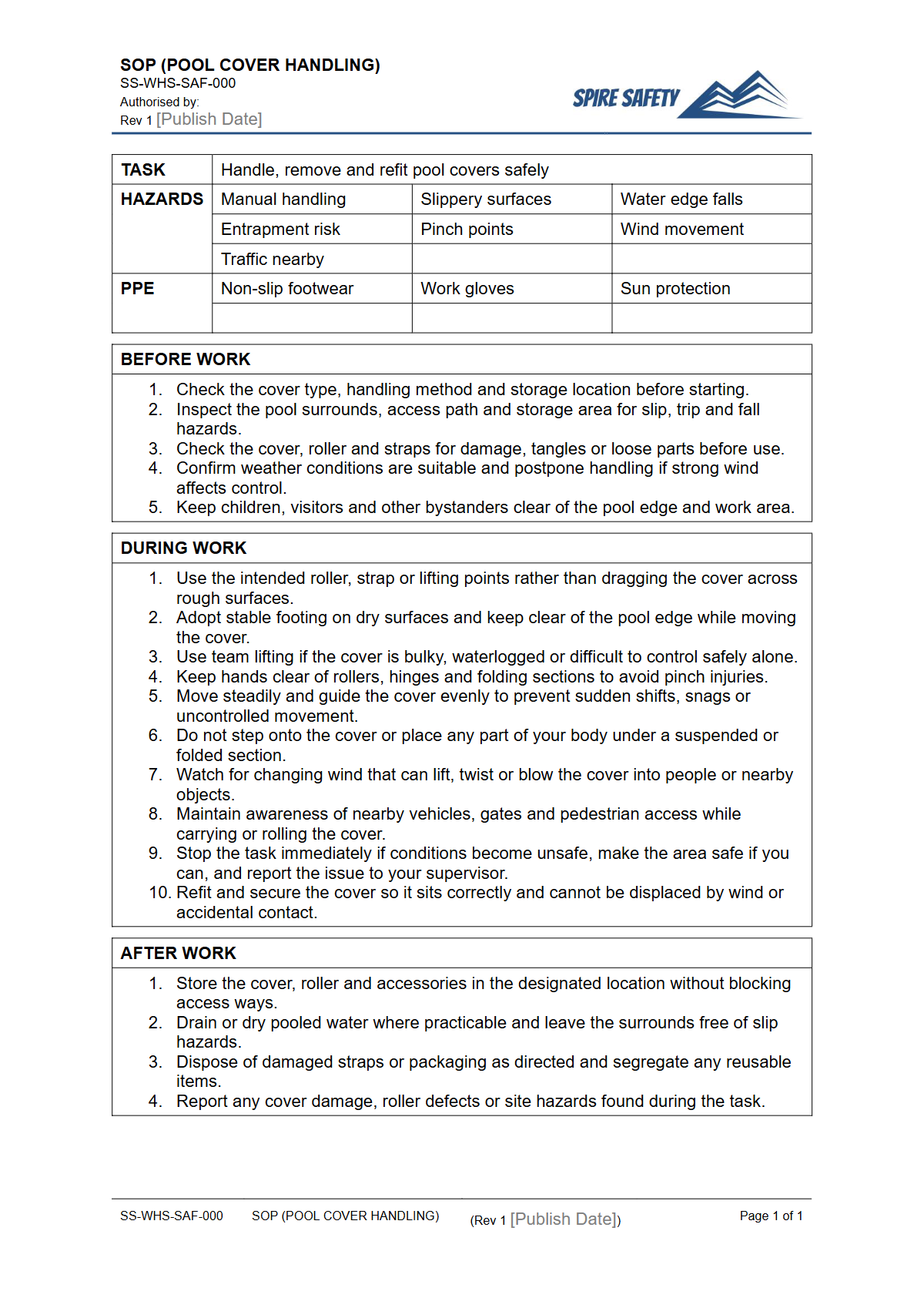
- Hazards and Risks: A section to list potential dangers associated with the task.
- Personal Protective Equipment (PPE): Specifies the required PPE, such as non-slip footwear and gloves.
- Pre-Operational Checks: Steps to take before commencing the task, like inspecting the cover and equipment for damage.
- Step-by-Step Procedure: A clear, sequential guide for removing and replacing the pool cover safely.
- Post-Task Housekeeping: Instructions for storing the cover and equipment correctly.
- Emergency Procedures: Outlines the immediate actions to take in case of an incident.
When to use it
A Safe Operating Procedure for pool cover handling should be a living document, actively used in your day-to-day operations. It is essential for training new employees, providing refresher training for existing staff, and as a quick reference before starting the task.
It also serves as a critical piece of evidence during incident investigations, helping to understand if correct procedures were followed.
Regularly reviewing and updating SOPs is a cornerstone of a proactive safety culture. This process ensures that your procedures keep pace with any changes in equipment, environment, or regulations.
This review is often a key activity during a WHS compliance audit, demonstrating a commitment to continuous improvement.
Who should use it
This procedure is intended for any worker tasked with handling a pool cover. This can include pool technicians, maintenance staff, lifeguards, groundskeepers, and property managers in settings like hotels, aquatic centres, schools, and resorts.
Clear, documented instructions ensure everyone performs the task to the same safety standard.
Supervisors and managers also have a critical role. They are responsible for ensuring workers are trained on the SOP, understand its requirements, and follow it consistently.
For PCBUs (Persons Conducting a Business or Undertaking), providing and enforcing such procedures is a fundamental part of fulfilling their primary duty of care. If you are uncertain about defining roles and responsibilities, targeted WHS consulting can provide valuable clarity for your organisation.
This document is one of many tools designed to make Australian workplaces safer. For more templates, checklists, and guides, browse our complete free WHS resources library.
Common mistakes
Common mistakes to avoid
- Using a generic template without customising it for the specific pool cover, equipment, and worksite.
- Allowing a single person to handle a cover that the SOP designates as a two-person job.
- Failing to inspect the cover, roller, or straps for wear and tear before each use.
- Not enforcing the use of specified PPE, especially non-slip footwear on wet poolside surfaces.
Legal references
Legal considerations
The following legal requirements may be relevant to this type of work.
- Work Health and Safety Act (Harmonised) — Provides the primary duties for protecting workers and other people from work health and safety risks.
- Work Health and Safety Regulations (Harmonised) — Sets out requirements supporting the management of workplace hazards and risks.
The following codes may be relevant to this type of work.
- Managing WHS Risks Code of Practice — Provides practical guidance on identifying hazards, assessing risks and applying effective controls.
- Work Health and Safety Consultation, Cooperation and Coordination Code of Practice — Provides practical guidance on consulting workers and coordinating with other duty holders.
- Managing the Work Environment and Facilities Code of Practice — Provides practical guidance on safe work environments, workplace facilities and related controls.
Did you know
The Weight of Water
A wet pool cover can weigh 50-100% more than its dry weight due to trapped water. This dramatically increases the physical strain and risk of musculoskeletal injury during manual handling.
Hidden Drowning Risk
A person, particularly a child, who falls into a partially covered pool can become disoriented and trapped under the cover. This creates a serious drowning hazard that is often overlooked.
FAQ
Frequently asked questions
01Is a Safe Operating Procedure for pool covers legally required in Australia?
02How many people are needed to handle a large pool cover safely?
03What PPE is generally required for handling pool covers?
04How often should we review our Pool Cover Handling SOP?
Share this resource
Free Safe Operating Procedure (Pool Cover Handling) Template
Browse Categories
How To Use It
- 1Download and open in Word or PDF.
- 2Replace the placeholders with your business details.
- 3Get it reviewed by a WHS specialist before rollout.
Need it customised?
Our WHS consultants can adapt this template to your site, run a gap analysis, or audit what you already have in place.
Book a Free Consultation WHS consulting servicesor call 1300 156 382
Related templates
- Free Safe Operating Procedure (Pool Deck Cleaning) Template
- Free Safe Operating Procedure (Pool Deck Inspection) Template
- Free Safe Operating Procedure (Pool Fence Cleaning) Template
- Free Safe Operating Procedure (Pool Filter Cleaning) Template
- Free Safe Operating Procedure (Pool Furniture Setup) Template
- Free Safe Operating Procedure (Pool Gate Inspection) Template