
Free Safe Operating Procedure (Pole Climbing) Template
Download our Free Safe Operating Procedure (Pole Climbing) Template to establish a clear, step-by-step process for this high-risk task. Get your DOCX now.
Free Safe Operating Procedure (Pole Climbing) Template
DOCX • 126 KB + PDF
Updated Oct 2026
No signup required
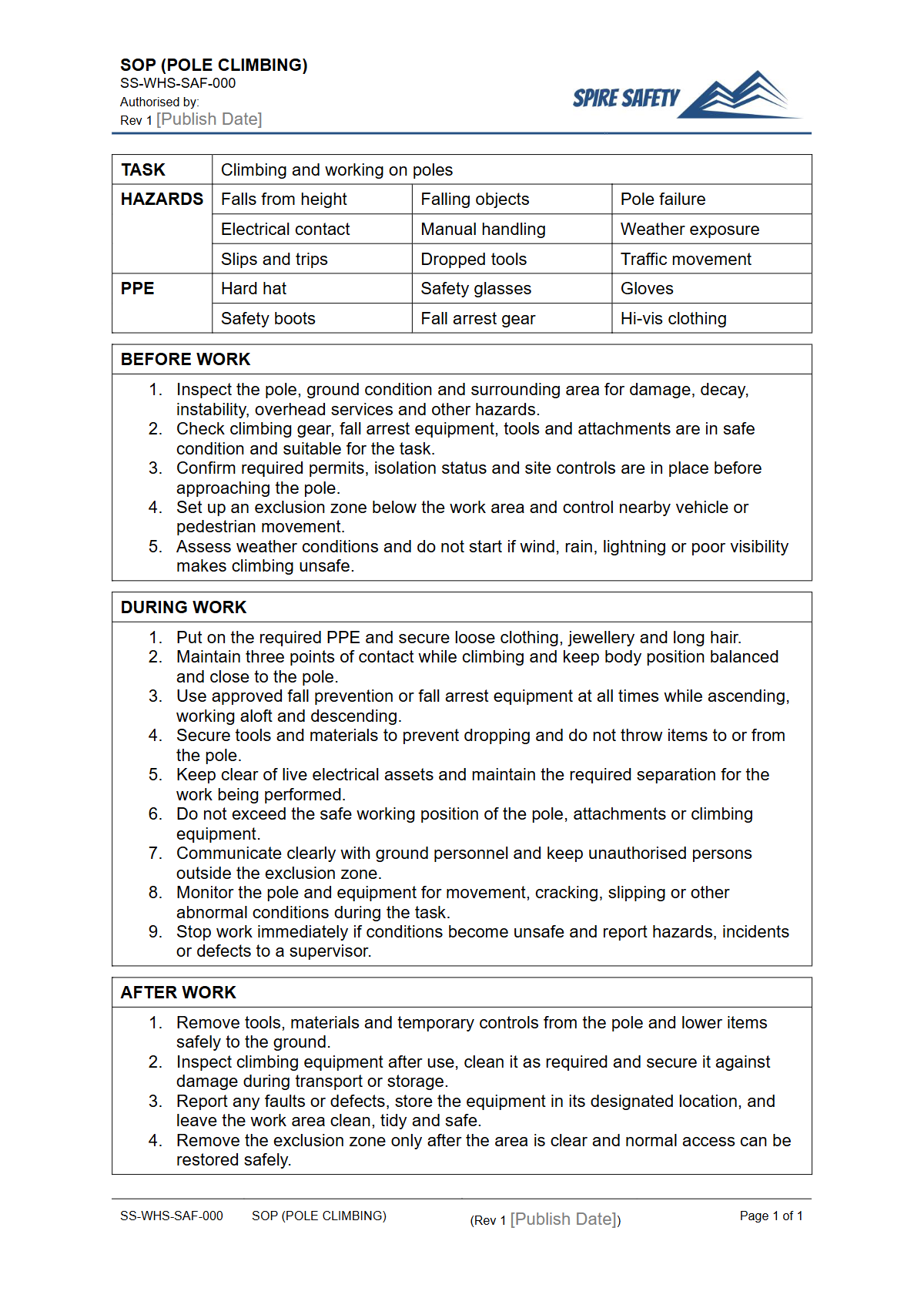
Purpose of the Free Safe Operating Procedure (Pole Climbing) Template
Pole climbing is a high-risk activity that exposes workers to significant dangers, including falls from height, electrocution, structural failure of the pole, and ergonomic injuries. This Free Safe Operating Procedure (Pole Climbing) Template provides a structured framework for documenting the essential safety steps required to perform this task safely.
By establishing a clear, repeatable process, you can standardise work methods, reduce the likelihood of incidents, and demonstrate a commitment to worker safety. It also serves as a critical document for worker training, competency assessments, and site inductions.
Using a documented procedure helps your organisation meet its primary duty of care under Australian WHS legislation. An effective SOP is a cornerstone of a robust safety framework, providing clarity for both workers performing the task and supervisors overseeing it.
A good SOP is a core component of a broader safety framework. Developing comprehensive WHS management systems ensures all risks are systematically controlled.
Video walkthrough
How to use the Free Safe Operating Procedure (Pole Climbing) Template
This template is provided in both DOCX and PDF formats. We recommend downloading the DOCX version to customise it for your specific operational needs.
The document is pre-formatted with sections for you to populate, including pre-climb inspections, required personal protective equipment (PPE), step-by-step climbing and descending procedures, and emergency response actions.
IMPORTANT: This document is a template, not a finished safety solution. You MUST customise it to reflect your specific workplace conditions.
This includes the types of poles being climbed (e.g., wood, steel, concrete), the climbing equipment used (gaffs, ladders, fall-arrest systems), environmental factors, and the competency of your workers. We strongly advise conducting a site-specific risk assessment and consulting with your workers to ensure the final SOP is practical, comprehensive, and effective for your business.
When to use a Safe Operating Procedure for Pole Climbing
A Safe Operating Procedure for pole climbing should be integrated into your daily operations and safety lifecycle. It should be used:
- As the basis for developing a Safe Work Method Statement (SWMS) if the task is classified as high-risk construction work.
- During the induction and training of new workers who will be required to climb poles.
- As a reference tool for experienced workers before they commence a climb.
- For conducting refresher training and verifying worker competency on a regular basis.
- As a key document during incident investigations to review whether procedures were followed and if they remain adequate.
Periodic reviews of your SOP are essential for maintaining its relevance and effectiveness. Scheduling regular reviews as part of a formal WHS compliance auditing program helps identify gaps and drive continuous improvement in your safety practices.
Who should use it
This template is designed for use by various personnel within an organisation where pole climbing is performed. This includes:
- Persons Conducting a Business or Undertaking (PCBUs): To fulfil their duty to provide safe systems of work.
- WHS Managers and Safety Officers: To develop and implement risk controls for high-risk tasks.
- Supervisors and Team Leaders: To train, supervise, and monitor workers performing the task.
- Workers: As a clear guide to follow to ensure their own safety and the safety of others.
- Trainers and Assessors: As a foundational document for building training programs and assessing competency.
While this SOP covers pole climbing, a complete safety system requires procedures for all site equipment. You may also need a FREE Telehandler SOP Template if lifting equipment is used nearby.
Consistency across your safety documentation is vital. Using a similar format, like that found in our Free Air Compressor SOP Template, can help workers recognise and follow procedures more easily.
Many work sites with pole climbing activities also use heavy machinery. Ensure you have procedures for all equipment, such as our FREE Grader SOP (Safe Operating Procedure) Template.
For more procedural templates and safety guides to help build out your safety management system, browse our complete free WHS resources library.
Common mistakes
Common mistakes to avoid
- Failing to thoroughly inspect the pole for rot, cracks, or termite damage before climbing.
- Using poorly maintained or uninspected climbing equipment (e.g., blunt gaffs, frayed harnesses).
- Not maintaining three points of contact while ascending or descending the pole.
- Working too close to live electrical conductors without proper authorisation, insulation, or controls.
Legal references
Legal considerations
The following legal requirements may be relevant to this type of work.
- Work Health and Safety Act (Harmonised) — Provides the primary duties for protecting workers and other people from work health and safety risks.
- Work Health and Safety Regulations (Harmonised) — Sets out requirements supporting the management of workplace hazards and risks.
The following codes may be relevant to this type of work.
- Managing WHS Risks Code of Practice — Provides practical guidance on identifying hazards, assessing risks and applying effective controls.
- Work Health and Safety Consultation, Cooperation and Coordination Code of Practice — Provides practical guidance on consulting workers and coordinating with other duty holders.
- Managing the Work Environment and Facilities Code of Practice — Provides practical guidance on safe work environments, workplace facilities and related controls.
Did you know
The 'Sound Test'
Before climbing, workers often strike a wooden pole with a hammer. A solid, resonant sound indicates a healthy pole, while a dull thud can signify internal rot and an unsafe structure.
Fall Arrest vs. Fall Restraint
Pole climbing systems are typically 'fall arrest' systems, designed to stop a fall in progress. This differs from 'fall restraint' systems, which are designed to prevent a worker from reaching a fall hazard in the first place.
FAQ
Frequently asked questions
01What is a Safe Operating Procedure for pole climbing?
02Is pole climbing considered high-risk work in Australia?
03What PPE is required for pole climbing?
04Who is responsible for creating a pole climbing SOP?
Share this resource
Free Safe Operating Procedure (Pole Climbing) Template
Browse Categories
How To Use It
- 1Download and open in Word or PDF.
- 2Replace the placeholders with your business details.
- 3Get it reviewed by a WHS specialist before rollout.
Need it customised?
Our WHS consultants can adapt this template to your site, run a gap analysis, or audit what you already have in place.
Book a Free Consultation WHS consulting servicesor call 1300 156 382
Related templates
- Free Safe Operating Procedure (Pole Saw) Template
- Free Safe Operating Procedure (Pond Debris Removal) Template
- Free Safe Operating Procedure (Pond Edge Maintenance) Template
- Free Safe Operating Procedure (Pontoon Access) Template
- Free Safe Operating Procedure (Pool Backwashing) Template
- Free Safe Operating Procedure (Pool Chemical Dosing System Operation) Template