
Free Safe Operating Procedure (Pole Saw) Template
Download our free Safe Operating Procedure (Pole Saw) Template to document safety controls for tree trimming and pruning at your Australian workplace.
Free Safe Operating Procedure (Pole Saw) Template
DOCX • 126 KB + PDF
Updated Oct 2026
No signup required
Purpose of the Free Safe Operating Procedure (Pole Saw) Template
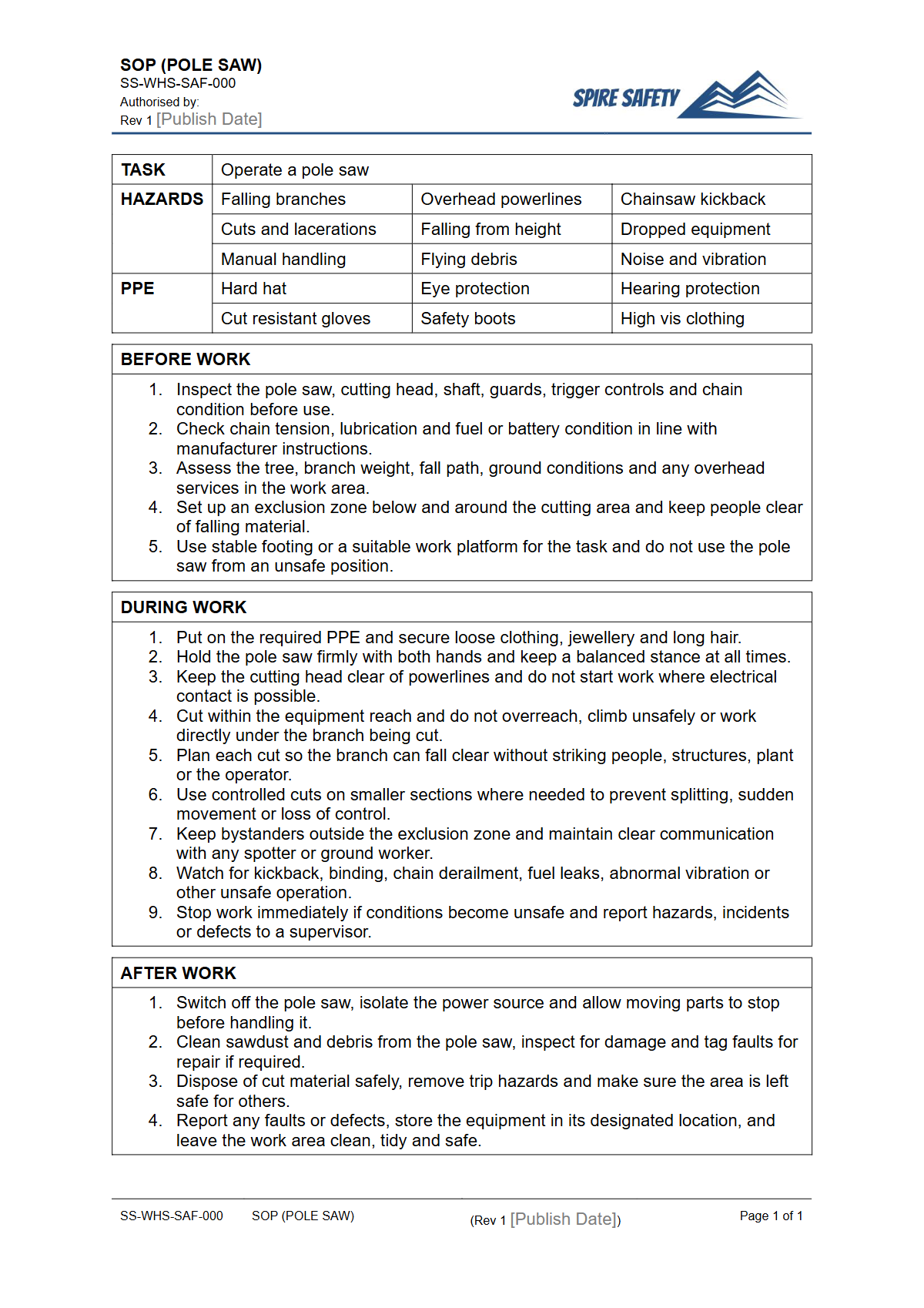
This Free Safe Operating Procedure (Pole Saw) Template provides a structured framework for documenting the risks and controls associated with operating powered pole saws for tree trimming, pruning, and related arboricultural tasks. Using a comprehensive SOP is a practical way to provide clear instructions to workers, ensuring tasks are performed safely and consistently.
Implementing detailed SOPs for high-risk equipment is a fundamental component of effective WHS management systems, helping your organisation meet its duty of care.
A well-drafted SOP helps to standardise training, simplify supervision, and provide a clear reference for workers on pre-operational checks, safe use, and post-operational procedures. It formalises the steps required to manage hazards like kickback, falling branches, contact with overhead powerlines, and musculoskeletal strain.
This template is designed as a starting point, aligned with Australian WHS principles, to help you create a site-specific document that protects your workers and supports your safety program.
Video walkthrough
How to use the Free Safe Operating Procedure (Pole Saw) Template
Our Free Safe Operating Procedure (Pole Saw) Template is provided in an editable DOCX format for easy customisation. To use it effectively, you must adapt its contents to reflect the specific pole saw models, work environments, and tasks performed at your site.
A generic document is not sufficient; it must be made relevant to your unique operational context.
Important: This document is a template and not a finished Safe Operating Procedure. We have populated it with common hazards and controls, but you must consult with your team, review your specific equipment manuals, and conduct a site-specific risk assessment.
Ensure the final SOP accurately reflects the 'who, what, where, and how' of pole saw use in your business. Regular reviews, especially after an incident or when new equipment is introduced, are critical, and this process can be verified through a WHS compliance audit.
When to use a Pole Saw SOP
A Safe Operating Procedure for a pole saw should be used in several key situations. It is an essential training document for new workers or those unfamiliar with the specific model of pole saw being used.
The SOP should be referenced during toolbox talks before commencing trimming or pruning activities, especially in complex or high-risk areas. It also serves as a guide for pre-start inspections, ensuring the equipment is safe to use before any work begins.
For workers, it is a constant reference for correct technique, required Personal Protective Equipment (PPE), and emergency procedures. The SOP also provides a baseline for incident investigations, helping to determine if established procedures were followed.
Who should use it
This SOP template is designed for anyone responsible for the health and safety of workers using pole saws. This includes Persons Conducting a Business or Undertaking (PCBUs), site supervisors, safety managers, and team leaders in industries like arboriculture, landscaping, parks and gardens, and local government.
The final, customised SOP should be read, understood, and followed by all operators of pole saws. It is also a valuable resource for WHS consultants and those responsible for developing and implementing safety documentation.
Using specific SOPs for each piece of equipment, such as our FREE Circular Saw SOP Template for other cutting tasks, helps build a comprehensive safety library for your operations.
Key considerations for your Pole Saw SOP
When customising this template, pay close attention to the following areas:
- Types of Pole Saws: Specify whether the SOP covers petrol, electric, or battery-powered models, as hazards and checks can differ.
- Work Environment: Detail controls for specific site hazards, such as uneven ground, proximity to public spaces, and the presence of overhead electrical services. Managing ground-level hazards is just as important, similar to the planning required when using machinery covered in our FREE Trencher SOP Template.
- Falling Objects & Exclusion Zones: Clearly define the method for establishing and maintaining exclusion zones to protect the operator and others from falling branches.
- Emergency Procedures: Outline steps to take in case of injury, equipment failure, or unexpected situations like a hung-up branch or contact with a powerline.
- PPE Requirements: List all mandatory PPE, including head protection (helmet with chin strap), eye and face protection (visor or goggles), hearing protection, safety footwear, and appropriate gloves.
By thoroughly addressing these points, you can transform this template into a robust, site-specific safety tool. This dedication to documenting safe work practices for individual plant items, from pole saws to larger equipment like that detailed in our FREE Telehandler SOP Template, demonstrates a strong commitment to WHS. Find more templates like this in our complete free WHS resources library.
Common mistakes
Common mistakes to avoid
- Failing to establish and maintain a clear exclusion zone for falling debris.
- Neglecting to check for overhead powerlines and other aerial hazards before starting work.
- Overreaching or working from an unstable footing, leading to loss of balance and control.
- Using a dull or improperly tensioned chain, which increases the risk of kickback and poor cutting performance.
Legal references
Legal considerations
The following legal requirements may be relevant to this type of work.
- Work Health and Safety Act (Harmonised) — Provides the primary duties for protecting workers and other people from work health and safety risks.
- Work Health and Safety Regulations (Harmonised) — Sets out requirements supporting the management of workplace hazards and risks.
The following codes may be relevant to this type of work.
- Managing WHS Risks Code of Practice — Provides practical guidance on identifying hazards, assessing risks and applying effective controls.
- Work Health and Safety Consultation, Cooperation and Coordination Code of Practice — Provides practical guidance on consulting workers and coordinating with other duty holders.
- Managing the Work Environment and Facilities Code of Practice — Provides practical guidance on safe work environments, workplace facilities and related controls.
Did you know
The Danger Zone
The 'danger zone' or 'drop zone' around a tree being pruned with a pole saw should be at least two times the height of the tallest branch being cut. This area must be clearly marked and kept clear of all personnel.
Powerline Proximity
According to Australian electrical safety standards, unqualified persons and their tools must maintain a minimum approach distance from overhead powerlines, often 3 metres or more. Always assume lines are live and have them de-energised by the authority if work is required nearby.
FAQ
Frequently asked questions
01What PPE is required for using a pole saw?
02How often should a pole saw SOP be reviewed?
03Can a generic SOP be used for all types of pole saws?
04What are the main hazards of using a pole saw?
Share this resource
Free Safe Operating Procedure (Pole Saw) Template
Browse Categories
How To Use It
- 1Download and open in Word or PDF.
- 2Replace the placeholders with your business details.
- 3Get it reviewed by a WHS specialist before rollout.
Need it customised?
Our WHS consultants can adapt this template to your site, run a gap analysis, or audit what you already have in place.
Book a Free Consultation WHS consulting servicesor call 1300 156 382
Related templates
- Free Safe Operating Procedure (Pond Debris Removal) Template
- Free Safe Operating Procedure (Pond Edge Maintenance) Template
- Free Safe Operating Procedure (Pontoon Access) Template
- Free Safe Operating Procedure (Pool Backwashing) Template
- Free Safe Operating Procedure (Pool Chemical Dosing System Operation) Template
- Free Safe Operating Procedure (Pool Cover Handling) Template