
Free Safe Operating Procedure (Pond Edge Maintenance) Template
Effectively manage the risks associated with working near water with our detailed SOP template. Download your free Pond Edge Maintenance SOP to start today.
Free Safe Operating Procedure (Pond Edge Maintenance) Template
DOCX • 126 KB + PDF
Updated Oct 2026
No signup required
Purpose of the Free Safe Operating Procedure (Pond Edge Maintenance) Template
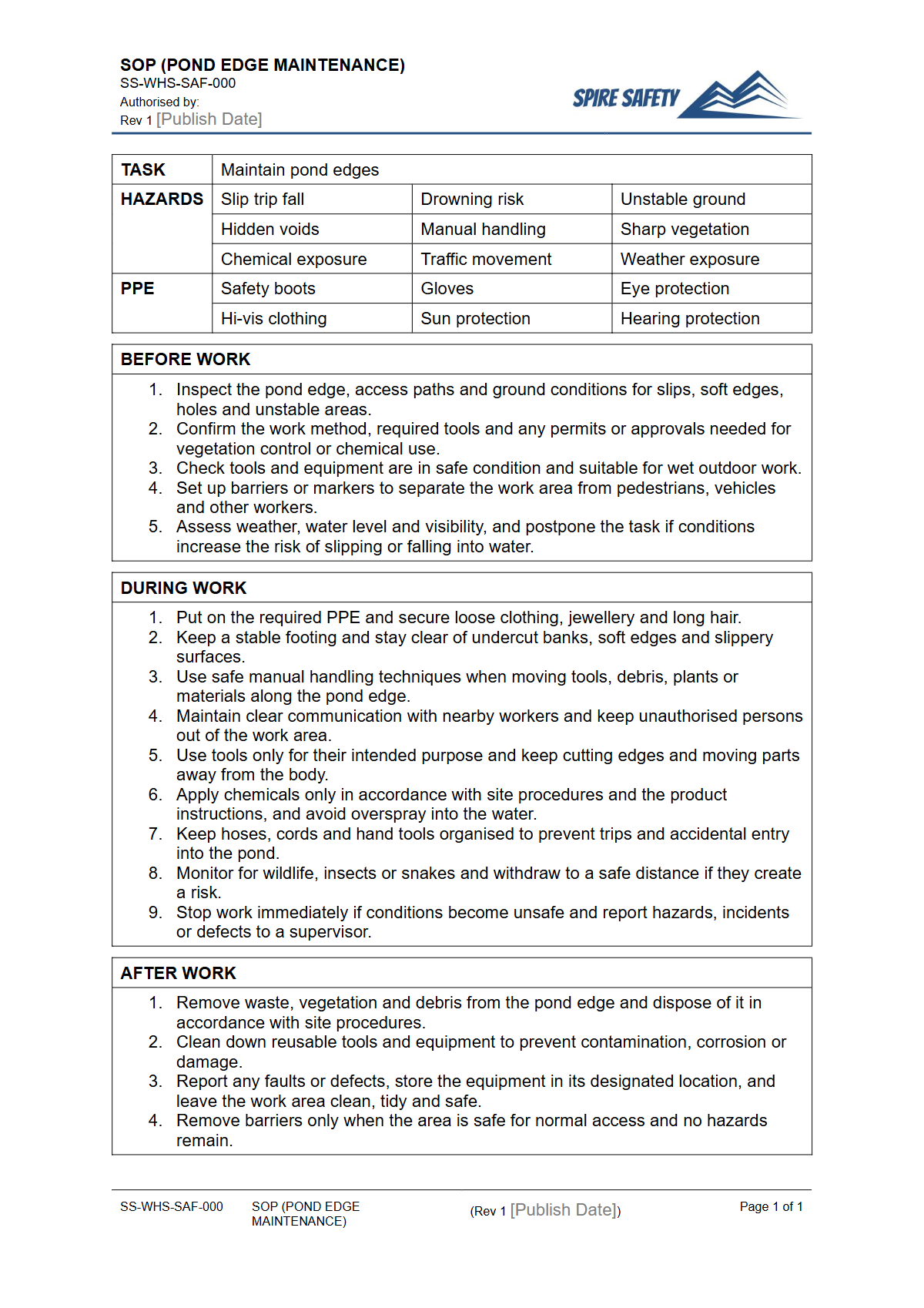
Working near bodies of water presents unique and significant risks. This Free Safe Operating Procedure (Pond Edge Maintenance) Template provides a structured framework for identifying hazards and implementing control measures for tasks performed at the edge of ponds, dams, or other contained water bodies.
It helps organisations document a clear, step-by-step process to ensure tasks such as vegetation control, erosion repair, and general groundskeeping are conducted safely. Using a formalised SOP promotes consistent, safe work practices, reduces the risk of incidents like drowning or falls, and assists in meeting your WHS obligations.
A well-developed SOP is a cornerstone of a proactive safety culture. It demonstrates a commitment to worker wellbeing and forms a critical part of more comprehensive WHS management systems. By clearly outlining procedures, required personal protective equipment (PPE), and emergency responses, this template helps you systematically manage risks associated with unstable ground, water hazards, and the use of equipment near water.
Video walkthrough
How to use the Free Safe Operating Procedure (Pond Edge Maintenance) Template
This resource is available for immediate download as a DOCX file, allowing for easy customisation to suit your specific operational needs. A PDF version is also provided for straightforward distribution and printing.
The template is designed as a robust starting point, structured in line with Australian WHS principles.
Important: This is a template and must be customised for your workplace. We have provided a foundation, but you are responsible for adapting it to the unique hazards, equipment, personnel, and environmental conditions of your specific site.
A generic procedure is not sufficient; you must conduct your own risk assessment and detail the precise control measures relevant to your operations before implementation.
Key Sections to Customise
- Hazard Identification: Detail all potential hazards specific to your pond, such as steep or slippery banks, submerged objects, poor water quality (biological hazards), and venomous snakes or insects.
- Risk Control Measures: Specify the exact controls to be used. This includes defining exclusion zones, mandating the use of specific PPE (e.g., life vests/PFDs, non-slip footwear), procedures for using tools and machinery, and requirements for a spotter.
- Equipment: List all machinery and tools to be used, from whipper snippers and mowers to larger earthmoving equipment. Reference manufacturer instructions where necessary.
- Emergency Procedures: Outline a clear, site-specific emergency plan. Include steps for water rescue, first aid for drowning, communication methods, and emergency contact details.
When to use it
A Safe Operating Procedure for pond edge maintenance should be developed and approved before any such work begins. It should be used as a primary reference document for planning and executing all related tasks.
It is also an essential tool for worker training and induction, ensuring everyone involved understands the approved safe method of work. The SOP should be reviewed during toolbox talks before a job starts, especially if conditions have changed (e.g., after heavy rain). For specialised tasks like creating drainage channels, you may need to integrate procedures from other documents, such as a free Trencher SOP.
Who should use it
This template is designed for anyone responsible for the safety of workers performing maintenance near water. This includes:
- WHS Managers and Safety Officers: For developing and integrating safe work systems within the organisation's overall safety framework.
- Supervisors and Team Leaders: For instructing workers, overseeing tasks, and ensuring procedures are followed correctly on the ground.
- Business Owners and PCBUs: To fulfil their primary duty of care by providing safe systems of work for employees and contractors.
- Workers and Contractors: As a practical guide to follow, helping them understand the risks and the steps they must take to protect themselves and others.
For larger-scale pond remediation or construction that involves re-profiling banks, a free Scraper SOP may also be relevant to consult. Regularly verifying that the documented procedures are being followed is also critical, which can be achieved through observation and formal safety checks as part of a WHS compliance auditing program. For tasks like revegetating the pond banks after work is complete, a specific Spreader SOP might be required to detail the safe use of that equipment. You can find these and more in our free WHS resources library.
Common mistakes
Common mistakes to avoid
- Assuming the ground is stable right up to the water's edge.
- Failing to account for changing weather conditions, such as rain making surfaces extra slick.
- Neglecting to include specific, practical emergency procedures for a water-related incident.
- Using the template as-is without customising it for the specific site, tasks, and equipment in use.
Legal references
Legal considerations
The following legal requirements may be relevant to this type of work.
- Work Health and Safety Act (Harmonised) — Provides the primary duties for protecting workers and other people from work health and safety risks.
- Work Health and Safety Regulations (Harmonised) — Sets out requirements supporting the management of workplace hazards and risks.
The following codes may be relevant to this type of work.
- Managing WHS Risks Code of Practice — Provides practical guidance on identifying hazards, assessing risks and applying effective controls.
- Work Health and Safety Consultation, Cooperation and Coordination Code of Practice — Provides practical guidance on consulting workers and coordinating with other duty holders.
- Managing the Work Environment and Facilities Code of Practice — Provides practical guidance on safe work environments, workplace facilities and related controls.
Did you know
Unstable Ground
The ground within several metres of a pond's edge can be waterlogged and structurally unstable, even if it appears solid. This 'saturated zone' increases the risk of collapse, especially under the weight of machinery or vehicles.
The Hierarchy of Controls
When managing risks for pond edge work, implementing higher-level controls like installing permanent guardrails (engineering) is far more effective and reliable than relying solely on PPE like life jackets (personal protective equipment).
FAQ
Frequently asked questions
01What are the main hazards of pond edge maintenance?
02Is a life jacket required for working near a pond?
03Can I use this SOP for creek or river bank maintenance?
04How often should an SOP for pond maintenance be reviewed?
Share this resource
Free Safe Operating Procedure (Pond Edge Maintenance) Template
Browse Categories
How To Use It
- 1Download and open in Word or PDF.
- 2Replace the placeholders with your business details.
- 3Get it reviewed by a WHS specialist before rollout.
Need it customised?
Our WHS consultants can adapt this template to your site, run a gap analysis, or audit what you already have in place.
Book a Free Consultation WHS consulting servicesor call 1300 156 382
Related templates
- Free Safe Operating Procedure (Pontoon Access) Template
- Free Safe Operating Procedure (Pool Backwashing) Template
- Free Safe Operating Procedure (Pool Chemical Dosing System Operation) Template
- Free Safe Operating Procedure (Pool Cover Handling) Template
- Free Safe Operating Procedure (Pool Deck Cleaning) Template
- Free Safe Operating Procedure (Pool Deck Inspection) Template