
Free Safe Operating Procedure (Pond Debris Removal) Template
Download our free Safe Operating Procedure for pond debris removal. This customisable template helps you document safe work practices for your team.
Free Safe Operating Procedure (Pond Debris Removal) Template
DOCX • 126 KB + PDF
Updated Oct 2026
No signup required
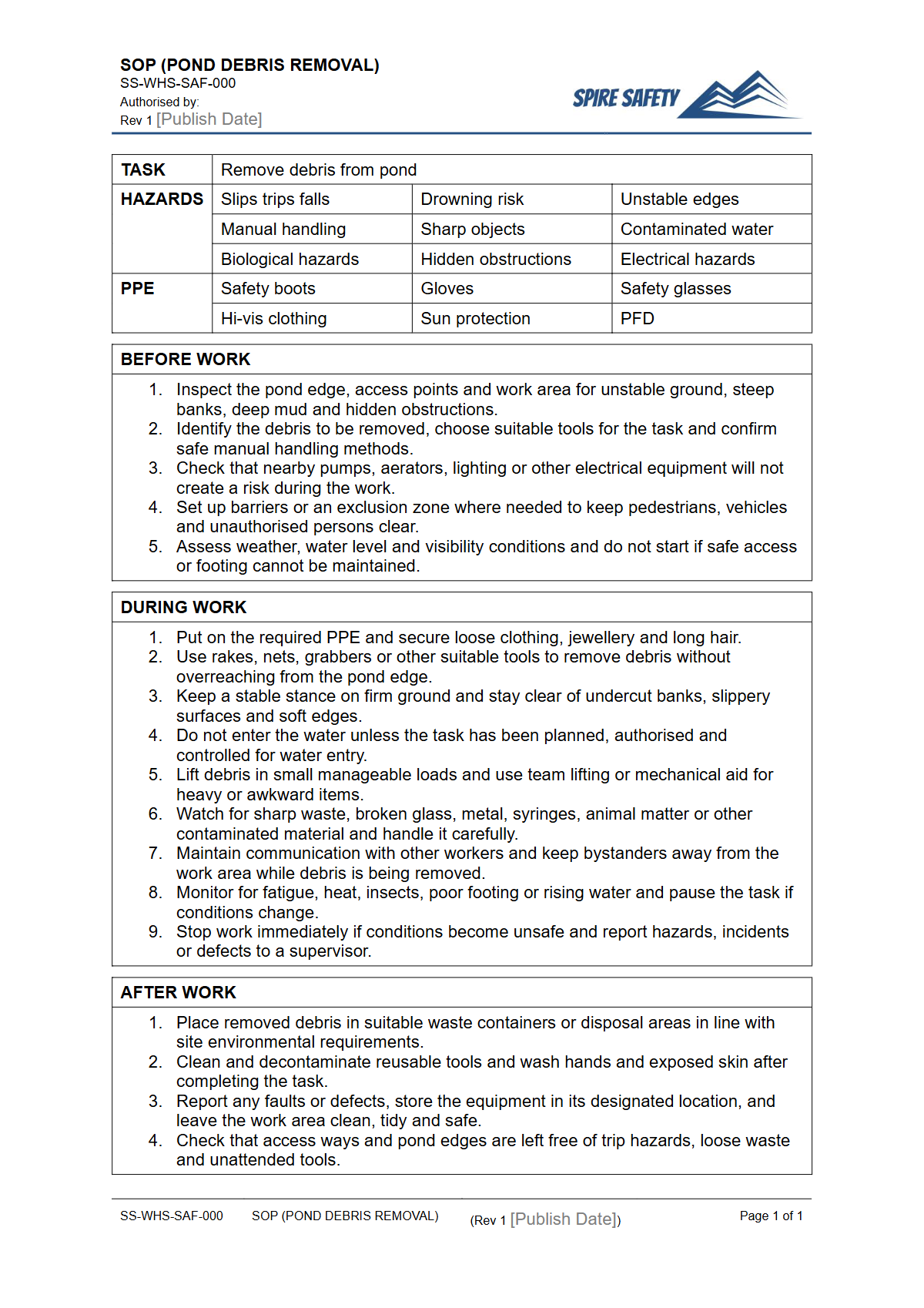
Purpose of the Free Safe Operating Procedure (Pond Debris Removal) Template
This Free Safe Operating Procedure (Pond Debris Removal) Template provides a structured framework for businesses to document the required steps for safely removing debris from ponds, dams, and other artificial water bodies. The primary purpose is to manage significant work health and safety (WHS) risks associated with the task.
These hazards include drowning, slips, trips, and falls at the water's edge, musculoskeletal injuries from hazardous manual tasks, and exposure to biological hazards like bacteria, algae, and fungi present in the water and sludge. By implementing a formal SOP, organisations can ensure workers are aware of the risks and follow a consistent, safe method for every clean-up operation.
A well-defined SOP is a critical component of a proactive safety culture. It serves as a training tool for new employees and a reference for experienced workers, promoting a standardised approach to risk management.
Formalising procedures helps your organisation meet its primary duty of care under Australian WHS legislation. Integrating such procedures into broader WHS management systems demonstrates a commitment to workplace safety and operational excellence.
Video walkthrough
How to use the Free Safe Operating Procedure (Pond Debris Removal) Template
This document is provided in both DOCX and PDF formats for your convenience. The DOCX file is fully editable, allowing you to tailor the content to the unique circumstances of your workplace.
To effectively use this Safe Operating Procedure for pond debris removal, you must review and modify each section to align with your specific site conditions, the equipment being used (e.g., rakes, nets, pumps, excavators), the type of debris being removed, and the skill level of your personnel. You should add site-specific emergency procedures, contact details, and details of any required permits.
Important: This is a template, not a finished safety document. To be effective, you must customise this template to reflect the specific equipment, environment, and personnel at your worksite.
We have provided a structured starting point aligned with Australian WHS principles, but the final responsibility for creating a safe and comprehensive procedure lies with the Person Conducting a Business or Undertaking (PCBU). Once customised, the SOP should be used as part of your training and induction processes.
Its effectiveness should be verified through regular WHS compliance audits and workplace inspections.
When to use this Safe Operating Procedure
An SOP for pond debris removal should be developed and implemented before any such work commences. It is essential for a range of scenarios, including:
- Routine maintenance and seasonal cleaning of ornamental ponds, stormwater retention basins, or agricultural dams.
- Post-storm or flood clean-ups where large amounts of debris, such as branches and rubbish, have accumulated.
- Preparing a water body for specific activities or treatments, such as controlling algal blooms or improving water quality.
- Responding to environmental incidents where contaminants need to be safely removed from a pond.
For large-scale operations, such as removing fallen trees after a severe storm, the scope of work may require additional risk assessments and potentially the use of heavy machinery. In these cases, your procedures should cross-reference other relevant documents, such as a telehandler SOP if one is used for lifting.
Who should use it
This SOP is intended for use by several key roles within an organisation:
- Persons Conducting a Business or Undertaking (PCBUs): To ensure they are meeting their duty of care by providing a safe system of work.
- Managers and Supervisors: To train workers, oversee the task, and ensure the documented procedures are followed correctly.
- WHS Professionals: To integrate the SOP into the organisation's overall safety management system and use it as a basis for risk assessments and audits.
- Workers and Contractors: To understand the steps and safety precautions required before, during, and after the task. Anyone operating tools to break down debris, for instance, should be familiar with the relevant circular saw SOP in addition to this one.
Ultimately, anyone involved in the planning, supervision, or execution of pond debris removal needs to be familiar with the contents of the finalised Safe Operating Procedure. Sometimes, the task may involve minor earthworks to improve drainage or access; in these instances, a specific trencher SOP may also be necessary for operators of that equipment.
This template is just one of many freely available documents designed to help your business manage workplace risks. You can explore our complete free WHS resources library for more templates, checklists, and guides.
Common mistakes
Common mistakes to avoid
- Underestimating the risk of drowning, even in shallow water.
- Failing to identify and control biological hazards from contaminated water or sludge.
- Using incorrect manual handling techniques for lifting wet, heavy, or awkward debris.
- Working alone without a buddy system or a reliable communication and emergency plan.
Legal references
Legal considerations
The following legal requirements may be relevant to this type of work.
- Work Health and Safety Act (Harmonised) — Provides the primary duties for protecting workers and other people from work health and safety risks.
- Work Health and Safety Regulations (Harmonised) — Sets out requirements supporting the management of workplace hazards and risks.
The following codes may be relevant to this type of work.
- Managing WHS Risks Code of Practice — Provides practical guidance on identifying hazards, assessing risks and applying effective controls.
- Work Health and Safety Consultation, Cooperation and Coordination Code of Practice — Provides practical guidance on consulting workers and coordinating with other duty holders.
- Managing the Work Environment and Facilities Code of Practice — Provides practical guidance on safe work environments, workplace facilities and related controls.
Did you know
Waterborne Hazards
Still or stagnant water, common in ponds needing cleaning, can harbour harmful bacteria like Legionella and E. coli, posing a significant health risk to workers if inhaled or ingested.
Drowning Risk
According to Royal Life Saving Australia, a significant number of adult drowning deaths occur in inland waterways. This highlights the serious risk of working near any body of water, regardless of its perceived depth.
FAQ
Frequently asked questions
01What are the main hazards involved in pond debris removal?
02Is a Safe Operating Procedure legally required for cleaning a pond in Australia?
03What Personal Protective Equipment (PPE) is needed for pond debris removal?
04How often should an SOP for pond debris removal be reviewed?
Share this resource
Free Safe Operating Procedure (Pond Debris Removal) Template
Browse Categories
How To Use It
- 1Download and open in Word or PDF.
- 2Replace the placeholders with your business details.
- 3Get it reviewed by a WHS specialist before rollout.
Need it customised?
Our WHS consultants can adapt this template to your site, run a gap analysis, or audit what you already have in place.
Book a Free Consultation WHS consulting servicesor call 1300 156 382
Related templates
- Free Safe Operating Procedure (Pond Edge Maintenance) Template
- Free Safe Operating Procedure (Pontoon Access) Template
- Free Safe Operating Procedure (Pool Backwashing) Template
- Free Safe Operating Procedure (Pool Chemical Dosing System Operation) Template
- Free Safe Operating Procedure (Pool Cover Handling) Template
- Free Safe Operating Procedure (Pool Deck Cleaning) Template