
Free Safe Operating Procedure (Playground Sand Raking) Template
Formalise your safety measures for maintaining play areas with our free playground sand raking SOP.
Free Safe Operating Procedure (Playground Sand Raking) Template
DOCX • 126 KB + PDF
Updated Oct 2026
No signup required
Purpose of the Free Safe Operating Procedure (Playground Sand Raking) Template
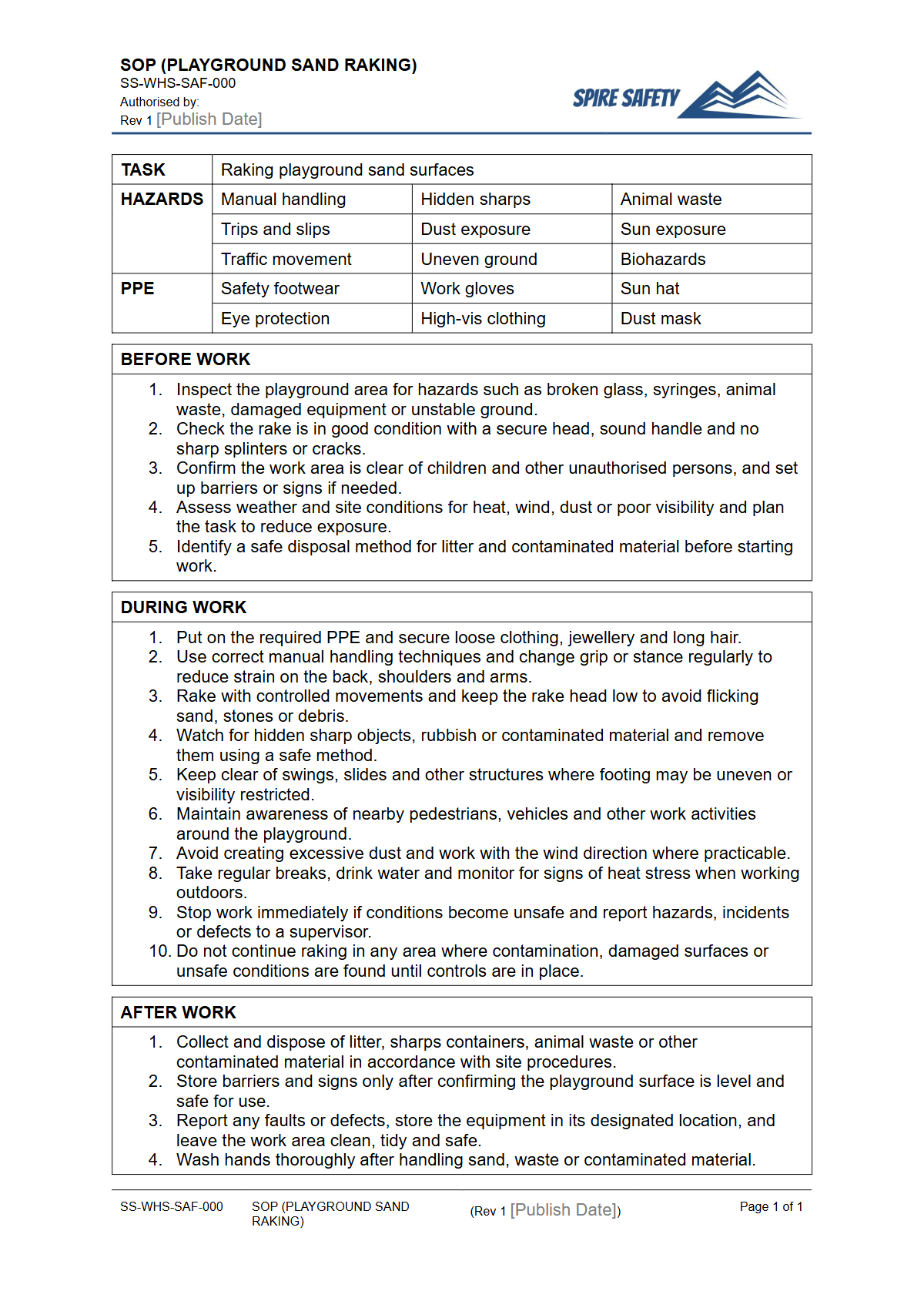
Maintaining a playground sandpit seems like a simple task, but it carries significant health and safety risks. This free Safe Operating Procedure (Playground Sand Raking) Template provides a structured framework for documenting the required steps to perform the task safely.
Its primary purpose is to help organisations like schools, childcare centres, and local councils identify hazards and implement effective control measures. A documented SOP ensures a consistent and safe approach is followed every time.
Key hazards addressed in sand raking include the presence of sharp objects like broken glass or discarded needles, biological contaminants such as animal faeces, and ergonomic risks from manual handling. The procedure also prompts consideration of environmental factors like sun exposure and dust inhalation.
By systematically outlining pre-operational checks, step-by-step instructions, and post-task clean-up, this template helps you fulfil your duty of care. These documented procedures should form part of your broader WHS management systems, demonstrating a proactive approach to safety management.
Hazards and Control Measures
A comprehensive SOP for this task should identify specific risks and detail the controls needed to mitigate them. Common examples include:
- Sharp Objects: Control with puncture-resistant gloves, visual inspection, and use of a fine-tined rake to sift the sand.
- Biological Hazards: Control by wearing gloves, using appropriate tools to remove waste, and practising good hygiene like hand washing after the task.
- Manual Task Risks: Control through training on correct lifting and raking techniques, using lightweight tools, and taking regular breaks to avoid strains.
- Environmental Exposure: Control with sun-safe PPE (hat, long sleeves, sunscreen) and scheduling work during cooler parts of the day where possible.
Video walkthrough
How to use the Free Safe Operating Procedure (Playground Sand Raking) Template
This Safe Operating Procedure (Playground Sand Raking) Template is provided as a starting point in both DOCX and PDF formats. The DOCX file is fully editable, allowing you to adapt it to your specific operational needs and environment. To use the template effectively, follow these steps:
Important: This document is a template and must be customised to your specific workplace. We recommend you consult with your team, including the workers who perform the task, to ensure it reflects your actual equipment, environment, and processes.
A generic procedure that doesn't match your reality is not an effective control.
- Download: Choose the DOCX version for easy editing.
- Consult: Involve groundskeepers, maintenance staff, and supervisors in the review process. Their practical experience is invaluable for identifying all relevant steps and risks.
- Customise: Add your company name and logo. Modify the steps to reflect the specific rakes or equipment used. Detail your site-specific requirements for PPE, waste disposal (especially for sharps), and emergency procedures.
- Train: Use the finalised SOP as a training tool for all relevant workers. Ensure they understand every step and the reasoning behind the safety controls.
- Review: Schedule regular reviews of the SOP (e.g., annually or after an incident) to ensure it remains current and effective.
Once you have customised this document, you can explore our full free WHS resources library for other templates that may support your operations.
When to use it
A Safe Operating Procedure for playground sand raking should be integrated into your regular maintenance and safety schedule. It is not a document that should sit on a shelf; it is an active tool for risk management. Use this SOP in the following situations:
- Daily or Regular Maintenance: It should be the primary guidance document for staff conducting routine cleaning and inspection of sandpits. In high-use areas, this should be a daily task performed before children access the playground.
- Training and Induction: When new staff are employed or assigned to grounds maintenance duties, this SOP is an essential part of their induction and task-specific training.
- Risk Assessments: The content of the SOP is a direct output of a risk assessment. It should be reviewed and updated whenever a risk assessment for the playground area is conducted or revised.
- Incident Investigation: If an injury or near-miss occurs related to the sandpit, the SOP should be reviewed as part of the investigation to determine if it was being followed and if it needs improvement.
The procedure is also a valuable reference when planning related tasks. For example, it can also inform the process for topping up sand levels, which may require a separate FREE Spreader SOP (Safe Operating Procedure) Template.
Who should use it
This SOP is intended for any person or organisation responsible for the safety and maintenance of playgrounds with sandpits. This includes a range of roles:
- PCBU (Person Conducting a Business or Undertaking): The organisation (e.g., school, council, childcare business) has the primary duty of care. This template helps them establish and provide a safe system of work.
- Managers and Supervisors: They are responsible for implementing the SOP, ensuring workers are trained, and verifying that the procedure is being followed correctly.
- Groundskeepers and Maintenance Workers: These are the primary users of the SOP. It gives them clear, step-by-step instructions to follow to keep themselves and others safe.
- WHS Officers and Advisors: They will typically be responsible for developing, authorising, and managing the organisation's library of SOPs. If you require expert assistance in tailoring this document or developing other safety resources, our WHS consulting team can provide tailored support.
Ultimately, anyone involved in the lifecycle of playground maintenance, from planning to execution, can benefit from having a clear, documented procedure. Cleaning tools and equipment after use is also a key step, which may be covered by procedures like our Free Air Compressor SOP (Safe Operating Procedure) Template.
Common mistakes
Common mistakes to avoid
- Superficial raking that doesn't sift deep enough to uncover buried hazards.
- Forgetting to check the sand before children enter the play area, especially after weekends or holidays.
- Using incorrect manual handling techniques, leading to back or shoulder strain.
- Failing to wear appropriate PPE, particularly puncture-resistant gloves and sun protection.
Legal references
Legal considerations
The following legal requirements may be relevant to this type of work.
- Work Health and Safety Act (Harmonised) — Provides the primary duties for protecting workers and other people from work health and safety risks.
- Work Health and Safety Regulations (Harmonised) — Sets out requirements supporting the management of workplace hazards and risks.
The following codes may be relevant to this type of work.
- Managing WHS Risks Code of Practice — Provides practical guidance on identifying hazards, assessing risks and applying effective controls.
- Work Health and Safety Consultation, Cooperation and Coordination Code of Practice — Provides practical guidance on consulting workers and coordinating with other duty holders.
- Managing the Work Environment and Facilities Code of Practice — Provides practical guidance on safe work environments, workplace facilities and related controls.
Did you know
Hidden Dangers
Sandpits can unfortunately conceal hazardous waste, including discarded needles and broken glass. A thorough raking process is a critical control measure to protect children from serious injury.
The Importance of Depth
Australian Standards for playground safety (AS 4685) specify minimum depths for sand and other soft-fall materials to provide adequate impact absorption. Raking helps maintain an even, uncompacted surface, contributing to this safety function.
FAQ
Frequently asked questions
01What hazards are involved in raking a playground sandpit?
02How often should a playground sandpit be raked and inspected?
03Is a Safe Operating Procedure a legal requirement in Australia?
04What personal protective equipment (PPE) is needed for raking sandpits?
Share this resource
Free Safe Operating Procedure (Playground Sand Raking) Template
Browse Categories
How To Use It
- 1Download and open in Word or PDF.
- 2Replace the placeholders with your business details.
- 3Get it reviewed by a WHS specialist before rollout.
Need it customised?
Our WHS consultants can adapt this template to your site, run a gap analysis, or audit what you already have in place.
Book a Free Consultation WHS consulting servicesor call 1300 156 382
Related templates
- Free Safe Operating Procedure (Playing Surface Check) Template
- Free Safe Operating Procedure (Pneumatic Isolation) Template
- Free Safe Operating Procedure (Pole Climbing) Template
- Free Safe Operating Procedure (Pole Saw) Template
- Free Safe Operating Procedure (Pond Debris Removal) Template
- Free Safe Operating Procedure (Pond Edge Maintenance) Template