
Free Safe Operating Procedure (Platform Trolley) Template
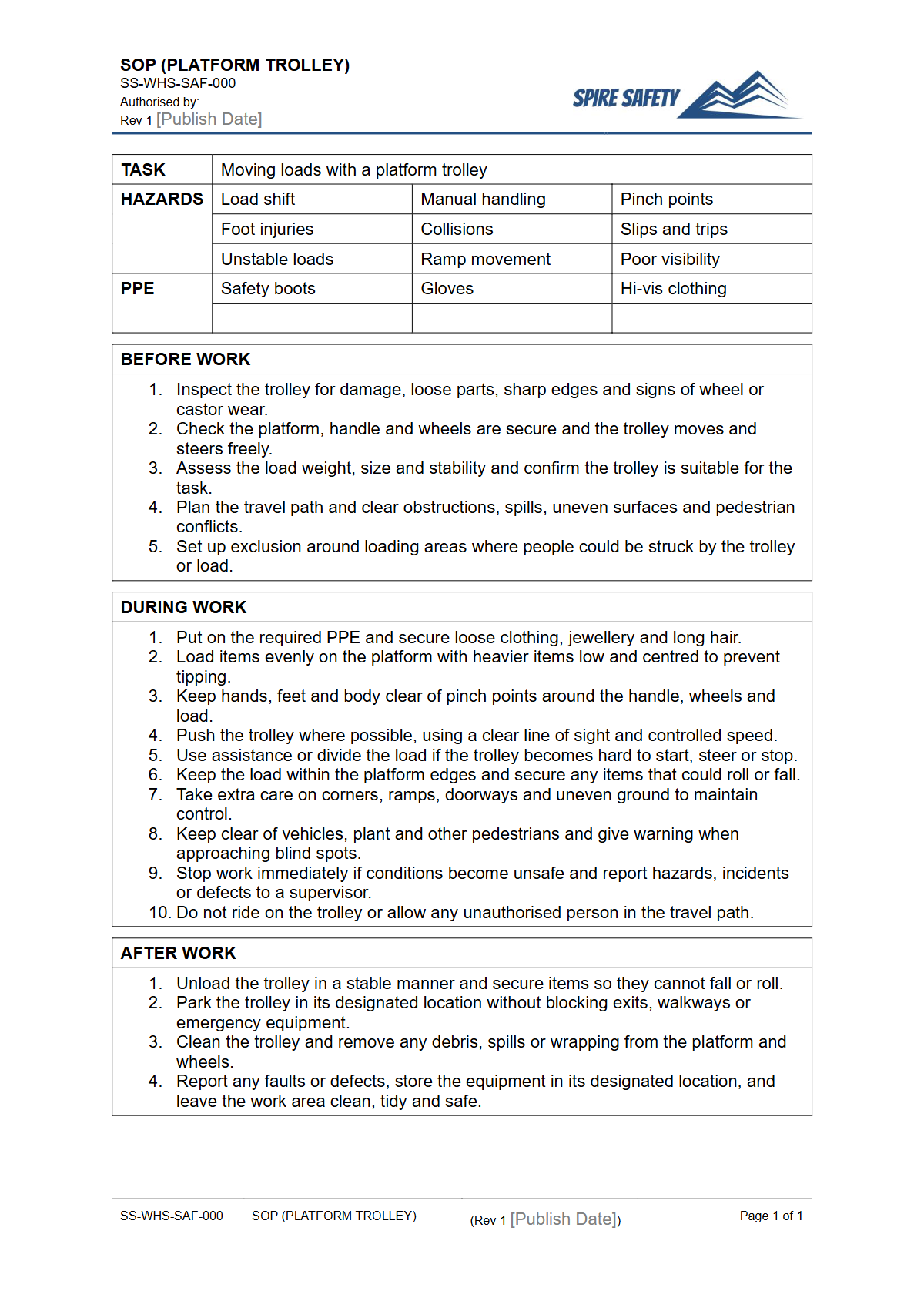
Download our free Safe Operating Procedure for platform trolleys, a structured template for documenting safe work practices.
Free Safe Operating Procedure (Platform Trolley) Template
DOCX • 126 KB + PDF
Updated Oct 2026
No signup required
Purpose of the Free Safe Operating Procedure (Platform Trolley) Template
Effectively managing workplace risks associated with manual handling is a fundamental part of any robust safety system. This Free Safe Operating Procedure (Platform Trolley) Template provides a structured starting point for your organisation to document the required steps for the safe use of platform trolleys.
By clearly outlining procedures, you can help reduce the risk of musculoskeletal injuries, slips, trips, and falls associated with moving goods in warehouses, retail spaces, and workshops. A well-developed SOP is a core component of effective WHS management systems, demonstrating a commitment to proactive risk management and worker safety.
Video walkthrough
How to use the Free Safe Operating Procedure (Platform Trolley) Template
This resource is available as a fully editable DOCX file and a print-ready PDF. To use it, download the DOCX version and adapt it to reflect your workplace's specific equipment, environment, and risk profile.
You should consult with workers and supervisors during this process to ensure the final procedure is practical and addresses all relevant hazards. This process is similar for other equipment, such as the steps outlined in our FREE Conveyer System SOP.
Important: This is a template only. It is not a complete, ready-to-use document.
To be effective and support your safety obligations, we stress that you must customise this template with site-specific information, including details of the trolleys in use, typical loads, travel paths, and emergency procedures.
When to use a Platform Trolley SOP
A formal SOP for platform trolleys should be used as a key part of your safety processes. It is essential for worker induction and new-starter training, ensuring everyone understands the expected safe behaviours from day one.
It also serves as a reference for regular refresher training and can be used by supervisors to conduct safety observations or performance reviews. Having documented procedures like this is a key piece of evidence reviewed during a WHS compliance audit, helping to verify that your safety systems are being implemented correctly.
Who should use this Safe Operating Procedure
This Safe Operating Procedure should be used by several groups within an organisation:
- Workers and Operators: The primary audience. They must be trained on the SOP and follow it during their daily tasks to ensure their own safety and the safety of others.
- Supervisors and Team Leaders: Responsible for ensuring workers are trained on the SOP, understand its requirements, and follow the procedure consistently. They also play a key role in enforcing the documented controls.
- WHS Managers and Personnel: Responsible for developing, reviewing, and updating the SOP in consultation with workers, ensuring it remains current and aligned with legislation and best practice.
The principles of creating and using an SOP apply to a wide range of equipment. For example, while the hazards are different, the procedural logic is similar to that found in our Free Air Compressor SOP.
Key Elements of an Effective Platform Trolley SOP
To ensure your final document is comprehensive, make sure it includes these essential sections, all of which are prompted in our template:
- Required Personal Protective Equipment (PPE): Specify necessary PPE, such as steel-capped boots and gloves.
- Pre-Operational Safety Checks: A checklist of items to inspect before use, including wheels, frame integrity, handle security, and the cleanliness of the platform. This systematic approach is vital for all equipment, as shown in resources like our FREE Circular Saw SOP (Safe Operating Procedure) Template.
- Step-by-Step Operating Procedure: Detailed instructions for loading (placing heavier items at the bottom), securing the load, pushing versus pulling, navigating ramps and doorways, and unloading safely.
- Post-Operation Actions: Instructions for cleaning the trolley and storing it in its designated location, ensuring it doesn't create a trip hazard.
- Emergency Procedures: Guidance on what to do in case of a load spill, collision, or injury.
Developing robust documentation is a continuous process. You can explore our entire free WHS resources library for more templates and guides to support your safety management efforts.
Common mistakes
Common mistakes to avoid
- Overloading the trolley beyond its specified safe working load (SWL).
- Failing to conduct a pre-start check of wheels, handles, and frame.
- Stacking items too high, obstructing the operator's view of the path ahead.
- Leaving an unattended trolley in a walkway, creating a trip hazard or blocking an emergency route.
Legal references
Legal considerations
The following legal requirements may be relevant to this type of work.
- Work Health and Safety Act (Harmonised) — Provides the primary duties for protecting workers and other people from work health and safety risks.
- Work Health and Safety Regulations (Harmonised) — Sets out requirements supporting the management of workplace hazards and risks.
The following codes may be relevant to this type of work.
- Managing WHS Risks Code of Practice — Provides practical guidance on identifying hazards, assessing risks and applying effective controls.
- Work Health and Safety Consultation, Cooperation and Coordination Code of Practice — Provides practical guidance on consulting workers and coordinating with other duty holders.
- Managing the Work Environment and Facilities Code of Practice — Provides practical guidance on safe work environments, workplace facilities and related controls.
Did you know
Manual Task Injuries
According to Safe Work Australia, manual handling is a leading cause of workplace injury in Australia, accounting for a significant portion of all serious workers' compensation claims.
Push, Don't Pull
Pushing a trolley generally allows for better control and visibility, and it places less strain on the lower back compared to pulling. Most ergonomic guidelines recommend pushing whenever possible.
FAQ
Frequently asked questions
01What are the main hazards of using a platform trolley?
02Is a Safe Operating Procedure a legal requirement for platform trolleys in Australia?
03How often should a platform trolley SOP be reviewed?
04Can this template be used for motorised platform trolleys?
Share this resource
Free Safe Operating Procedure (Platform Trolley) Template
Browse Categories
How To Use It
- 1Download and open in Word or PDF.
- 2Replace the placeholders with your business details.
- 3Get it reviewed by a WHS specialist before rollout.
Need it customised?
Our WHS consultants can adapt this template to your site, run a gap analysis, or audit what you already have in place.
Book a Free Consultation WHS consulting servicesor call 1300 156 382
Related templates
- Free Safe Operating Procedure (Playground Rake Over) Template
- Free Safe Operating Procedure (Playground Sand Raking) Template
- Free Safe Operating Procedure (Playing Surface Check) Template
- Free Safe Operating Procedure (Pneumatic Isolation) Template
- Free Safe Operating Procedure (Pole Climbing) Template
- Free Safe Operating Procedure (Pole Saw) Template