
Free Safe Operating Procedure (Playground Rake Over) Template
Formalise the process for maintaining playground soft fall with our SOP template. Download your customisable Playground Rake Over guide for free.
Free Safe Operating Procedure (Playground Rake Over) Template
DOCX • 126 KB + PDF
Updated Oct 2026
No signup required
Purpose of the Free Safe Operating Procedure (Playground Rake Over) Template
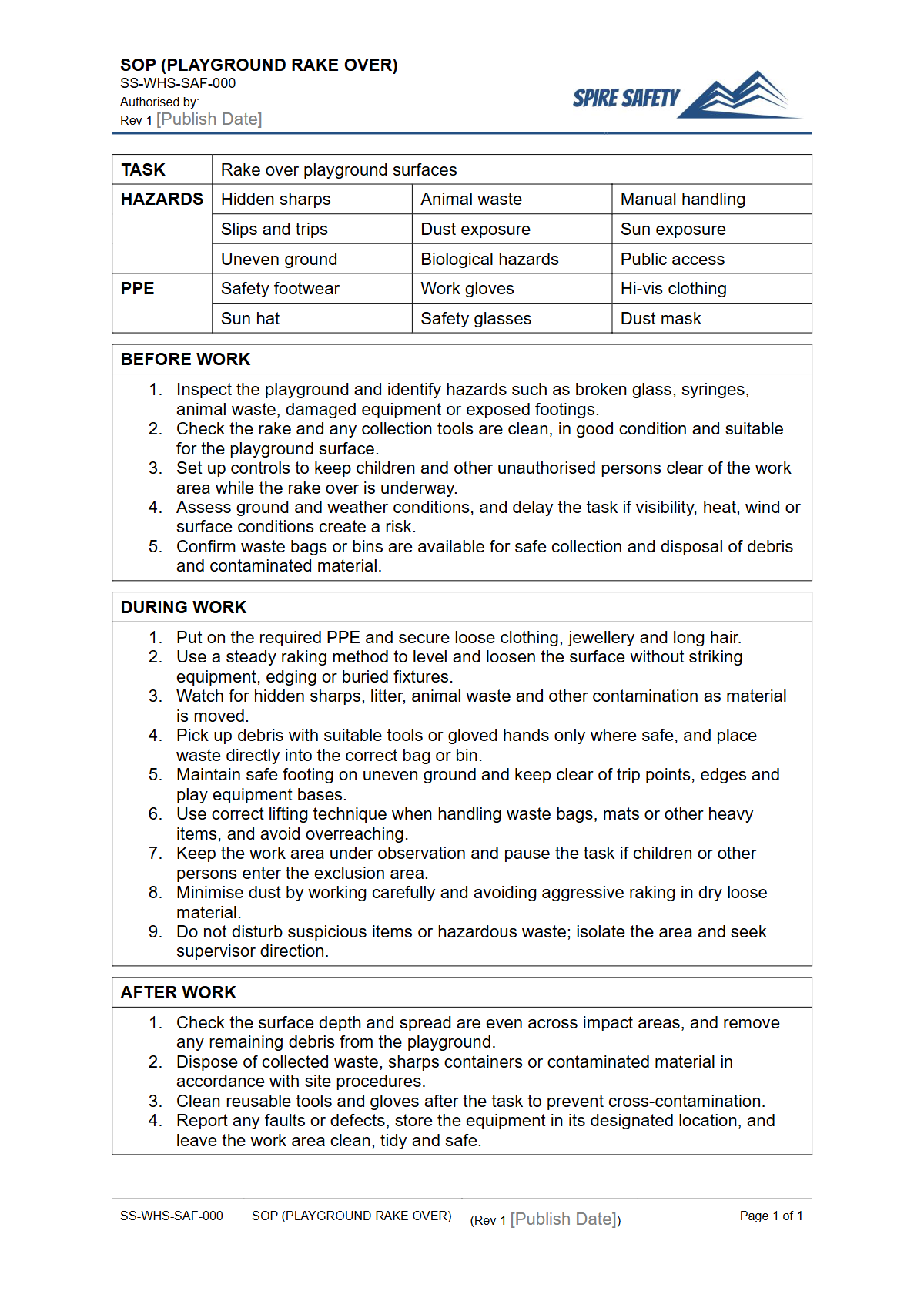
This Free Safe Operating Procedure (Playground Rake Over) Template provides a structured framework for documenting the steps required to safely maintain playground soft fall surfaces. Raking over materials like bark, sand, or rubber crumb is a critical task for ensuring playground safety and hygiene.
The primary purpose of this SOP is to control risks associated with the job, including manual handling injuries, exposure to sharps like needles or broken glass, biological hazards, and environmental factors like sun exposure.
By implementing a formal procedure, organisations can ensure consistency in how the task is performed, provide a clear basis for worker training, and demonstrate due diligence in managing workplace risks. A well-defined SOP helps workers recognise and mitigate hazards before they cause harm.
Effective procedures are a key component of a robust WHS management system, helping to create a safer environment for both employees and the public.
Video walkthrough
How to use the Free Safe Operating Procedure (Playground Rake Over) Template
To use this Safe Operating Procedure for playground rake overs, simply download the DOCX file and adapt it to your specific operational context. The template is logically structured, covering sections for required PPE, pre-operational checks, step-by-step instructions, and post-task clean-up.
You should review each section and add, remove, or modify content to align with the equipment used, the specific playground environment, and your organisation's existing safety protocols.
Important: This document is a template and must be customised. We have created it as a strong starting point, but it is your responsibility to ensure the final SOP reflects the unique hazards and control measures relevant to your workplace.
This process should involve consultation with the workers who actually perform the task. If you require assistance with this customisation, consider our WHS consulting services.
When to use this Safe Operating Procedure
This SOP should be used whenever a worker is required to rake over or level playground soft fall surfaces. Its application is crucial for several scenarios, including:
- Routine Maintenance: As part of a scheduled maintenance program (e.g., daily or weekly checks).
- Post-Incident: After an incident or near miss has been reported, requiring the area to be inspected and made safe.
- Following Heavy Use: After weekends, school holidays, or community events that lead to displacement of soft fall material.
- After Weather Events: Following strong winds or heavy rain that can shift surfacing materials or wash in debris.
- Responding to Reports: When a member of the public or staff reports potential hazards like buried objects or uneven surfaces.
While this SOP is specific to raking, other grounds maintenance tasks may require separate procedures. For instance, creating new garden beds or drainage channels near a play area would necessitate a different process, such as the one outlined in our free Trencher SOP.
Who should use this Safe Operating Procedure
This procedure is designed for any person or worker (PCBU) responsible for the maintenance and safety of playgrounds. This includes:
- Local council groundskeepers and maintenance teams.
- School principals, business managers, and facilities staff.
- Childcare centre directors and maintenance personnel.
- Property maintenance contractors hired to service playgrounds.
- Managers responsible for developing and implementing safety systems.
It serves as both an instructional guide for workers and a management tool for supervisors to verify that tasks are being completed safely. Adherence to the SOP should be periodically verified through processes like WHS compliance auditing to ensure its ongoing effectiveness.
Similarly, if the task involves replenishing the soft fall material from bulk bags or piles, a separate procedure may be needed. You may find our free Spreader SOP template useful for documenting the safe use of that type of equipment. For an extensive selection of other templates, feel free to browse our complete free WHS resources library.
Common mistakes
Common mistakes to avoid
- Only raking the surface without probing or sifting for objects hidden deeper in the soft fall.
- Failing to wear appropriate puncture-resistant gloves, increasing the risk of injury from sharps.
- Not having a clear and safe procedure for the disposal of hazardous items found, such as needles.
- Performing the task during peak UV hours without adequate sun protection.
Legal references
Legal considerations
The following legal requirements may be relevant to this type of work.
- Work Health and Safety Act (Harmonised) — Provides the primary duties for protecting workers and other people from work health and safety risks.
- Work Health and Safety Regulations (Harmonised) — Sets out requirements supporting the management of workplace hazards and risks.
The following codes may be relevant to this type of work.
- Managing WHS Risks Code of Practice — Provides practical guidance on identifying hazards, assessing risks and applying effective controls.
- Work Health and Safety Consultation, Cooperation and Coordination Code of Practice — Provides practical guidance on consulting workers and coordinating with other duty holders.
- Managing the Work Environment and Facilities Code of Practice — Provides practical guidance on safe work environments, workplace facilities and related controls.
Did you know
The 'Critical Fall Height'
Playground soft fall materials are rated for a 'critical fall height', which is the maximum height from which a fall is not expected to cause a life-threatening head injury. Regular raking and leveling helps maintain the required depth to ensure this safety rating is not compromised.
FAQ
Frequently asked questions
01What are the main hazards when raking playgrounds?
02How often should playground soft fall be raked over?
03Is this SOP template enough to be WHS-aligned?
04What PPE is required for raking a playground?
Share this resource
Free Safe Operating Procedure (Playground Rake Over) Template
Browse Categories
How To Use It
- 1Download and open in Word or PDF.
- 2Replace the placeholders with your business details.
- 3Get it reviewed by a WHS specialist before rollout.
Need it customised?
Our WHS consultants can adapt this template to your site, run a gap analysis, or audit what you already have in place.
Book a Free Consultation WHS consulting servicesor call 1300 156 382
Related templates
- Free Safe Operating Procedure (Playground Sand Raking) Template
- Free Safe Operating Procedure (Playing Surface Check) Template
- Free Safe Operating Procedure (Pneumatic Isolation) Template
- Free Safe Operating Procedure (Pole Climbing) Template
- Free Safe Operating Procedure (Pole Saw) Template
- Free Safe Operating Procedure (Pond Debris Removal) Template