
Free Safe Operating Procedure (Plate Warmer) Template
Download our free Safe Operating Procedure (Plate Warmer) Template to outline safe work methods for hospitality equipment. This DOCX helps manage risks.
Free Safe Operating Procedure (Plate Warmer) Template
DOCX • 126 KB + PDF
Updated Oct 2026
No signup required
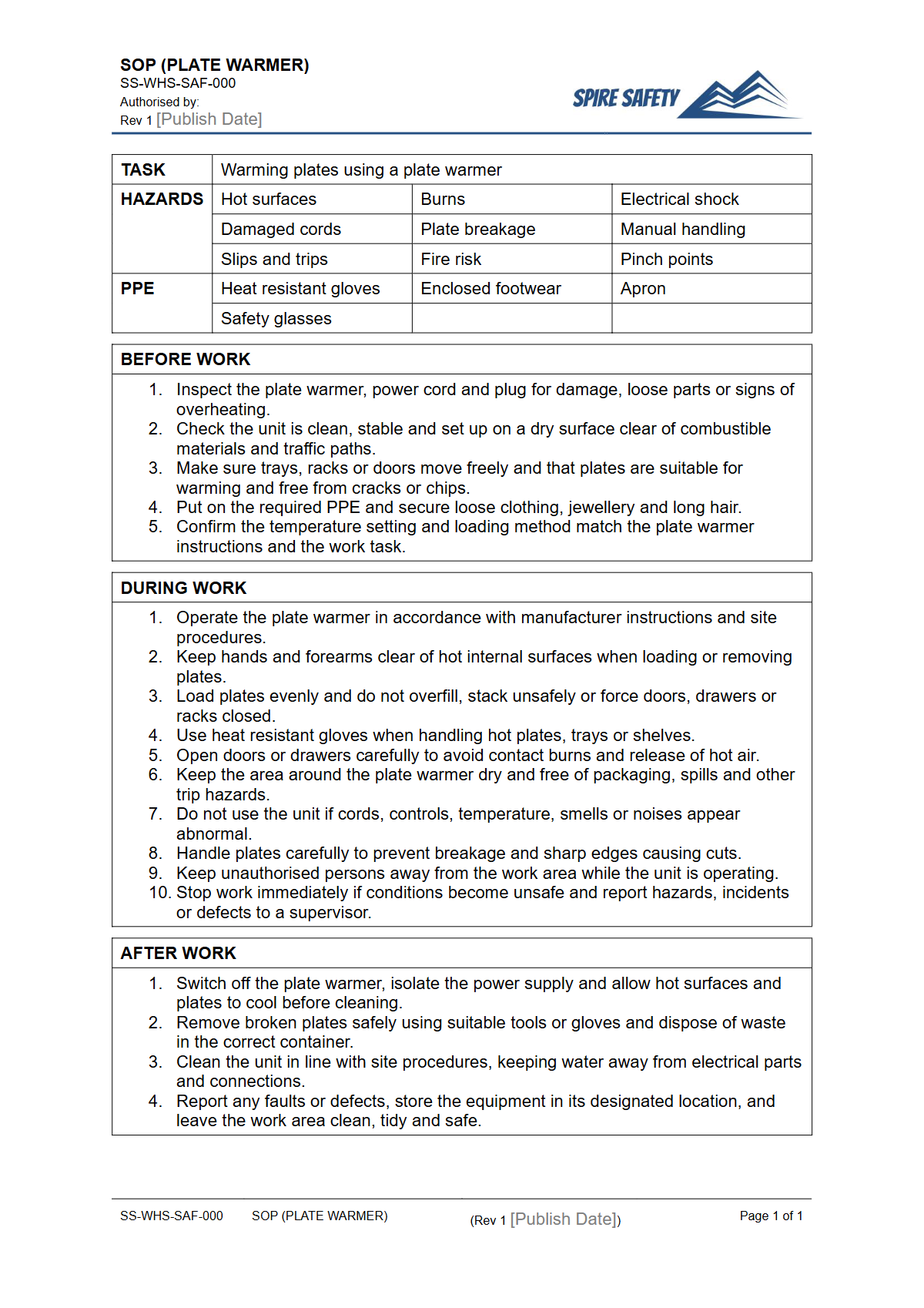
Purpose of the Free Safe Operating Procedure (Plate Warmer) Template
A Safe Operating Procedure (SOP) is a critical document for ensuring safety and consistency in any commercial kitchen or hospitality environment. This free Safe Operating Procedure (Plate Warmer) Template provides a structured foundation for documenting the correct, step-by-step process for using your equipment safely, helping to minimise the risk of injury.
Plate warmers, while seemingly simple, introduce significant hazards, including contact burns from hot surfaces, electrical faults, and manual handling risks associated with loading and unloading heavy stacks of plates.
Using a documented procedure helps your organisation meet its primary duty of care under Australian WHS laws by providing a clear safe system of work. It establishes clear instructions for all workers, reduces the likelihood of incidents, and serves as an essential training resource.
Formalising procedures for all kitchen equipment, including creating a Safe Operating Procedure for a deep fryer, is a hallmark of a proactive safety culture.
Video walkthrough
How to use the Free Safe Operating Procedure (Plate Warmer) Template
This template is designed to be a starting point. It is not a complete, ready-to-use document.
You must customise it with information specific to your workplace, the exact model of your plate warmer, and your operational requirements. This includes detailing specific pre-start checks, temperature settings, cleaning procedures, and emergency actions relevant to your environment.
To effectively implement this SOP:
- Identify the specific model: Record the make, model, and serial number of the plate warmer.
- Consult the manual: Incorporate the manufacturer’s instructions and safety warnings into your procedure.
- Conduct a risk assessment: Identify all foreseeable hazards associated with the equipment's use in your kitchen and document the control measures.
- Detail the procedure: Write clear, simple, step-by-step instructions for pre-operational checks, operation, cleaning, and shutdown.
- Specify PPE: List any Personal Protective Equipment (PPE) required, such as heat-resistant gloves.
- Train your team: Ensure all relevant workers are trained on the final SOP and that their competency is verified and recorded.
A well-customised SOP is a key document reviewed during WHS compliance audits to demonstrate that safe work systems are not only documented but also implemented and understood by workers. An incomplete or generic procedure offers limited practical or legal protection.
When to use this Safe Operating Procedure
A plate warmer SOP is a living document that should be used consistently, not just filed away. It is essential during worker inductions and for specific task training to ensure new team members understand the risks and correct procedures from day one.
It should also be used for refresher training to prevent complacency and reinforce safe work habits among experienced staff.
The SOP should be readily accessible to all operators near the equipment for easy reference. It is also a vital tool following a near miss or incident, providing a baseline against which to review what went wrong and make necessary improvements.
If you require assistance integrating these documents into your training programs, specialist WHS consulting services can provide tailored support.
Who should use this Safe Operating Procedure
This document is intended for use by Persons Conducting a Business or Undertaking (PCBUs) in the hospitality sector, including restaurant owners, hotel managers, and catering business operators. The responsibility for developing, implementing, and reviewing the SOP typically falls to a kitchen manager, head chef, or a designated WHS officer.
They must ensure the procedure is accurate and effectively communicated to all workers who operate or work near the plate warmer.
Ultimately, all kitchen staff, chefs, and assistants tasked with using the equipment must be trained on and follow the procedure. Integrating this SOP into a comprehensive WHS management system ensures that safety responsibilities are clearly defined and consistently managed across the entire organisation.
You can find more templates and guides in our free WHS resources library to support your safety framework.
Common mistakes
Common mistakes to avoid
- Using a generic template without customising it to the specific model and workplace environment.
- Failing to train staff on the finalised SOP and verify their understanding.
- Neglecting to schedule and document regular equipment inspections and maintenance.
- Storing flammable materials or liquids too close to the plate warmer unit.
Legal references
Legal considerations
The following legal requirements may be relevant to this type of work.
- Work Health and Safety Act (Harmonised) — Provides the primary duties for protecting workers and other people from work health and safety risks.
- Work Health and Safety Regulations (Harmonised) — Sets out requirements supporting the management of workplace hazards and risks.
The following codes may be relevant to this type of work.
- Managing WHS Risks Code of Practice — Provides practical guidance on identifying hazards, assessing risks and applying effective controls.
- Work Health and Safety Consultation, Cooperation and Coordination Code of Practice — Provides practical guidance on consulting workers and coordinating with other duty holders.
- Managing the Work Environment and Facilities Code of Practice — Provides practical guidance on safe work environments, workplace facilities and related controls.
Did you know
Thermal Burns
Contact burns from hot surfaces are one of the most common injuries in commercial kitchens. A plate warmer can reach temperatures high enough to cause serious skin damage in seconds.
Electrical Safety
Regularly testing and tagging portable electrical equipment, as required for items like plate warmers, is a critical control measure to prevent electric shock and fires in the workplace.
FAQ
Frequently asked questions
01What are the main hazards of using a plate warmer?
02Is a Safe Operating Procedure a legal requirement in Australia?
03How often should we review our plate warmer SOP?
04Can I use this template for other kitchen appliances like a bain-marie?
Share this resource
Free Safe Operating Procedure (Plate Warmer) Template
Browse Categories
How To Use It
- 1Download and open in Word or PDF.
- 2Replace the placeholders with your business details.
- 3Get it reviewed by a WHS specialist before rollout.
Need it customised?
Our WHS consultants can adapt this template to your site, run a gap analysis, or audit what you already have in place.
Book a Free Consultation WHS consulting servicesor call 1300 156 382
Related templates
- Free Safe Operating Procedure (Platform Trolley) Template
- Free Safe Operating Procedure (Playground Rake Over) Template
- Free Safe Operating Procedure (Playground Sand Raking) Template
- Free Safe Operating Procedure (Playing Surface Check) Template
- Free Safe Operating Procedure (Pneumatic Isolation) Template
- Free Safe Operating Procedure (Pole Climbing) Template