
Free Safe Operating Procedure (Plant Tray Handling) Template
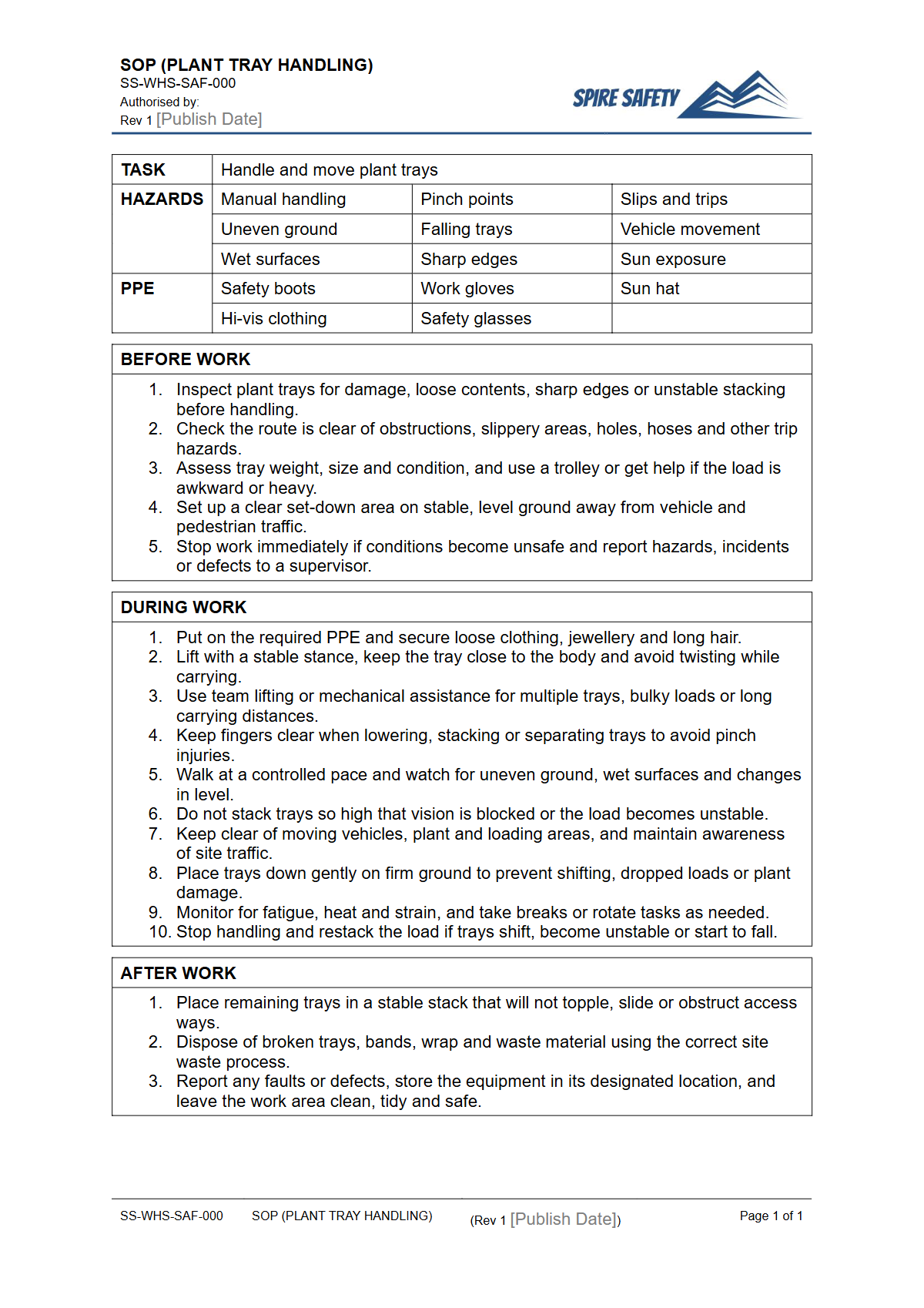
Our Free Safe Operating Procedure for Plant Tray Handling helps document controls for manual tasks. Download the customisable DOCX and PDF template today.
Free Safe Operating Procedure (Plant Tray Handling) Template
DOCX • 126 KB + PDF
Updated Oct 2026
No signup required
Purpose of the Free Safe Operating Procedure (Plant Tray Handling) Template
Handling plant trays, especially when repetitive or involving awkward postures, presents significant ergonomic risks. The primary purpose of this Safe Operating Procedure (SOP) is to outline the required control measures to manage hazards like manual handling strains, sprains, and back injuries.
It formalises a safe system of work, ensuring all workers understand the expected techniques for lifting, carrying, and placing trays, whether by hand or with mechanical aids. This helps create a consistent and safe work environment, minimising the likelihood of incidents.
For related agricultural tasks, you might also find our FREE Planter SOP useful for documenting similar processes.
Video walkthrough
How to use the Free Safe Operating Procedure (Plant Tray Handling) Template
To effectively implement this Safe Operating Procedure for Plant Tray Handling, you must adapt it to your specific operational context. Start by conducting a risk assessment of your plant tray handling tasks in consultation with your workers.
Use the findings to populate the template with details specific to your site, including the types of trays used, weights, travel distances, and any mechanical aids available (e.g., trolleys, benches). The result should be a practical document that forms a core part of your overall WHS management systems.
Important: Customise to Your Workplace
Note: We provide this template as a starting point. You must customise it to reflect the specific hazards, risks, and control measures relevant to your workplace.
Generic procedures are not sufficient for ensuring safety or meeting your legal obligations.
When to use it
An SOP for plant tray handling should be used as a key reference document in several situations. It is essential for inducting new employees and for providing specific task training to any worker required to handle trays.
It should also be readily available in the work area for quick reference. Furthermore, the SOP should be reviewed and updated whenever there is a change to the task, equipment, or environment, or following any near miss or incident.
Regular reviews are a key component of effective safety management and are often examined during a WHS compliance auditing process.
Who should use it
This procedure is intended for use by a range of personnel within an organisation. Persons Conducting a Business or Undertaking (PCBUs), managers, and supervisors are responsible for ensuring the SOP is developed, implemented, and enforced.
WHS and HR personnel will use it as part of their safety and training frameworks. Most importantly, workers who perform plant tray handling tasks must be trained in the procedure and follow it to ensure their own safety and the safety of others.
Documenting procedures for all equipment, such as with our Spreader SOP Template, helps build a comprehensive safety library.
In complex operations, plant trays may be part of a larger automated process. If your workflow involves mechanised movement, integrating this procedure with a Conveyer System SOP ensures seamless safety from one stage to the next.
This creates a holistic view of the process, identifying risks at handover points between manual and automated systems.
Developing thorough, site-specific safety documentation can be complex. If you require specialised assistance in developing or reviewing your safe systems of work, our general WHS consulting services can provide expert guidance tailored to your industry, ensuring your procedures are practical and aligned with best practice.
Common mistakes
Common mistakes to avoid
- Using the template without customising it with site-specific details, hazards, and controls.
- Failing to consult with workers who actually perform the task during the SOP's development.
- Not providing practical training on the finalised SOP for all relevant new and existing staff.
- Forgetting to review and update the SOP after an incident or when processes or equipment change.
Legal references
Legal considerations
The following legal requirements may be relevant to this type of work.
- Work Health and Safety Act (Harmonised) — Provides the primary duties for protecting workers and other people from work health and safety risks.
- Work Health and Safety Regulations (Harmonised) — Sets out requirements supporting the management of workplace hazards and risks.
The following codes may be relevant to this type of work.
- Managing WHS Risks Code of Practice — Provides practical guidance on identifying hazards, assessing risks and applying effective controls.
- Work Health and Safety Consultation, Cooperation and Coordination Code of Practice — Provides practical guidance on consulting workers and coordinating with other duty holders.
- Managing the Work Environment and Facilities Code of Practice — Provides practical guidance on safe work environments, workplace facilities and related controls.
Did you know
A Heavy Toll
According to Safe Work Australia, work-related musculoskeletal disorders account for a significant portion of all serious workers' compensation claims, with manual handling being a leading cause.
FAQ
Frequently asked questions
01What are the main hazards of handling plant trays?
02How do you write a good SOP for a manual handling task?
03Who is responsible for implementing this plant tray handling SOP?
04Is an SOP legally required for moving plant trays?
Share this resource
Free Safe Operating Procedure (Plant Tray Handling) Template
Browse Categories
How To Use It
- 1Download and open in Word or PDF.
- 2Replace the placeholders with your business details.
- 3Get it reviewed by a WHS specialist before rollout.
Need it customised?
Our WHS consultants can adapt this template to your site, run a gap analysis, or audit what you already have in place.
Book a Free Consultation WHS consulting servicesor call 1300 156 382
Related templates
- Free Safe Operating Procedure (Plate Clamp) Template
- Free Safe Operating Procedure (Plate Load Test) Template
- Free Safe Operating Procedure (Plate Rack Handling) Template
- Free Safe Operating Procedure (Plate Warmer) Template
- Free Safe Operating Procedure (Platform Trolley) Template
- Free Safe Operating Procedure (Playground Rake Over) Template