
Free Safe Operating Procedure (Plant Room Housekeeping) Template
Improve plant room safety and organisation with our free Safe Operating Procedure. This structured template helps you control common hazards. Download now.
Free Safe Operating Procedure (Plant Room Housekeeping) Template
DOCX • 126 KB + PDF
Updated Oct 2026
No signup required
Purpose of the Free Safe Operating Procedure (Plant Room Housekeeping) Template
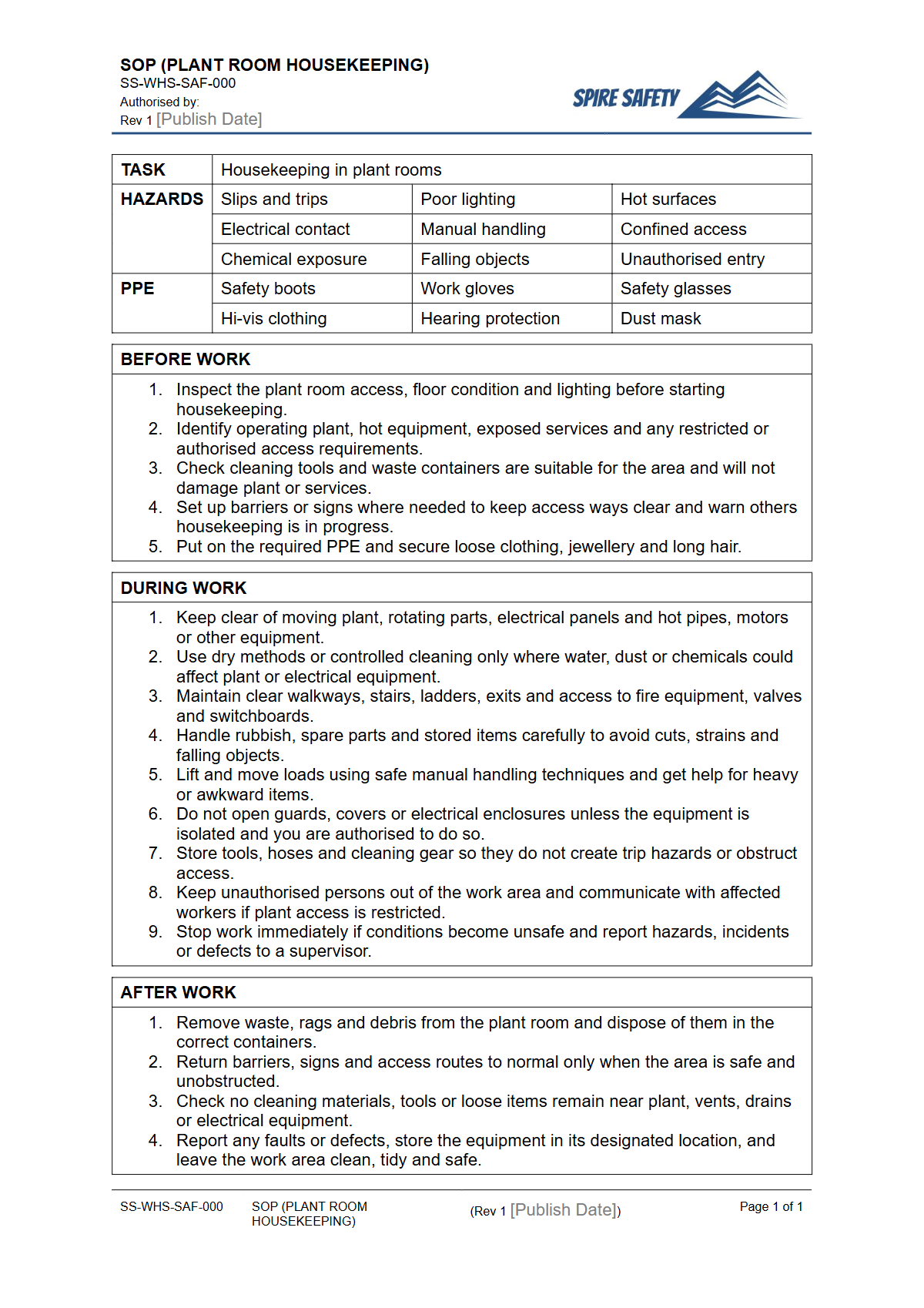
A plant room is often the heart of a building's operations, containing critical and potentially hazardous equipment. The primary purpose of this Safe Operating Procedure for Plant Room Housekeeping is to establish clear, repeatable steps to manage the work environment and minimise risks to personnel.
It directly addresses hazards such as slips from fluid leaks, trips over tools and debris, fire from accumulated combustible waste, and exposure to hazardous substances. A documented procedure ensures that all personnel, including staff and contractors, understand the standards for cleanliness and organisation required to work safely and maintain equipment effectively.
Formalising these steps helps embed a positive safety culture and provides a solid basis for training and supervision. Integrating this SOP into your overarching WHS management systems ensures a consistent and documented approach to safety across the organisation.
Video walkthrough
How to use the Free Safe Operating Procedure (Plant Room Housekeeping) Template
This downloadable document is a starting point, aligned with Australian WHS principles. IMPORTANT: We are not familiar with your unique circumstances, so you must customise this document to suit the specific hazards and operational requirements of your workplace. Before implementation, a person conducting a business or undertaking (PCBU) should facilitate a thorough risk assessment of the plant room.
You must consider the specific types of machinery, chemicals used, floor surfaces, access and egress routes, and waste generated. Edit the DOCX file to include site-specific details, assign responsibilities to named roles, and set realistic cleaning frequencies.
The finished SOP should be a practical tool used by your team, not just a document filed away. For complex environments, engaging professional support can ensure your safety documentation is robust and fit for purpose.
Expert WHS consulting can provide tailored advice for your specific operational needs.
When to use it
This SOP should be integrated into daily operations as a continuous process, not a one-off task. It is designed to guide routine housekeeping checks, which may be conducted daily or at the start and end of each shift.
It is also essential for guiding clean-up activities following maintenance, repairs, or equipment installation where debris and spills are common. The procedure should be referenced during toolbox talks and safety meetings to reinforce expectations and communicate standards clearly.
We recommend regular reviews of the SOP, typically annually or after any incident, to ensure it remains relevant and effective in controlling risks.
Who should use it
This procedure is intended for anyone who accesses or works in a plant room environment. Primary users include facilities managers, maintenance technicians, boiler operators, and other operational staff responsible for the day-to-day running of the plant.
It is also a critical induction document for contractors, who must be made aware of your site's safety procedures before commencing work. Supervisors should use the SOP to monitor compliance and conduct workplace inspections, while managers can use it as evidence of proactive risk management.
It should be used alongside specific equipment procedures, like our Free Air Compressor SOP, to create a comprehensive safety framework. In larger facilities, this housekeeping standard supports the safe operation of major assets covered by documents like a Conveyer System SOP.
Key Components of Effective Plant Room Housekeeping
- Floors and Walkways: Ensure all walkways, stairs, and access routes are kept clear of obstructions at all times. Tools, spare parts, and waste materials must not be left on the floor. Spills of oil, water, or other liquids must be cleaned up immediately using appropriate spill kits to prevent slip hazards.
- Equipment and Machinery: Keep the areas around machinery and control panels clear to allow for safe operation, inspection, and emergency access. The surfaces of equipment should be kept free of dust, oil, and grime, which can pose a fire risk or hide defects. This principle of maintaining clear operational zones is vital across a worksite, as detailed in other guides like our SOP for deep fryer operation.
- Waste Management: Establish designated, clearly labelled bins for different types of waste, such as general refuse, oily rags (in a fire-rated container), and recyclables. Waste should be removed regularly to prevent accumulation, which can increase fire load and attract pests. All procedures must align with environmental and safety regulations for waste disposal.
- Storage of Tools and Materials: Implement a clear storage system for tools, parts, and chemicals using designated shelving, cabinets, and tool boards. Flammable or hazardous substances must be stored in compliant safety cabinets, away from ignition sources. Proper labelling is essential for both safety and efficiency. To find more examples of structured safety documents, you can browse our complete free WHS resources library.
Common mistakes
Common mistakes to avoid
- Blocking access to fire extinguishers, electrical panels, or emergency exits with equipment or stored items.
- Leaving tools, hoses, or extension cords on the floor, creating serious trip hazards.
- Failing to clean up spills of oil, water, or other fluids immediately.
- Improperly storing flammable liquids or oily rags, significantly increasing fire risk.
Legal references
Legal considerations
The following legal requirements may be relevant to this type of work.
- Work Health and Safety Act (Harmonised) — Provides the primary duties for protecting workers and other people from work health and safety risks.
- Work Health and Safety Regulations (Harmonised) — Sets out requirements supporting the management of workplace hazards and risks.
The following codes may be relevant to this type of work.
- Managing WHS Risks Code of Practice — Provides practical guidance on identifying hazards, assessing risks and applying effective controls.
- Work Health and Safety Consultation, Cooperation and Coordination Code of Practice — Provides practical guidance on consulting workers and coordinating with other duty holders.
- Managing the Work Environment and Facilities Code of Practice — Provides practical guidance on safe work environments, workplace facilities and related controls.
Did you know
A Common Hazard
According to Safe Work Australia, slips, trips and falls are a leading cause of serious workplace injuries, and poor housekeeping is a major contributing factor.
Fire Risk
Accumulated dust, particularly from materials like wood or flour, can become highly combustible. Similarly, oily rags left in a pile can self-ignite, making proper waste management a critical fire prevention measure in plant rooms.
FAQ
Frequently asked questions
01What should a Plant Room Housekeeping SOP cover?
02How often should plant room housekeeping be performed?
03Is this template suitable for all types of plant rooms?
04Why is good housekeeping in a plant room so important for safety?
Share this resource
Free Safe Operating Procedure (Plant Room Housekeeping) Template
Browse Categories
How To Use It
- 1Download and open in Word or PDF.
- 2Replace the placeholders with your business details.
- 3Get it reviewed by a WHS specialist before rollout.
Need it customised?
Our WHS consultants can adapt this template to your site, run a gap analysis, or audit what you already have in place.
Book a Free Consultation WHS consulting servicesor call 1300 156 382
Related templates
- Free Safe Operating Procedure (Plant Stake Installation) Template
- Free Safe Operating Procedure (Plant Tie Installation) Template
- Free Safe Operating Procedure (Plant Tray Handling) Template
- Free Safe Operating Procedure (Plate Clamp) Template
- Free Safe Operating Procedure (Plate Load Test) Template
- Free Safe Operating Procedure (Plate Rack Handling) Template