
Free Safe Operating Procedure (Plant Stake Installation) Template
Download our free Safe Operating Procedure (Plant Stake Installation) Template. This customisable DOCX and PDF provides a clear framework for your safety systems.
Free Safe Operating Procedure (Plant Stake Installation) Template
DOCX • 126 KB + PDF
Updated Oct 2026
No signup required
Purpose of the Free Safe Operating Procedure (Plant Stake Installation) Template
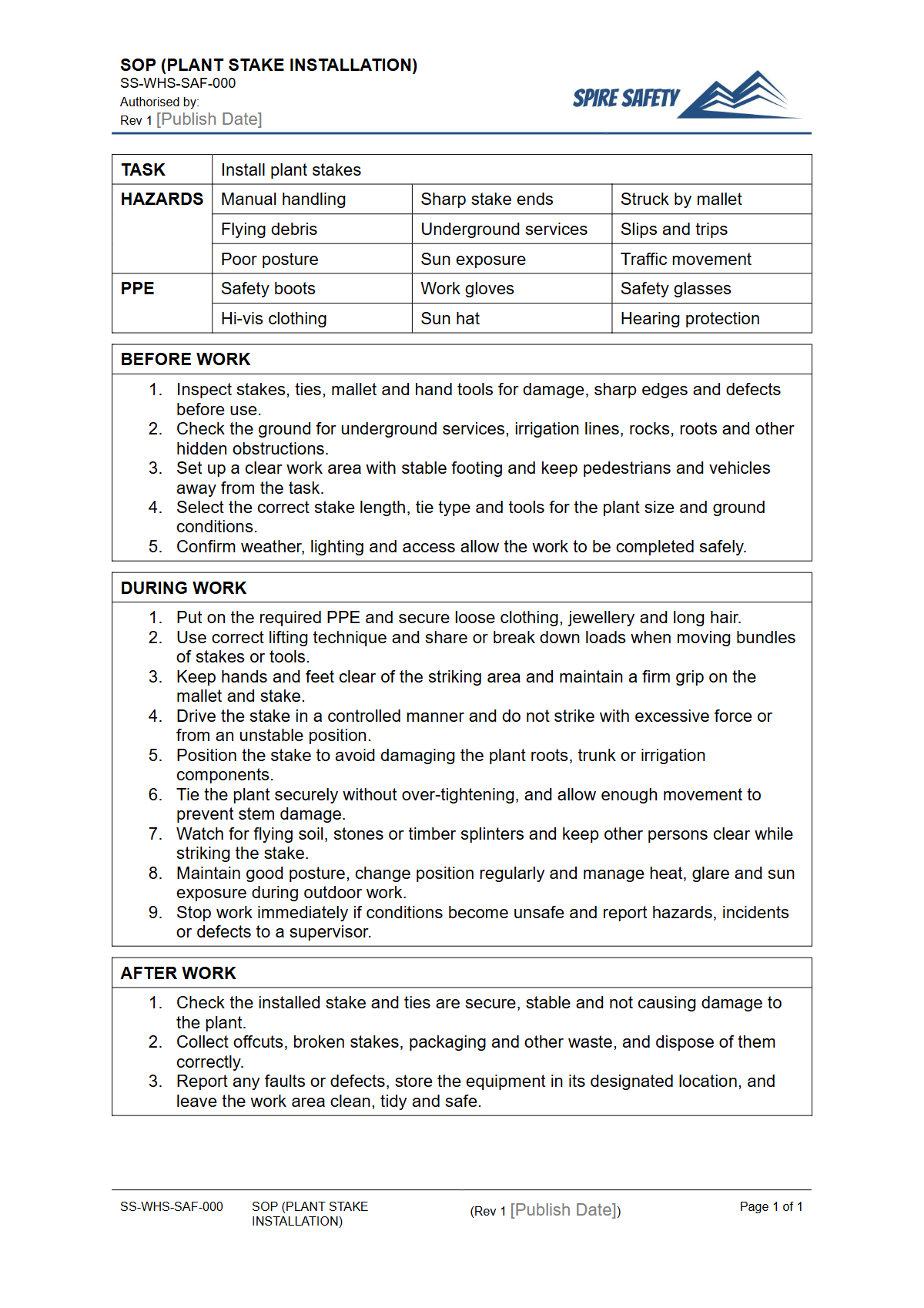
This free Safe Operating Procedure (Plant Stake Installation) Template provides a structured framework for businesses to document a safe system of work for installing stakes in gardens, nurseries, agricultural settings, and landscaping projects. The primary goal of this SOP is to manage risks and prevent injuries associated with what can seem like a simple task.
It helps your organisation systematically address hazards such as musculoskeletal disorders from repetitive hammering, eye injuries from flying debris, hand injuries from misplaced mallet strikes, and the significant danger of striking underground services like pipes and electrical cables.
By implementing a clear procedure, you provide workers with explicit instructions on the expected safe behaviour and control measures. This document serves as a critical component of your risk management process, aligned with Australian WHS best practices, helping you demonstrate a commitment to worker health and safety.
Video walkthrough
How to use the Free Safe Operating Procedure (Plant Stake Installation) Template
Our Safe Operating Procedure for plant stake installation is designed for immediate use after customisation. Download the template in your preferred format (DOCX for easy editing or PDF) and integrate it into your safety management documentation.
Before use, it is essential to conduct a site-specific risk assessment and modify the template to reflect the unique conditions of your workplace. This includes adding details about the specific tools used, soil conditions, types of stakes, and personnel involved.
Important: To ensure this document is effective, you must customise it to reflect the specific equipment, environment, and personnel at your worksite. We have provided a robust starting point, but site-specific risks and control measures must be added by a competent person.
An SOP is most effective when it is part of one of your comprehensive WHS management systems, linking training, supervision, and incident reporting together.
When to use it
A Safe Operating Procedure for plant stake installation should be a living document within your organisation. It is intended for use before any work commences to plan the task safely.
It serves as an essential training tool for new employees or for workers assigned to the task for the first time. It should also be referenced during toolbox talks or pre-start meetings to refresh safety awareness, particularly if site conditions change.
In the unfortunate event of a near miss or incident, the SOP provides a baseline against which to conduct an investigation and improve processes.
This document is particularly useful for tasks that often run alongside other agricultural or landscaping activities. For consistency, you may wish to use it in conjunction with documents like our free Planter SOP template to ensure all stages of the work are covered.
Who should use it
This SOP is intended for a range of personnel within an organisation. Persons Conducting a Business or Undertaking (PCBUs) can use it to fulfil their primary duty of care to provide a safe working environment.
Managers and supervisors should use the SOP to train workers, monitor adherence to safe work practices, and ensure controls are in place and effective. Most importantly, workers performing plant stake installation tasks must use the SOP to understand the required steps, potential hazards, and the control measures they need to follow to protect themselves and others.
Developing and reviewing the SOP should be a consultative process. Involving the workers who perform the task ensures the procedure is practical, accurate, and reflects the reality of the work being done.
This collaborative approach improves ownership and adherence to safety protocols. For more complex ground disturbance tasks, consider using a more specific procedure like our free Trencher SOP template.
Review and Continuous Improvement
Safety procedures are not static. This SOP should be reviewed regularly—at least annually—or more frequently if there are changes to the work process, new equipment is introduced, an incident occurs, or legislative changes demand it.
Regular reviews, which can be informed by findings from WHS compliance audits, ensure the document remains relevant and effective in controlling risks.
If you require assistance in tailoring this procedure or developing a more comprehensive safety framework, our expert WHS consulting services can provide tailored support for your business needs. You can also explore our wider free WHS resources library for other templates and guides to support your safety goals.
Common mistakes
Common mistakes to avoid
- Using damaged or inappropriate tools (e.g., using a rock instead of a proper mallet).
- Failing to check for underground services before starting any ground penetration.
- Not wearing appropriate Personal Protective Equipment (PPE), especially safety glasses and gloves.
- Adopting poor manual handling postures, leading to back, shoulder, or wrist strain.
Legal references
Legal considerations
The following legal requirements may be relevant to this type of work.
- Work Health and Safety Act (Harmonised) — Provides the primary duties for protecting workers and other people from work health and safety risks.
- Work Health and Safety Regulations (Harmonised) — Sets out requirements supporting the management of workplace hazards and risks.
The following codes may be relevant to this type of work.
- Managing WHS Risks Code of Practice — Provides practical guidance on identifying hazards, assessing risks and applying effective controls.
- Work Health and Safety Consultation, Cooperation and Coordination Code of Practice — Provides practical guidance on consulting workers and coordinating with other duty holders.
- Managing the Work Environment and Facilities Code of Practice — Provides practical guidance on safe work environments, workplace facilities and related controls.
Did you know
Hidden Dangers
A surprising number of workplace injuries in landscaping and horticulture are related to simple manual tasks like hammering stakes, often due to repetitive strain or flying debris.
Soil Matters
Soil condition significantly impacts the force required to install a stake. Hard, compacted, or rocky soil increases the risk of musculoskeletal injuries and tool-related incidents.
FAQ
Frequently asked questions
01What are the main hazards when installing plant stakes?
02Is a Safe Operating Procedure a legal requirement for installing plant stakes?
03How often should I review my plant stake installation SOP?
04Can I use this template for installing larger posts or fence lines?
Share this resource
Free Safe Operating Procedure (Plant Stake Installation) Template
Browse Categories
How To Use It
- 1Download and open in Word or PDF.
- 2Replace the placeholders with your business details.
- 3Get it reviewed by a WHS specialist before rollout.
Need it customised?
Our WHS consultants can adapt this template to your site, run a gap analysis, or audit what you already have in place.
Book a Free Consultation WHS consulting servicesor call 1300 156 382
Related templates
- Free Safe Operating Procedure (Plant Tie Installation) Template
- Free Safe Operating Procedure (Plant Tray Handling) Template
- Free Safe Operating Procedure (Plate Clamp) Template
- Free Safe Operating Procedure (Plate Load Test) Template
- Free Safe Operating Procedure (Plate Rack Handling) Template
- Free Safe Operating Procedure (Plate Warmer) Template