
Free Safe Operating Procedure (Plant Room Cleaning) Template
Download our free Plant Room Cleaning Safe Operating Procedure template to manage hazards in machinery spaces. Customise this DOCX or PDF resource today.
Free Safe Operating Procedure (Plant Room Cleaning) Template
DOCX • 126 KB + PDF
Updated Oct 2026
No signup required
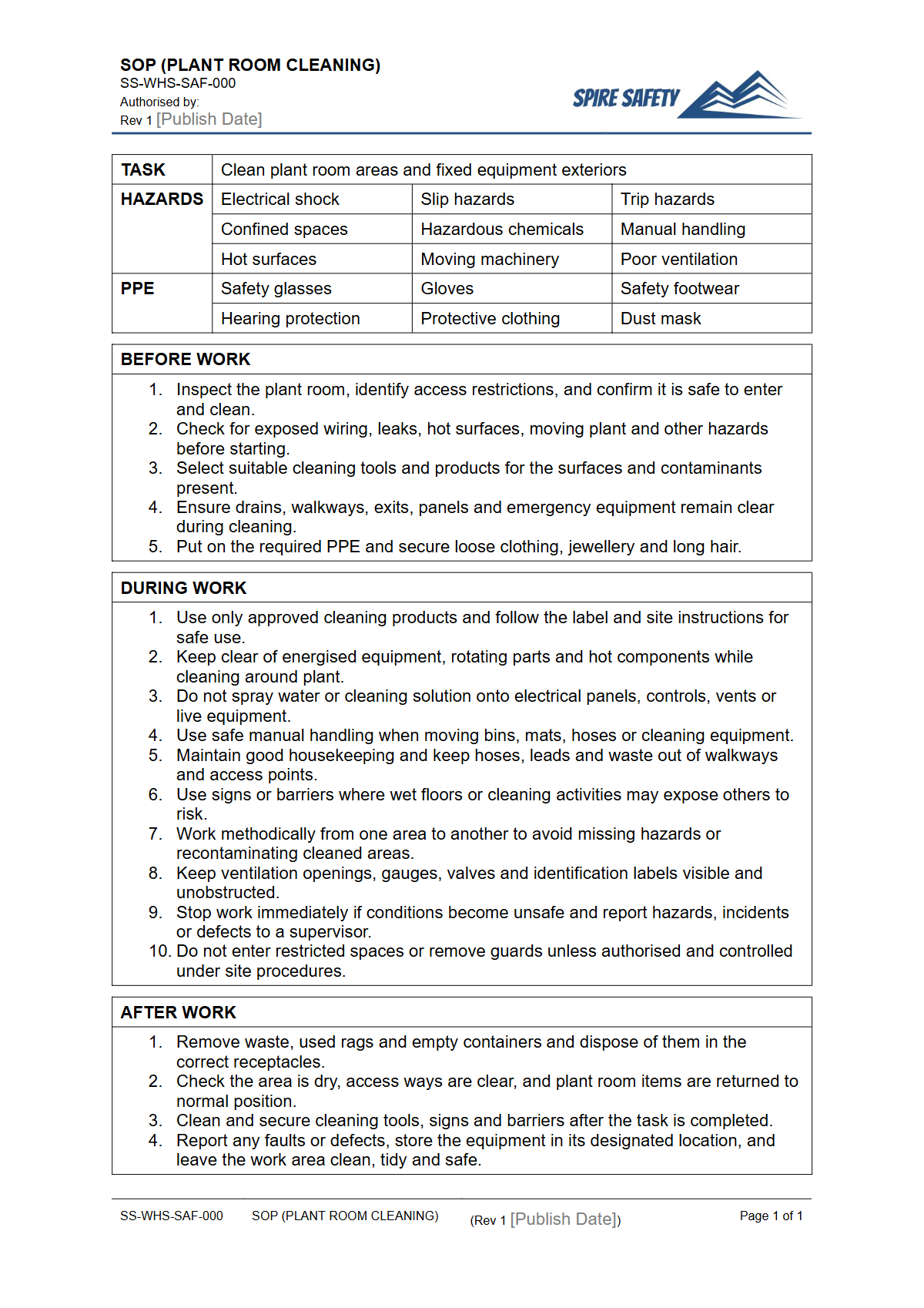
Purpose of the Free Safe Operating Procedure (Plant Room Cleaning) Template
Plant rooms are hubs of critical infrastructure, but they also contain numerous hazards, from electrical systems and moving machinery to chemical storage and potential slip-and-fall risks. This Free Safe Operating Procedure (Plant Room Cleaning) Template provides a structured starting point for organisations to document a safe and systematic process for cleaning these essential spaces.
Using a clear SOP helps control hazards, ensures consistency in cleaning standards, and demonstrates a commitment to proactive WHS management.
This document is designed to be integrated into your broader safety framework. A well-developed SOP is a cornerstone of effective WHS management systems, providing clear, actionable instructions that minimise risk for workers and contractors.
Video walkthrough
How to use the Free Safe Operating Procedure (Plant Room Cleaning) Template
This template is available as a fully editable DOCX file and a printable PDF. To use it effectively, follow these steps:
- Download the template in your preferred format.
- Conduct a thorough risk assessment of the specific plant room(s) where the cleaning will occur. Identify all machinery, energy sources, chemicals, and site-specific hazards.
- Customise the template with the details from your risk assessment. Add your company name and logo, and fill in the specific steps, required Personal Protective Equipment (PPE), lockout/tagout procedures, and emergency contacts relevant to your workplace.
- Train all relevant personnel on the contents of the final SOP. Ensure they understand every step and have demonstrated their competence.
- Schedule regular reviews of the SOP to ensure it remains current, especially after any incident or change in equipment or process.
Important: This document is a template, not a finished procedure. It is essential that you customise it to reflect the unique conditions and risks of your specific workplace.
We cannot guarantee that the unmodified template will be sufficient for your needs; its effectiveness depends on your diligent customisation and implementation.
When to use a Plant Room Cleaning Safe Operating Procedure
A Safe Operating Procedure for plant room cleaning should be consulted before and during every cleaning task, whether it is part of a routine maintenance schedule or an ad-hoc requirement. It serves as a pre-task checklist for supervisors to plan the work and for workers to prepare safely.
The SOP is also a vital training document for inducting new employees or contractors who may be unfamiliar with the specific hazards of your facility's plant room.
For example, if your plant room contains specific machinery, it's crucial to have clear instructions for its isolation, like those outlined in our Free Air Compressor SOP (Safe Operating Procedure) Template.
Who should use this Safe Operating Procedure
This SOP is intended for use by a range of personnel within an organisation, including:
- Facilities Managers and Supervisors: To plan, schedule, and oversee cleaning tasks safely.
- Maintenance Staff and Cleaners: As a step-by-step guide to perform their duties without endangering themselves or others.
- WHS Officers and Managers: To standardise procedures, assist in risk assessments, and ensure documentation aligns with Australian WHS practice.
- Contractors: As part of their site induction to ensure they adhere to your specific safety requirements.
Ensuring these procedures are correctly developed and implemented can be complex. If you need expert guidance on tailoring safety documents to your operations, our WHS consulting team can provide tailored support.
Key Hazards in Plant Room Cleaning
When customising this template, pay close attention to common plant room hazards, including:
- Electrical Hazards: Contact with live wires, unsecured panels, or water ingress into electrical equipment. Lockout/Tagout (LOTO) procedures are critical.
- Chemical Hazards: Improper use or storage of cleaning chemicals, requiring reference to Safety Data Sheets (SDS) and correct PPE.
- Slips, Trips, and Falls: Wet floors, oil leaks, poor lighting, or clutter can lead to serious injuries.
- Mechanical Hazards: Unintended startup of machinery with moving parts, such as pumps, fans, or motors.
- Confined Spaces: Some plant rooms or associated areas may be classified as confined spaces, requiring specific entry permits and procedures.
The complexity of equipment in a plant room varies. Some facilities may have integrated systems that require their own specific procedures, such as the safe isolation of equipment detailed in our FREE Conveyer System SOP (Safe Operating Procedure) Template.
Review and Continuous Improvement
An SOP is a living document. It should be reviewed regularly—at least annually—and updated after any incident, near miss, or change in equipment, chemicals, or work practices.
Regular reviews ensure the procedure remains effective and reflects the current state of the workplace. This continuous improvement cycle is a key part of maintaining a safe work environment and can be verified through a systematic WHS compliance auditing process. You can explore many other templates to support your safety system in our free WHS resources library.
Common mistakes
Common mistakes to avoid
- Failing to conduct a site-specific risk assessment before using the template.
- Using generic cleaning chemicals without checking Safety Data Sheets (SDS) for compatibility and hazards.
- Neglecting lockout/tagout procedures for equipment before cleaning, creating electrical or mechanical risks.
- Inadequate training for staff on the specific procedures outlined in the final, customised SOP.
Legal references
Legal considerations
The following legal requirements may be relevant to this type of work.
- Work Health and Safety Act (Harmonised) — Provides the primary duties for protecting workers and other people from work health and safety risks.
- Work Health and Safety Regulations (Harmonised) — Sets out requirements supporting the management of workplace hazards and risks.
The following codes may be relevant to this type of work.
- Managing WHS Risks Code of Practice — Provides practical guidance on identifying hazards, assessing risks and applying effective controls.
- Work Health and Safety Consultation, Cooperation and Coordination Code of Practice — Provides practical guidance on consulting workers and coordinating with other duty holders.
- Managing the Work Environment and Facilities Code of Practice — Provides practical guidance on safe work environments, workplace facilities and related controls.
Did you know
Slips, Trips, and Falls
Slips, trips, and falls are a leading cause of workplace injuries in Australia, with wet or contaminated floors in areas like plant rooms being a major contributing factor.
Lockout/Tagout (LOTO)
Failing to de-energise and lock out equipment is a primary cause of serious injuries during maintenance and cleaning tasks. A robust LOTO procedure is non-negotiable for plant room safety.
FAQ
Frequently asked questions
01What should be included in an SOP for plant room cleaning?
02Is this template suitable for all types of plant rooms?
03How often should a Plant Room Cleaning SOP be reviewed?
04Who is responsible for enforcing the SOP?
Share this resource
Free Safe Operating Procedure (Plant Room Cleaning) Template
Browse Categories
How To Use It
- 1Download and open in Word or PDF.
- 2Replace the placeholders with your business details.
- 3Get it reviewed by a WHS specialist before rollout.
Need it customised?
Our WHS consultants can adapt this template to your site, run a gap analysis, or audit what you already have in place.
Book a Free Consultation WHS consulting servicesor call 1300 156 382
Related templates
- Free Safe Operating Procedure (Plant Room Housekeeping) Template
- Free Safe Operating Procedure (Plant Stake Installation) Template
- Free Safe Operating Procedure (Plant Tie Installation) Template
- Free Safe Operating Procedure (Plant Tray Handling) Template
- Free Safe Operating Procedure (Plate Clamp) Template
- Free Safe Operating Procedure (Plate Load Test) Template