
Free Safe Operating Procedure (Plant Repotting) Template
Manage horticultural hazards with our free Safe Operating Procedure for plant repotting. Download the fully customisable template to get started.
Free Safe Operating Procedure (Plant Repotting) Template
DOCX • 126 KB + PDF
Updated Oct 2026
No signup required
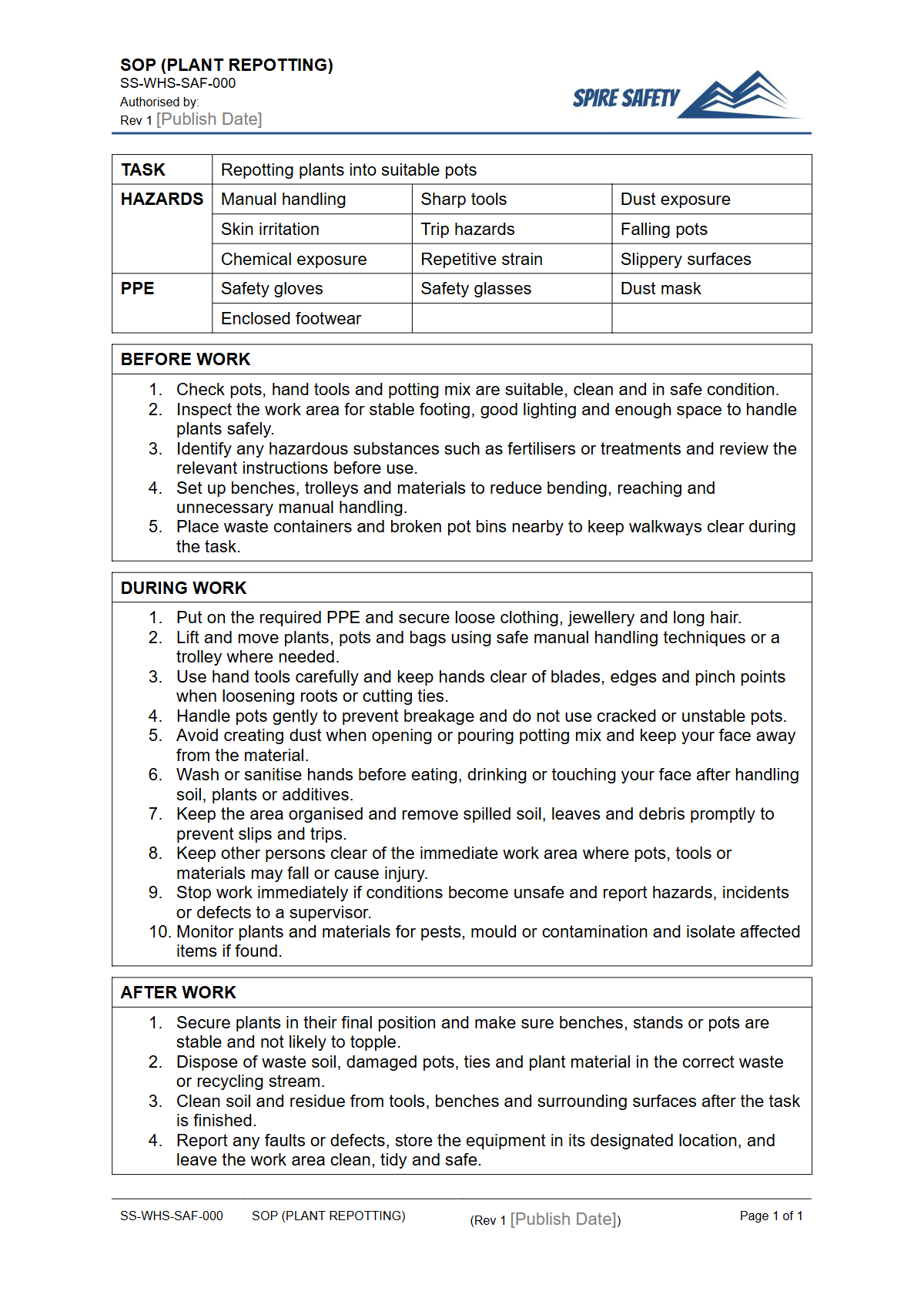
Purpose of the Free Safe Operating Procedure (Plant Repotting) Template
This free Safe Operating Procedure (Plant Repotting) Template provides a structured starting point for businesses to formalise their processes for repotting plants in commercial settings like nurseries, landscaping operations, and interior plantscaping services. While repotting may seem like a low-risk task, it involves several hazards that must be controlled to ensure worker safety.
These include manual handling risks from lifting heavy pots and bags of soil, ergonomic strains from repetitive or awkward postures, cuts and lacerations from tools, and biological hazards associated with potting mixes.
Implementing a formal SOP helps a Person Conducting a Business or Undertaking (PCBU) meet their primary duty of care under WHS law. It serves as a clear, step-by-step guide that outlines the safest way to perform the task, specifies required personal protective equipment (PPE), and details emergency procedures.
Using this template helps integrate specific safety controls into your broader WHS management systems, promoting a consistent and proactive approach to safety.
Video walkthrough
How to use the Free Safe Operating Procedure (Plant Repotting) Template
This document is a template, not a finished procedure. To use it effectively, you must adapt it to the unique circumstances of your workplace. Download the DOCX or PDF file and follow these steps:
- Consult: Engage in meaningful consultation with your workers who perform plant repotting tasks. Their firsthand experience is invaluable for identifying practical risks and effective controls.
- Customise: Modify the template to include details specific to your site. This includes the types of plants and pots handled, the specific tools used (e.g., trowels, secateurs), the brand of potting mix, and the layout of the work area.
- Review: Have a competent person review the customised SOP to ensure it aligns with current WHS legislation and codes of practice.
- Train: Use the finalised SOP as a training tool for all relevant workers, including new starters and as a refresher for existing staff during toolbox talks. Ensure everyone understands the steps and the reasoning behind them.
Note: This document has been developed as a general guide. We have not prepared it with your specific business needs in mind.
You must customise the template to reflect the actual risks and control measures in your workplace. For complex operations, consider engaging specialist WHS consulting to ensure your procedures are robust and effective.
When to use a Safe Operating Procedure
An SOP for plant repotting should be an active part of your daily operations. It is not a document to be filed away and forgotten. It should be used:
- During the induction and training of new employees.
- As a basis for pre-start meetings or toolbox talks before commencing repotting jobs.
- As a reference guide for workers to consult at any time.
- When conducting risk assessments or incident investigations related to horticultural tasks.
- As a performance standard when observing work practices or conducting safety audits.
By integrating the SOP into these regular activities, you embed safety into your organisational culture. For other common agricultural tasks, you may also need our free Planter SOP to ensure consistent safety standards.
Who should use it
This Safe Operating Procedure is designed for any person involved in commercial plant repotting activities. This includes:
- Workers: Nursery hands, horticulturalists, landscape gardeners, and interior plantscape technicians who perform the task.
- Supervisors and Team Leaders: To induct new workers, monitor compliance, and lead toolbox talks.
- Managers and PCBUs: To ensure a safe system of work is in place and to demonstrate compliance with WHS duties.
In environments where workers handle different types of materials and equipment, it's crucial to have procedures for each. For instance, teams that also manage soil amendments might require a free Spreader SOP to manage associated machinery risks.
You can find more targeted safety documents in our free WHS resources library to build out your safety documentation.
Common mistakes
Common mistakes to avoid
- Using the template without customising it for specific workplace tools, pots, and environments.
- Failing to consult with workers who perform the repotting task when drafting the procedure.
- Treating the SOP as a document for compliance only, rather than an active tool for training and daily work.
- Not providing or enforcing the use of required PPE, such as gloves and masks, specified in the SOP.
Legal references
Legal considerations
The following legal requirements may be relevant to this type of work.
- Work Health and Safety Act (Harmonised) — Provides the primary duties for protecting workers and other people from work health and safety risks.
- Work Health and Safety Regulations (Harmonised) — Sets out requirements supporting the management of workplace hazards and risks.
The following codes may be relevant to this type of work.
- Managing WHS Risks Code of Practice — Provides practical guidance on identifying hazards, assessing risks and applying effective controls.
- Work Health and Safety Consultation, Cooperation and Coordination Code of Practice — Provides practical guidance on consulting workers and coordinating with other duty holders.
- Managing the Work Environment and Facilities Code of Practice — Provides practical guidance on safe work environments, workplace facilities and related controls.
Did you know
Potting Mix Dangers
Some commercial potting mixes can contain Legionella longbeachae bacteria, which can cause Legionnaires' disease if inhaled. Wetting the mix before use and wearing a P2 mask are common controls.
Manual Handling Strain
Lifting a single 25kg bag of potting mix incorrectly can be enough to cause a serious and lasting back injury. Australian WHS laws place a strong emphasis on controlling risks from hazardous manual tasks.
FAQ
Frequently asked questions
01What hazards are involved in plant repotting?
02Is a Safe Operating Procedure legally required for plant repotting in Australia?
03How often should a plant repotting SOP be reviewed?
04Can I use this template for other gardening tasks?
Share this resource
Free Safe Operating Procedure (Plant Repotting) Template
Browse Categories
How To Use It
- 1Download and open in Word or PDF.
- 2Replace the placeholders with your business details.
- 3Get it reviewed by a WHS specialist before rollout.
Need it customised?
Our WHS consultants can adapt this template to your site, run a gap analysis, or audit what you already have in place.
Book a Free Consultation WHS consulting servicesor call 1300 156 382
Related templates
- Free Safe Operating Procedure (Plant Room Cleaning) Template
- Free Safe Operating Procedure (Plant Room Housekeeping) Template
- Free Safe Operating Procedure (Plant Stake Installation) Template
- Free Safe Operating Procedure (Plant Tie Installation) Template
- Free Safe Operating Procedure (Plant Tray Handling) Template
- Free Safe Operating Procedure (Plate Clamp) Template