
Free Safe Operating Procedure (Plant Labelling) Template
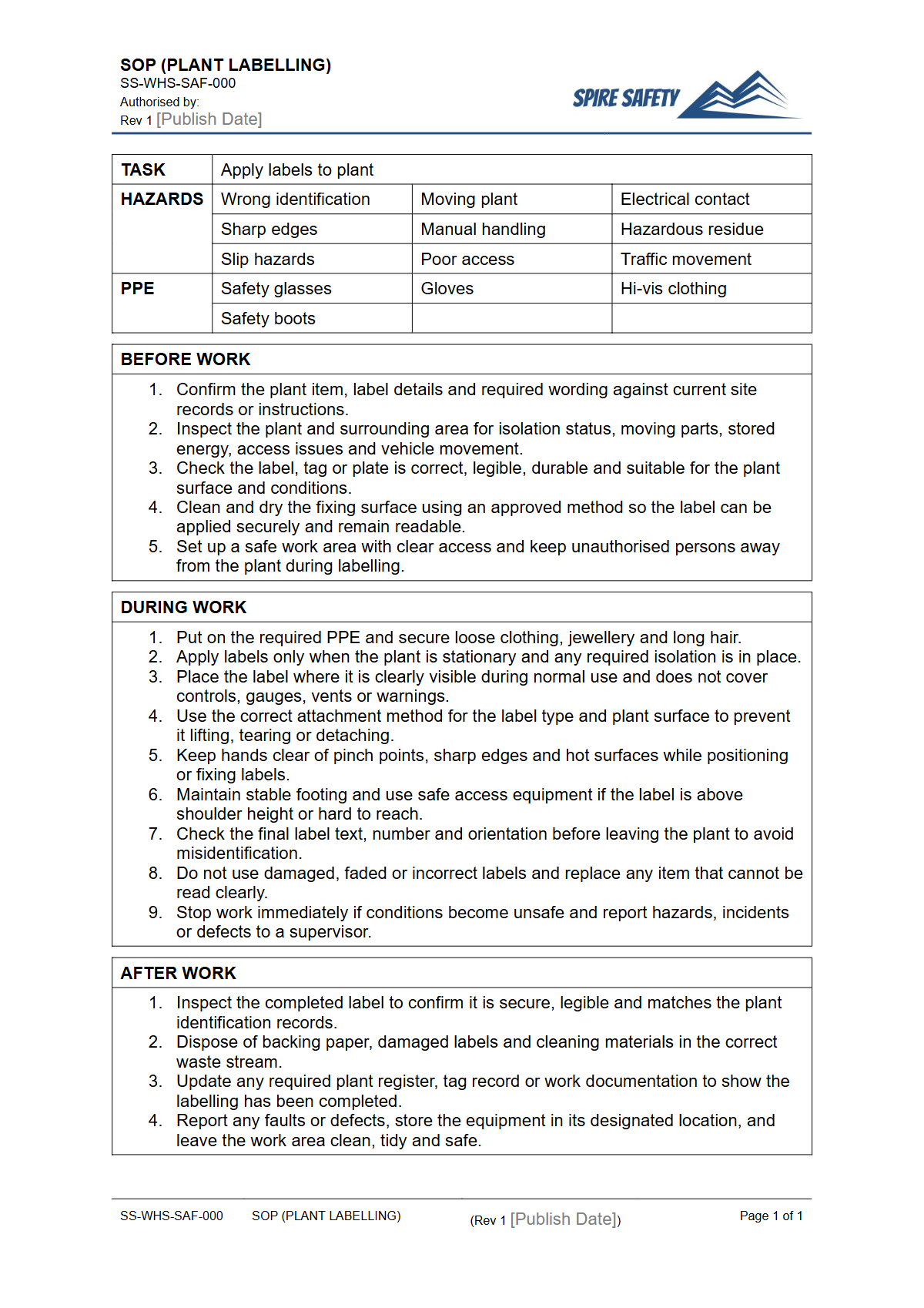
Download our free Safe Operating Procedure for Plant Labelling template. This customisable DOCX and PDF provides a clear framework for your safety systems.
Free Safe Operating Procedure (Plant Labelling) Template
DOCX • 126 KB + PDF
Updated Oct 2026
No signup required
Purpose of the Free Safe Operating Procedure (Plant Labelling) Template
A clear and consistent approach to plant labelling is essential for managing workplace hazards, communicating critical safety information, and ensuring operational efficiency. This free Safe Operating Procedure (Plant Labelling) Template provides a structured starting point for your organisation to develop a robust system for identifying and marking machinery, equipment, and their controls.
The primary purpose is to standardise procedures to prevent injuries, by clearly indicating operational instructions, hazards, required personal protective equipment (PPE), and emergency stop locations.
An effective SOP is a cornerstone of comprehensive WHS management systems, providing workers with clear, step-by-step instructions that reduce ambiguity and risk. Using this template helps demonstrate due diligence in managing risks associated with plant.
It formalises the process for labelling, ensuring that all information is accurate, visible, and understood by all personnel, thereby supporting training and competency requirements.
While this document provides a framework for general plant labelling protocols, specific types of machinery often require their own detailed procedures to address unique hazards. It should be used alongside equipment-specific documents, such as a circular saw SOP, to create a complete safety picture for your operators.
Video walkthrough
How to use the Free Safe Operating Procedure (Plant Labelling) Template
This resource is available as a fully editable DOCX file, allowing for extensive customisation, and a PDF for easy printing and distribution. To create a procedure that is effective and integrated into your daily operations, it must be adapted to your specific context.
We are not WHS lawyers, and this template does not constitute legal advice; it must be customised to reflect the specific plant, processes, and risks present in your workplace.
Customisation Steps:
- Consult: Engage with workers, supervisors, health and safety representatives (HSRs), and other relevant stakeholders. Their direct experience is invaluable for identifying practical labelling needs and potential issues.
- Identify: Conduct a thorough inventory of all plant and equipment on site that requires labelling. This includes machinery, power tools, pressure vessels, and control panels.
- Assess Risks: For each item of plant, perform a risk assessment to determine what information is critical to communicate via labels. Consider energy sources, pinch points, chemical hazards, and emergency procedures.
- Detail the Procedure: Use the template to document your organisation's standards. Specify the types of labels to be used (e.g., tags, decals, plates), colour-coding systems (aligned with AS 1319), and precise locations for placement to ensure high visibility.
- Review and Approve: Once drafted, the SOP should be reviewed by a competent person and formally approved by management before being implemented.
Your plant labelling SOP should work in harmony with other procedural documents. For instance, it can reference the instructions within our Free Air Compressor SOP to ensure consistency in how safety information is presented across different asset types.
Regularly reviewing the effectiveness of your labelling system is a key part of the 'check' phase in the Plan-Do-Check-Act cycle. This can be formally assessed during a WHS compliance auditing process to verify its implementation and efficacy.
When to use it
A Safe Operating Procedure for plant labelling should be a living document, implemented and reviewed as part of your organisation's ongoing safety management. It is not a one-time, 'set and forget' task. The SOP should be actively used, referenced, and updated in several key situations:
- When new plant or equipment is introduced to the workplace.
- After any modification is made to existing plant, which might change its operation or associated risks.
- Following a workplace incident, near miss, or hazard report involving plant.
- As part of a scheduled periodic review (e.g., annually) to ensure it remains current and effective.
- When new information about a plant-related hazard becomes available from manufacturers or safety authorities.
- During employee inductions and task-specific training sessions.
When introducing complex new equipment, the labelling process is a critical step in the commissioning phase. This SOP can be used alongside other key documents, like a Safe Operating Procedure for telehandler use, to ensure all safety aspects are covered before operation commences.
Who should use it
Responsibility for safety is shared across an organisation. While a specific person may be tasked with drafting the SOP, its successful implementation relies on several roles:
- PCBU (Person Conducting a Business or Undertaking): Holds the primary duty of care and is ultimately responsible for ensuring a safe system for plant labelling is developed, implemented, and maintained.
- Managers and Supervisors: Responsible for enforcing the procedure on the ground, ensuring workers are trained on the labelling system, and monitoring compliance during day-to-day operations.
- Workers and Operators: Must follow the procedures detailed in the SOP, use labels to inform their safe use of plant, and report any damaged, missing, or unclear labels to their supervisor immediately.
- WHS Advisors/Officers: Often lead the development and review of the SOP in consultation with other parties, provide guidance, and assist with training and monitoring.
Developing and implementing a robust suite of SOPs can be complex. Some organisations find value in engaging specialist WHS consulting services to ensure their documentation and processes align with best practice and legislative requirements.
This template is one of many documents available in our free WHS resources library, designed to help you build out your safety management system with structured, practical tools.
Common mistakes
Common mistakes to avoid
- Using inconsistent or unclear labelling conventions across different areas of the worksite.
- Failing to update or replace labels after plant has been modified, repaired, or cleaned.
- Not providing adequate training to ensure all workers understand the meaning of the labels, symbols, and colour codes used.
- Relying solely on labels as the primary risk control instead of implementing higher-order controls.
Legal references
Legal considerations
The following legal requirements may be relevant to this type of work.
- Work Health and Safety Act (Harmonised) — Provides the primary duties for protecting workers and other people from work health and safety risks.
- Work Health and Safety Regulations (Harmonised) — Sets out requirements supporting the management of workplace hazards and risks.
The following codes may be relevant to this type of work.
- Managing WHS Risks Code of Practice — Provides practical guidance on identifying hazards, assessing risks and applying effective controls.
- Work Health and Safety Consultation, Cooperation and Coordination Code of Practice — Provides practical guidance on consulting workers and coordinating with other duty holders.
- Managing the Work Environment and Facilities Code of Practice — Provides practical guidance on safe work environments, workplace facilities and related controls.
Did you know
Definition of Plant
Under model WHS laws, 'plant' is a broad term covering machinery, equipment, appliances, containers, implements, and tools, and any of their components or accessories.
Hierarchy of Controls
Effective labelling is an administrative control. While crucial, it sits lower on the hierarchy of controls and should be used to supplement higher-level controls like elimination, substitution, or engineering solutions.
FAQ
Frequently asked questions
01What is 'plant' in the context of Australian WHS laws?
02Why can't I just use a generic plant labelling SOP without customisation?
03Does a Plant Labelling SOP replace a risk assessment?
04How often should a Plant Labelling SOP be reviewed?
Share this resource
Free Safe Operating Procedure (Plant Labelling) Template
Browse Categories
How To Use It
- 1Download and open in Word or PDF.
- 2Replace the placeholders with your business details.
- 3Get it reviewed by a WHS specialist before rollout.
Need it customised?
Our WHS consultants can adapt this template to your site, run a gap analysis, or audit what you already have in place.
Book a Free Consultation WHS consulting servicesor call 1300 156 382
Related templates
- Free Safe Operating Procedure (Plant Propagation) Template
- Free Safe Operating Procedure (Plant Repotting) Template
- Free Safe Operating Procedure (Plant Room Cleaning) Template
- Free Safe Operating Procedure (Plant Room Housekeeping) Template
- Free Safe Operating Procedure (Plant Stake Installation) Template
- Free Safe Operating Procedure (Plant Tie Installation) Template