
Free Safe Operating Procedure (Pizza Cutter) Template
Download a free Safe Operating Procedure for pizza cutters. Our template (DOCX & PDF) is for Aussie workplaces, helping you manage risks. Start your SOP now.
Free Safe Operating Procedure (Pizza Cutter) Template
DOCX • 126 KB + PDF
Updated Oct 2026
No signup required
Purpose of the Free Safe Operating Procedure (Pizza Cutter) Template
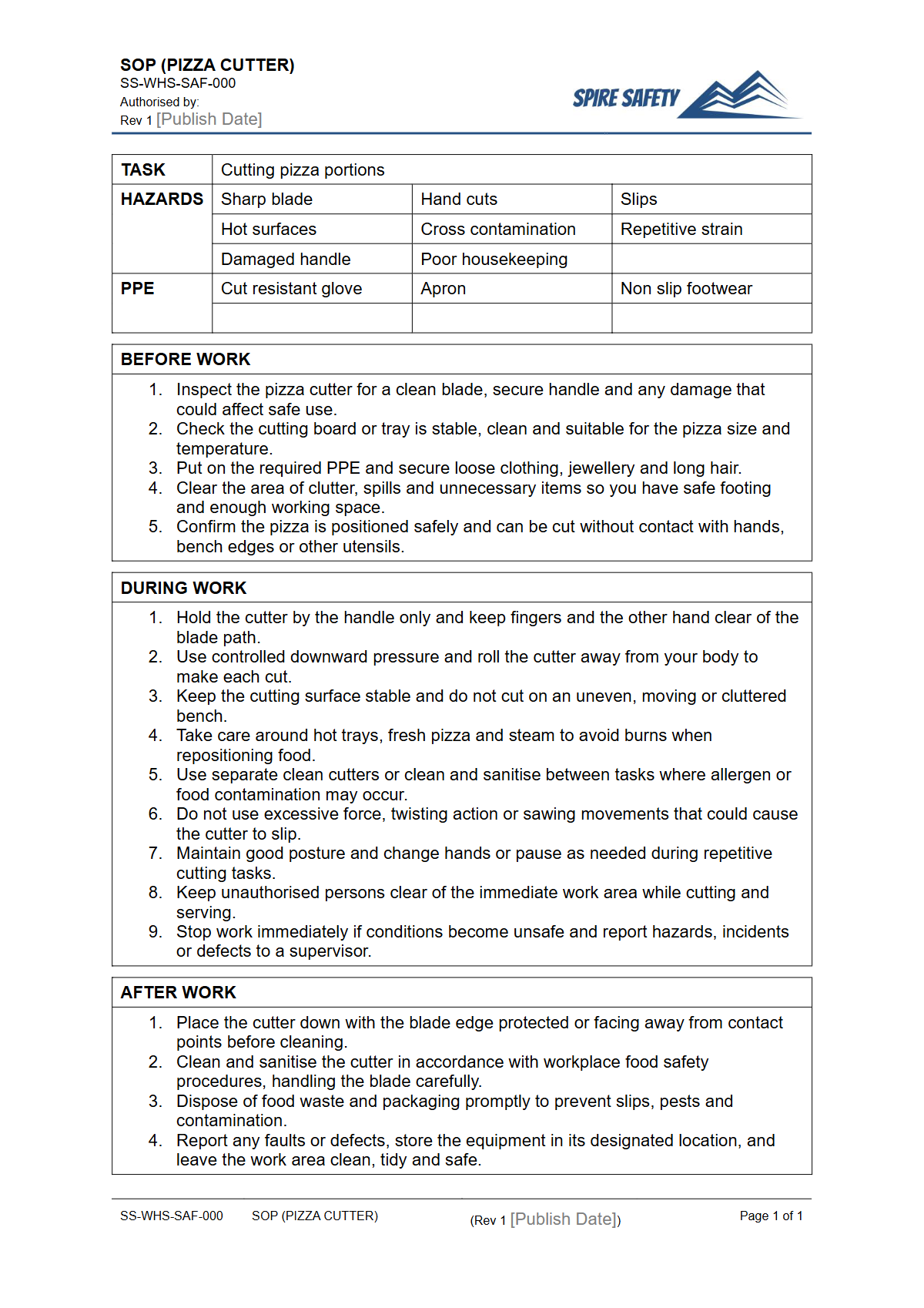
The primary purpose of this Safe Operating Procedure is to provide a clear, step-by-step guide for using a pizza cutter safely and effectively in a professional kitchen environment. It formalises expectations around pre-use checks, correct handling techniques, cleaning, and storage.
Documenting these steps helps prevent injuries, reduces the likelihood of food contamination, and provides a consistent training tool for new and existing employees. A well-implemented SOP is a fundamental component of proactive risk management, forming part of your broader WHS management systems. It transforms assumed knowledge into a reliable, documented process that everyone can follow.
Video walkthrough
How to use the Free Safe Operating Procedure (Pizza Cutter) Template
Simply download the template in your preferred format (DOCX for easy editing or PDF). The document is structured with sections for you to complete, including required personal protective equipment (PPE), potential hazards, risk controls, and a sequential guide to the task.
Fill in the details relevant to your workplace.
Important: Customise This Template
This document is a template and not a complete, ready-to-use procedure. It is essential that you customise this SOP to reflect the specific context of your workplace.
We have provided a framework, but you must adapt it to account for the exact type of pizza cutter you use (wheel, mezzaluna), your kitchen layout, existing workflows, and the specific risks identified in your own risk assessment. Creating tailored procedures for all equipment, from simple hand tools to larger items covered in our free Step Ladder SOP template, is crucial for effective safety management.
Key Hazards Associated With Pizza Cutters
While a simple tool, pizza cutters present several key hazards that must be managed:
- Cuts and Lacerations: The most obvious risk comes from contact with the sharp blade, either during use, cleaning, or when retrieving it from storage. Dull blades can exacerbate this risk by requiring more force, leading to slips.
- Ergonomic Strain: Repetitive cutting motions, especially in high-volume settings, can lead to musculoskeletal disorders (MSDs) affecting the hand, wrist, and arm. Poorly designed handles can contribute to this risk.
- Hygiene and Contamination: If not cleaned and sanitised properly, pizza cutters can harbour bacteria and become a source of cross-contamination between different food items.
- Slips and Falls: While an indirect hazard, liquid or food debris falling onto the floor during the cutting process can create slip hazards for the operator and other staff in the area.
For more complex cutting tools found in other industries, such as those covered in our FREE Circular Saw SOP Template, the range of hazards is much broader, highlighting the importance of task-specific analysis.
Implementing Effective Controls
To manage the identified hazards, your SOP should detail specific control measures. These form the core of the safe work practice. Key controls include:
- Equipment Selection and Maintenance: Use high-quality, professional-grade cutters with ergonomic handles and blade guards where available. Implement a schedule for checking blade sharpness and overall condition, replacing dull or damaged cutters immediately.
- Safe Work Practices: Detail the correct cutting technique, such as using a stable, non-slip cutting board and keeping the guiding hand clear of the blade's path. Specify proper cleaning and sanitising procedures according to food safety standards.
- Personal Protective Equipment (PPE): Based on your risk assessment, you may specify the use of cut-resistant gloves, particularly during cleaning or for high-intensity tasks.
- Training and Supervision: All staff must be trained on the contents of the SOP before using the equipment. Supervisors should monitor work practices to ensure the procedure is being followed correctly.
If you need assistance in developing robust control measures or conducting the initial risk assessment, engaging with professional WHS consulting services can provide expert, industry-specific guidance.
When to Use This Safe Operating Procedure
An SOP for a pizza cutter should be used as a primary training document for any new employee tasked with cutting pizzas. It should also be readily available in the work area for easy reference. The procedure should be formally reviewed:
- During annual or biennial safety reviews.
- After any incident or near-miss involving a pizza cutter.
- When a new type or model of pizza cutter is introduced.
- If there are changes to the workflow or kitchen layout.
It also serves as a key piece of evidence during safety assessments, demonstrating that a formal process is in place. Regular reviews can be integrated into your WHS compliance auditing schedule to ensure it remains current and effective.
Who Should Use This Safe Operating Procedure
This SOP is relevant to several roles within a food service business.
- Managers and Supervisors: They are responsible for customising, implementing, and enforcing the procedure, as well as ensuring all relevant staff are trained.
- Kitchen Staff (Chefs, Cooks, Kitchen Hands): These are the primary end-users. They must understand and follow the procedure during their daily work to ensure their own safety and that of their colleagues.
- WHS Representatives/Officers: They can use this template as part of a wider program to standardise safe work practices across all tasks and equipment in the workplace.
Developing a consistent approach to SOPs across the business ensures clarity and improves overall safety culture. You can find templates for a wide range of tasks and equipment in our free WHS resources library to support this process.
Common mistakes
Common mistakes to avoid
- Using the downloaded template without customising it for the specific cutter models and kitchen environment.
- Failing to adequately train all relevant staff on the SOP, treating it as a paperwork-only exercise.
- Neglecting equipment maintenance, especially allowing blades to become dull, which requires more force and increases slip and injury risk.
- Storing pizza cutters improperly, such as loose in a drawer, which creates a significant risk of accidental cuts.
Legal references
Legal considerations
The following legal requirements may be relevant to this type of work.
- Work Health and Safety Act (Harmonised) — Provides the primary duties for protecting workers and other people from work health and safety risks.
- Work Health and Safety Regulations (Harmonised) — Sets out requirements supporting the management of workplace hazards and risks.
The following codes may be relevant to this type of work.
- Managing WHS Risks Code of Practice — Provides practical guidance on identifying hazards, assessing risks and applying effective controls.
- Work Health and Safety Consultation, Cooperation and Coordination Code of Practice — Provides practical guidance on consulting workers and coordinating with other duty holders.
- Managing the Work Environment and Facilities Code of Practice — Provides practical guidance on safe work environments, workplace facilities and related controls.
Did you know
Unexpected Origins
The rolling pizza cutter was invented in 1892 by David S. Morgan. Its original patented purpose was not for food, but as a wallpaper cutter.
A Common Injury
Lacerations to the hands and fingers are among the most frequent injuries in the hospitality industry. A formal SOP is a simple but effective control measure to help prevent these common incidents.
FAQ
Frequently asked questions
01What should be included in a pizza cutter SOP?
02Is an SOP legally required for a pizza cutter in Australia?
03How often should we review this Safe Operating Procedure?
04Can I use this template for other kitchen knives?
Share this resource
Free Safe Operating Procedure (Pizza Cutter) Template
Browse Categories
How To Use It
- 1Download and open in Word or PDF.
- 2Replace the placeholders with your business details.
- 3Get it reviewed by a WHS specialist before rollout.
Need it customised?
Our WHS consultants can adapt this template to your site, run a gap analysis, or audit what you already have in place.
Book a Free Consultation WHS consulting servicesor call 1300 156 382
Related templates
- Free Safe Operating Procedure (Pizza Paddle Use) Template
- Free Safe Operating Procedure (Plant Division) Template
- Free Safe Operating Procedure (Plant Hardening) Template
- Free Safe Operating Procedure (Plant Labelling) Template
- Free Safe Operating Procedure (Plant Propagation) Template
- Free Safe Operating Procedure (Plant Repotting) Template