
Free Safe Operating Procedure (Plant Hardening) Template
Download our free Safe Operating Procedure for plant hardening to manage risks when acclimatising seedlings. Get your customisable DOCX and PDF template today.
Free Safe Operating Procedure (Plant Hardening) Template
DOCX • 126 KB + PDF
Updated Oct 2026
No signup required
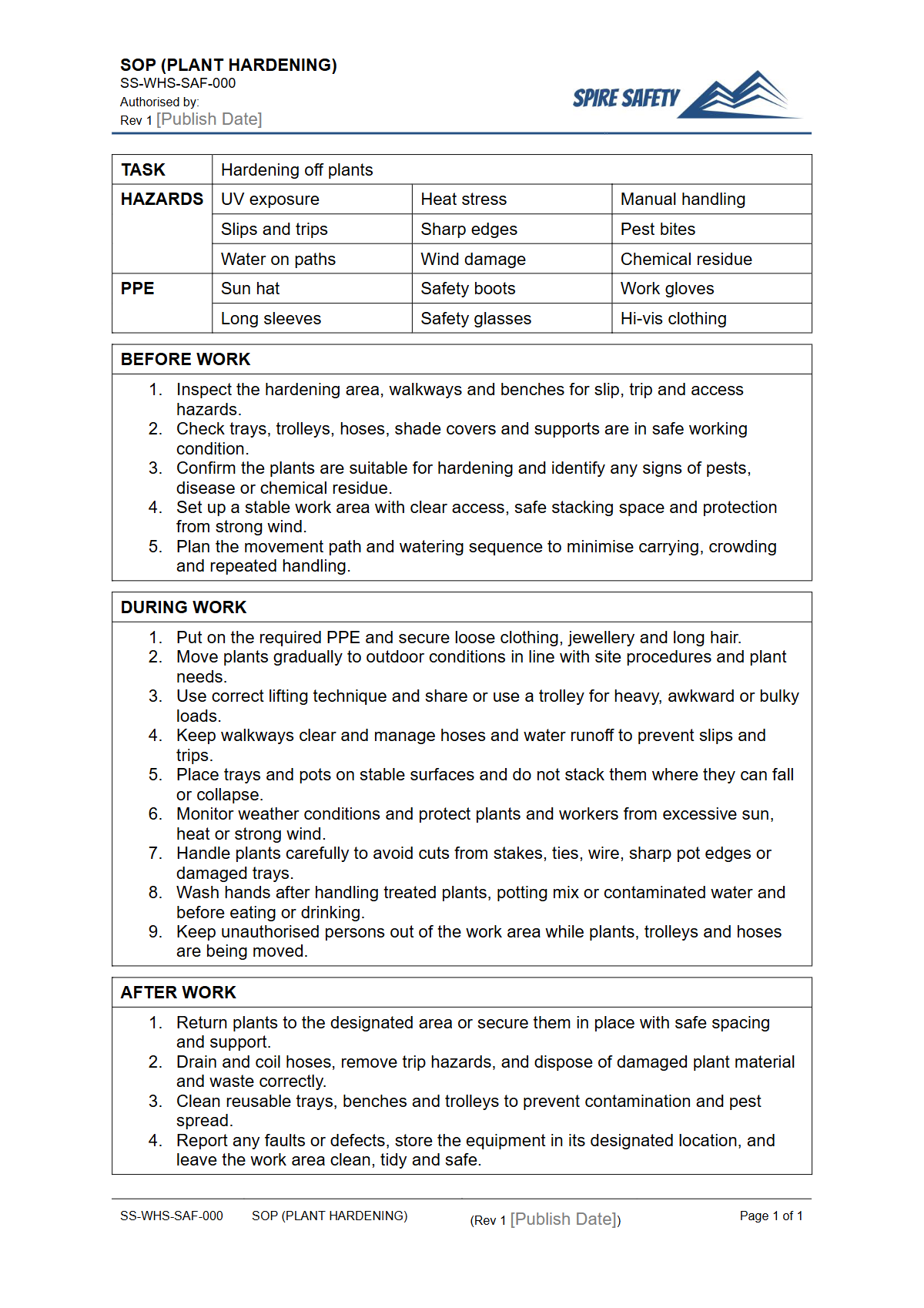
Purpose of the Free Safe Operating Procedure (Plant Hardening) Template
This Free Safe Operating Procedure (Plant Hardening) Template provides a structured framework for businesses to manage the health and safety risks associated with acclimatising young plants to outdoor conditions. The process of 'hardening off' involves gradually exposing seedlings to sunlight, wind, and fluctuating temperatures, which introduces several workplace hazards.
This SOP helps outline control measures for risks such as ergonomic injuries from manual handling, UV radiation exposure, and slips, trips, and falls in nursery or farm environments.
Using a standardised procedure ensures that all workers perform the task consistently and safely, minimising the risk of injury and reducing the likelihood of plant loss due to environmental shock. It serves as a vital tool for worker induction, training, and ongoing competency management.
Integrating this SOP into your safety framework is a key step in developing robust WHS management systems that protect your team and your business.
Video walkthrough
How to use the Free Safe Operating Procedure (Plant Hardening) Template
Our Free Safe Operating Procedure (Plant Hardening) Template is available in both DOCX and PDF formats. The DOCX file is fully editable, allowing you to tailor the document to your specific operational needs, while the PDF is a convenient, print-ready version for immediate use once customised.
The template includes sections for outlining required Personal Protective Equipment (PPE), pre-operational safety checks, a step-by-step procedure for the task, and emergency response protocols.
Note: This document is a template and must be customised to suit the specific circumstances of your workplace. We strongly recommend that a competent person, in consultation with workers who perform the task, reviews and amends the content.
You should detail the exact types of plants, equipment (e.g., trolleys, benches), and environmental conditions relevant to your site to ensure the procedure is effective and relevant. Tasks like this are often followed by mechanical work, which can be documented with a free Planter SOP.
When to use this Safe Operating Procedure
This SOP should be implemented whenever seedlings or young plants are being moved from a protected environment, such as a greenhouse or indoor propagation area, to an outdoor location for eventual planting. It is particularly critical for commercial nurseries, agricultural operations, and landscaping businesses that handle large volumes of plants seasonally.
The procedure should be used as the primary reference document for training new employees and for conducting refresher training for existing staff to ensure safe work practices are maintained. It can also form the basis of a toolbox talk before a large-scale planting project begins.
Who should use this document
This template is designed for use by anyone responsible for workplace health and safety in the horticultural, agricultural, and landscaping industries. This includes Nursery Managers, Farm Owners, Team Leaders, and Persons Conducting a Business or Undertaking (PCBUs).
Workers who perform plant hardening tasks should use the finalised SOP as their guide to performing the job safely. Supervisors can also use it to monitor compliance with established safety protocols and to facilitate risk assessments for related tasks, such as those covered by our free Spreader SOP template.
Key Hazards in Plant Hardening
While seemingly a low-risk task, plant hardening involves several significant hazards that this SOP helps to control. Understanding these risks is the first step toward effective management.
- Manual Handling: Lifting and carrying heavy trays of seedlings, often repetitively and from awkward postures, can lead to musculoskeletal injuries. The SOP should specify mechanical aids and safe lifting techniques.
- Environmental Exposure: Workers spending extended periods outdoors are at risk of UV radiation, heat stress, and dehydration. Controls include providing shaded areas, ensuring access to water, and mandating sun-safe PPE.
- Slips, Trips, and Falls: Wet floors from watering, uneven ground, and stray equipment like hoses or pots are common trip hazards in a nursery environment. Good housekeeping is an essential control measure.
- Chemicals: Workers may be exposed to residual fertilisers, fungicides, or pesticides on the plants. The SOP should specify required PPE, such as gloves, based on the chemicals used. For related agricultural tasks, consider our our Grain Drill SOP to manage machinery risks.
By formalising your approach to these hazards, you create a safer and more predictable work environment. For broader safety system guidance, our WHS consulting services can provide expert support tailored to your industry.
You can also explore our full free WHS resources library for other useful templates.
Common mistakes
Common mistakes to avoid
- Moving plants from a greenhouse to direct, full sun too quickly, causing leaf scorch.
- Forgetting to check weather forecasts for unexpected frosts, heatwaves, or high winds.
- Ignoring ergonomic risks by manually carrying heavy trays over long distances instead of using trolleys.
- Using a generic SOP without customising it for the specific site, tasks, and equipment involved.
Legal references
Legal considerations
The following legal requirements may be relevant to this type of work.
- Work Health and Safety Act (Harmonised) — Provides the primary duties for protecting workers and other people from work health and safety risks.
- Work Health and Safety Regulations (Harmonised) — Sets out requirements supporting the management of workplace hazards and risks.
The following codes may be relevant to this type of work.
- Managing WHS Risks Code of Practice — Provides practical guidance on identifying hazards, assessing risks and applying effective controls.
- Work Health and Safety Consultation, Cooperation and Coordination Code of Practice — Provides practical guidance on consulting workers and coordinating with other duty holders.
- Managing the Work Environment and Facilities Code of Practice — Provides practical guidance on safe work environments, workplace facilities and related controls.
Did you know
Transplant Shock
Plants that are not properly hardened off can suffer from 'transplant shock,' leading to wilting, scorching, or even death. A gradual, controlled process outlined in an SOP significantly increases plant survival rates.
Ergonomic Risk
The agriculture and horticulture industries have high rates of musculoskeletal disorders. Using mechanical aids like trolleys and adjustable-height benches can dramatically reduce the ergonomic risk associated with handling plant trays.
FAQ
Frequently asked questions
01What is plant hardening in a WHS context?
02Why is a Safe Operating Procedure necessary for plant hardening?
03Can I use this template for my commercial nursery operations?
04What other controls should I consider besides an SOP for plant hardening?
Share this resource
Free Safe Operating Procedure (Plant Hardening) Template
Browse Categories
How To Use It
- 1Download and open in Word or PDF.
- 2Replace the placeholders with your business details.
- 3Get it reviewed by a WHS specialist before rollout.
Need it customised?
Our WHS consultants can adapt this template to your site, run a gap analysis, or audit what you already have in place.
Book a Free Consultation WHS consulting servicesor call 1300 156 382
Related templates
- Free Safe Operating Procedure (Plant Labelling) Template
- Free Safe Operating Procedure (Plant Propagation) Template
- Free Safe Operating Procedure (Plant Repotting) Template
- Free Safe Operating Procedure (Plant Room Cleaning) Template
- Free Safe Operating Procedure (Plant Room Housekeeping) Template
- Free Safe Operating Procedure (Plant Stake Installation) Template