
Free Safe Operating Procedure (Pipe Reamer) Template
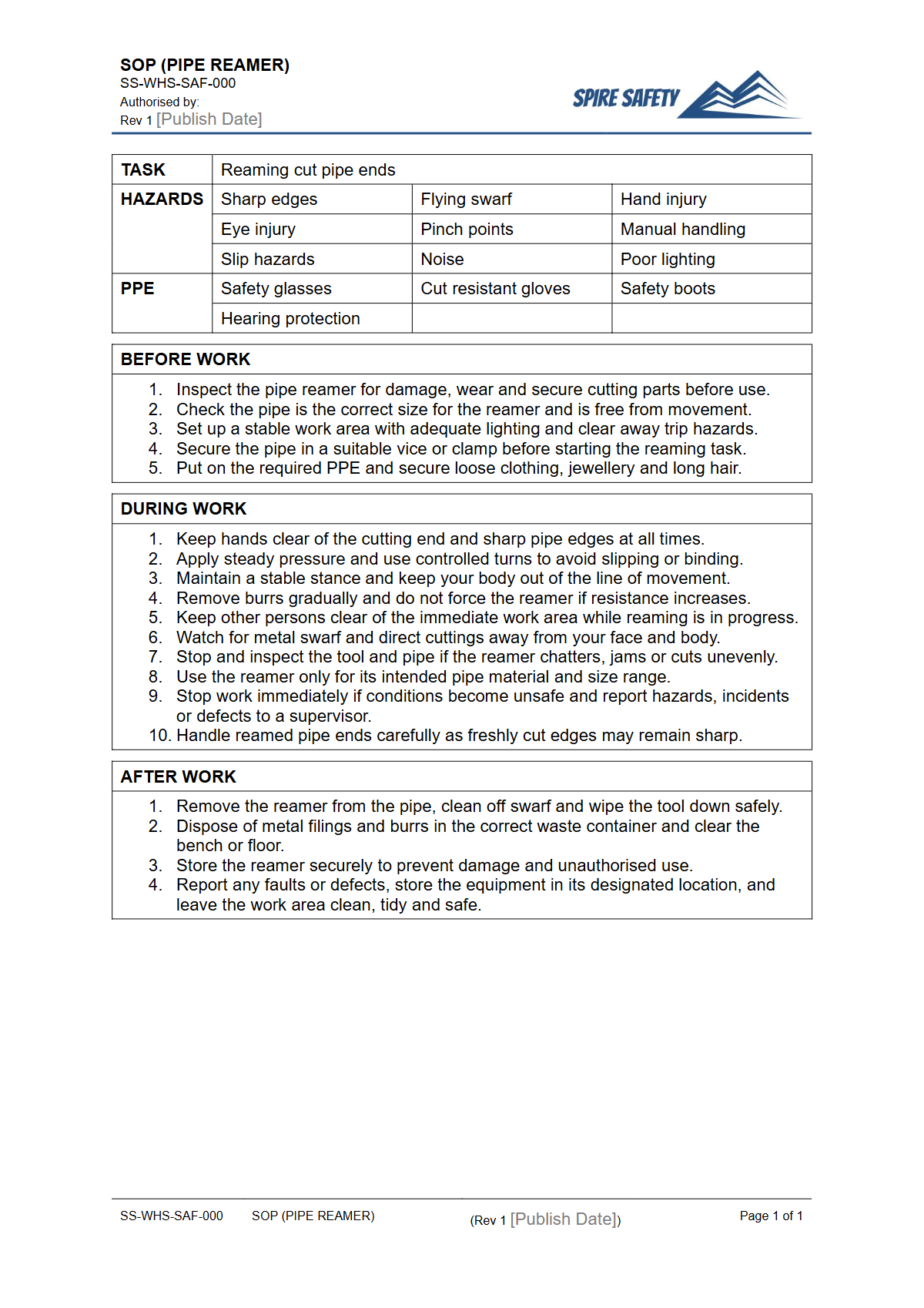
Download our Free Safe Operating Procedure (Pipe Reamer) Template to formalise safe work practices. This customisable DOCX and PDF helps you manage risks.
Free Safe Operating Procedure (Pipe Reamer) Template
DOCX • 126 KB + PDF
Updated Oct 2026
No signup required
Purpose of the Free Safe Operating Procedure (Pipe Reamer) Template
A pipe reamer is an essential tool in plumbing, fabrication, and construction for removing burrs from the inside of a cut pipe. While seemingly simple, its use involves hazards that must be controlled.
This Free Safe Operating Procedure (Pipe Reamer) Template provides a structured framework for documenting the required safety controls and work steps. It helps organisations establish a clear, repeatable process to minimise risks such as cuts from sharp blades, eye injuries from flying debris, and musculoskeletal strain from improper technique.
By documenting the approved method for using manual and powered pipe reamers, you create a vital training tool and a benchmark for safe performance. An SOP ensures that every worker, regardless of experience level, understands the identified hazards and the specific measures required to perform the task safely.
This contributes to a more consistent safety culture and helps demonstrate due diligence in managing workplace risks.
Video walkthrough
How to use the Free Safe Operating Procedure (Pipe Reamer) Template
This template is provided in both DOCX and PDF formats for your convenience. The DOCX file is fully editable, allowing you to adapt the content to your specific operational needs.
To use the template effectively, download the document and methodically work through each section. You should add details specific to the types of pipe reamers used on-site (e.g., manual, electric, pneumatic), the materials being worked on (e.g., copper, steel, PVC), and your unique site conditions.
It is vital to remember that this is a template, not a finished document. We have created it as a strong starting point, but you must customise it to reflect the specific equipment, tasks, and control measures relevant to your workplace.
We strongly recommend consulting with the workers who actually perform the task during the drafting and review process. Their hands-on experience is invaluable for creating a practical and effective procedure.
Should you require assistance in tailoring this document or developing more complex procedures, our WHS consulting team can provide expert guidance.
Implementing formal procedures is a cornerstone of effective safety management. Similar to how a Circular Saw SOP details the specific hazards of that tool, this document must be customised to capture the unique risks of pipe reaming in your context.
This process of customisation ensures the final SOP is relevant and actively used by your team.
When to use a Pipe Reamer SOP
A Safe Operating Procedure for a pipe reamer should be used as a primary reference document in several key situations. It is an essential part of the induction and training process for new employees or for existing workers assigned to tasks involving pipe reaming for the first time.
The SOP serves as the basis for practical demonstrations and competency assessments.
It should also be included in pre-start meetings or toolbox talks before any job involving significant pipe cutting and preparation begins. Furthermore, the document is a critical reference point during incident investigations.
If an injury occurs while using a pipe reamer, the SOP will be reviewed to determine if the procedure was followed and if it remains adequate for controlling the risks. Regular reviews, typically conducted annually or when new equipment is introduced, also rely on the existing SOP as a baseline for improvements. This practice is a fundamental component of well-structured WHS management systems.
Who should use this Safe Operating Procedure
This Safe Operating Procedure is intended for a range of personnel within an organisation. The primary users are the operators themselves—plumbers, pipefitters, fabricators, and maintenance workers—who physically handle the pipe reamers.
They must understand and follow the outlined steps to ensure their own safety and the safety of those around them.
Supervisors and team leaders also play a critical role. They use the SOP to conduct training, supervise work, and enforce safety standards on the job site.
They are responsible for ensuring workers have access to the document and understand its contents. WHS managers and safety officers use the SOP as part of the broader safety management system, integrating it into risk assessments, training programs, and compliance audits.
For larger projects that involve groundwork, this procedure complements other equipment-specific documents, like a Trencher SOP, to ensure a comprehensive approach to safety across all stages of work.
Key Elements of an Effective Pipe Reamer SOP
To be effective, your customised SOP should cover several critical areas. Begin with a clear list of potential hazards, including contact with sharp blades, flying debris, entanglement with powered models, and ergonomic strains.
Next, specify the mandatory Personal Protective Equipment (PPE), which at a minimum should include impact-resistant safety glasses and cut-resistant gloves. Depending on the environment, additional PPE like hearing protection or respiratory masks may be necessary.
The core of the document is the step-by-step procedure. This should be broken down into three phases: pre-operational checks (e.g., inspecting the blade for sharpness and damage, checking power cords), the operating sequence (e.g., securely clamping the pipe, applying steady pressure, avoiding excessive force), and post-operational tasks (e.g., cleaning the tool, safe storage).
When dealing with powered tools, the procedure should align with other SOPs for similar equipment, such as a Free Air Compressor SOP if using pneumatic reamers.
Finally, include a section on emergency procedures. Outline the immediate steps to take in case of an injury, including who to contact and the location of first aid kits.
Detailing these elements transforms the template into a robust, practical tool for your workplace. For more examples of safety documentation, you can browse our complete free WHS resources library.
Common mistakes
Common mistakes to avoid
- Using a dull or damaged reamer blade, which requires excessive force and can slip.
- Failing to properly secure the pipe in a vice or clamp before reaming.
- Neglecting to wear safety glasses, creating a high risk of eye injury from debris.
- Applying too much force or rocking the reamer, which can damage the pipe or cause the tool to bind.
Legal references
Legal considerations
The following legal requirements may be relevant to this type of work.
- Work Health and Safety Act (Harmonised) — Provides the primary duties for protecting workers and other people from work health and safety risks.
- Work Health and Safety Regulations (Harmonised) — Sets out requirements supporting the management of workplace hazards and risks.
The following codes may be relevant to this type of work.
- Managing WHS Risks Code of Practice — Provides practical guidance on identifying hazards, assessing risks and applying effective controls.
- Work Health and Safety Consultation, Cooperation and Coordination Code of Practice — Provides practical guidance on consulting workers and coordinating with other duty holders.
- Managing the Work Environment and Facilities Code of Practice — Provides practical guidance on safe work environments, workplace facilities and related controls.
Did you know
Deburring vs. Reaming
While the terms are often used interchangeably in the field, reaming technically refers to enlarging a hole to a precise dimension, whereas deburring simply removes the rough edge (burr) left after cutting, which is the primary function of a pipe reamer.
Material Matters
Different reamer designs and blade materials are used for various pipe types. Using a reamer designed for steel on a PVC pipe, for example, can damage the plastic and create an improper seal.
FAQ
Frequently asked questions
01What are the main hazards of using a pipe reamer?
02Is a Safe Operating Procedure a legal requirement for a pipe reamer?
03How often should our pipe reamer SOP be reviewed?
04What PPE is required when using a pipe reamer?
Share this resource
Free Safe Operating Procedure (Pipe Reamer) Template
Browse Categories
How To Use It
- 1Download and open in Word or PDF.
- 2Replace the placeholders with your business details.
- 3Get it reviewed by a WHS specialist before rollout.
Need it customised?
Our WHS consultants can adapt this template to your site, run a gap analysis, or audit what you already have in place.
Book a Free Consultation WHS consulting servicesor call 1300 156 382
Related templates
- Free Safe Operating Procedure (Pipe Saw) Template
- Free Safe Operating Procedure (Pipe Stand) Template
- Free Safe Operating Procedure (Pipe Threader) Template
- Free Safe Operating Procedure (Pipe Vice) Template
- Free Safe Operating Procedure (Pipette Use) Template
- Free Safe Operating Procedure (Pizza Cutter) Template