
Free Safe Operating Procedure (Pipe Threader) Template
Establish clear safety guidelines for using pipe threaders with our free template. Download this customisable DOCX to formalise your work health and safety.
Free Safe Operating Procedure (Pipe Threader) Template
DOCX • 126 KB + PDF
Updated Oct 2026
No signup required
Purpose of the Free Safe Operating Procedure (Pipe Threader) Template
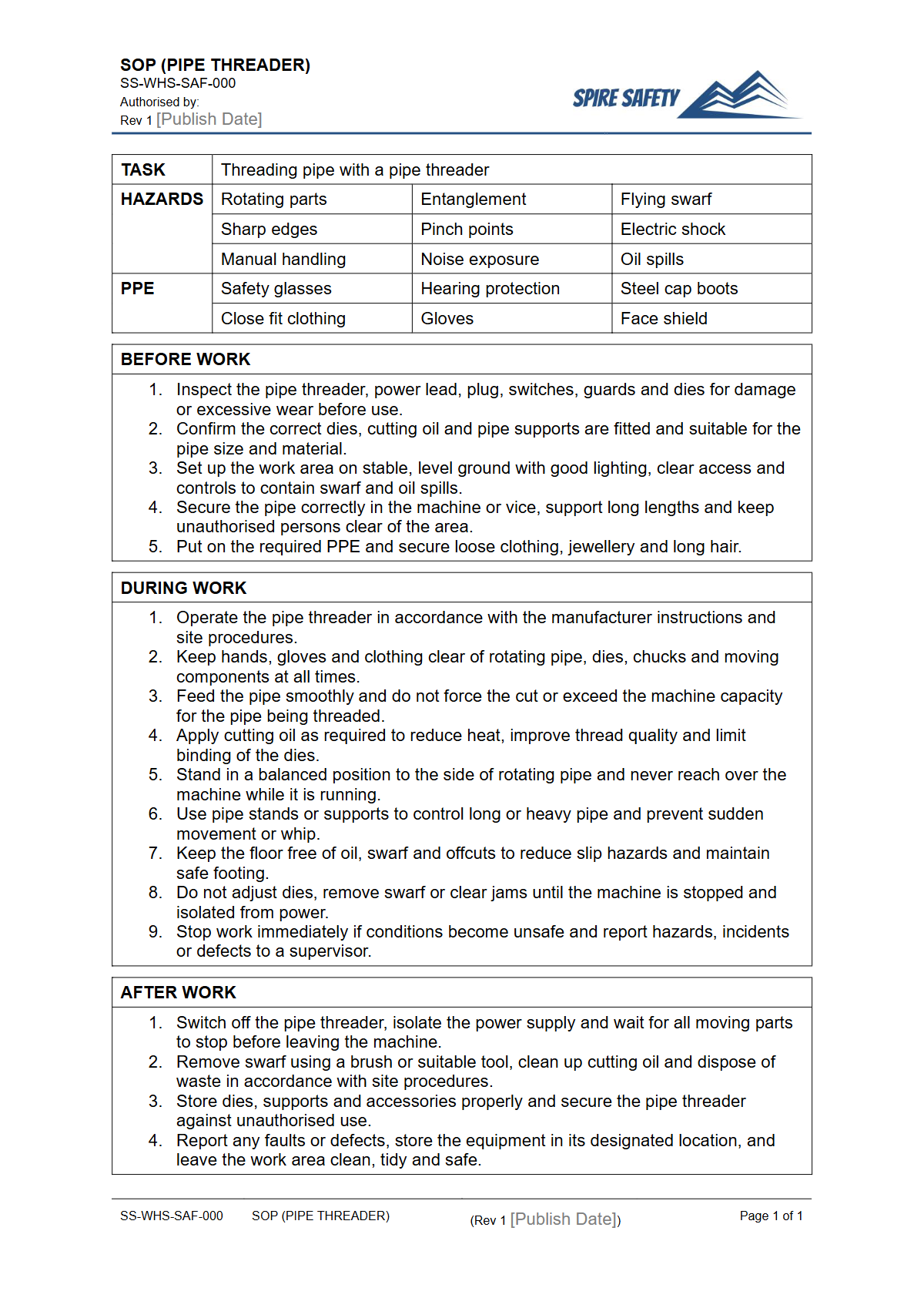
This free Safe Operating Procedure (Pipe Threader) Template provides a structured framework for documenting the safe use of portable and bench-mounted pipe threading machines in your workplace. Pipe threaders present significant risks if not used correctly, including entanglement from the rotating pipe, cuts from sharp metal swarf, and electrical shock.
A documented SOP is a fundamental tool for managing these hazards effectively.
By implementing a formal Safe Operating Procedure, your organisation can standardise its processes, ensuring every operator follows the same safety-critical steps. This document serves as a vital component of your risk management strategy, helping your PCBU (Person Conducting a Business or Undertaking) meet its primary duty of care under Australian WHS legislation.
While a pipe threader has specific risks like entanglement, other site equipment requires different controls, such as those detailed in a trencher SOP, highlighting the need for task-specific procedures.
Furthermore, this SOP template acts as a crucial training aid. It can be used to induct new workers, provide refresher training for existing staff, and to verify the competency of operators.
A clear, well-written procedure minimises ambiguity and helps foster a proactive safety culture where known hazards are consistently controlled.
Video walkthrough
How to use the Free Safe Operating Procedure (Pipe Threader) Template
To get started, download the template in your preferred format (DOCX for easy editing or PDF). The next step is customisation, which is essential for the document to be effective.
It is crucial to remember that this is a template. We haven't been to your workplace, so you must customise this document to reflect your specific equipment, environment, and organisational procedures.
Work through each section and replace the placeholder text with information specific to your site. This includes:
- Hazard Identification: List all potential hazards associated with your specific pipe threader model and the work area.
- Personal Protective Equipment (PPE): Specify the exact PPE required, such as safety glasses, steel-capped boots, and appropriate gloves (noting entanglement risks).
- Pre-Operational Checks: Detail the daily checks operators must perform, including inspecting the foot switch, power cords, safety guards, and die heads. Ensure the work area is clear of obstructions and that related equipment, such as that covered in an air compressor SOP, is also operated safely.
- Operating Steps: Provide a clear, sequential list of instructions for operating the machine. This should cover securing the pipe, applying cutting oil, engaging the die head, and monitoring the threading process. The level of detail should be similar to what's required for other powered tools, like those outlined in a circular saw Safe Operating Procedure.
- Post-Operational Shutdown: Outline the correct procedure for powering down the machine, cleaning the area of swarf and excess oil, and storing equipment.
Once tailored, this SOP should be integrated into your organisation's broader safety framework. Embedding this procedure within your overall WHS management systems ensures it is properly communicated, implemented, and reviewed as part of a cohesive approach to workplace safety.
When to use a Pipe Threader Safe Operating Procedure
A Safe Operating Procedure for a pipe threader is not a document that should be filed away and forgotten. It is an active tool to be used consistently throughout your operations.
Its primary use is during the training and onboarding of new operators, providing them with a definitive guide to safe work practices from day one.
The SOP should also be referenced for regular refresher training to prevent complacency and ensure long-term employees are kept up-to-date with best practices. It serves as an excellent pre-start checklist or toolbox talk topic before any pipe threading work commences, reminding workers of the key hazards and controls.
In the unfortunate event of an incident or near-miss, the SOP becomes a critical document for the investigation, helping to identify any deviations from the prescribed safe process.
Who should use this Safe Operating Procedure
This SOP is designed for use by multiple roles within a workplace. First and foremost, it is for the operators of the pipe threading equipment.
It provides them with clear, unambiguous instructions on how to perform their tasks safely and protects their health and wellbeing. Supervisors and team leaders should use the SOP to monitor work, enforce safety standards, and ensure their team members are competent and compliant.
Beyond the workshop floor, the document is essential for Health and Safety Representatives (HSRs), safety managers, and anyone responsible for developing and implementing safety policies. It serves as a vital reference for personnel conducting WHS compliance auditing to verify that safe systems of work are in place and being followed.
By providing a single, authoritative source of information, the SOP ensures everyone, from the operator to the manager, is aligned on how to manage the risks of pipe threading. You can find more templates like this in our comprehensive free WHS resources library.
Common mistakes
Common mistakes to avoid
- Failing to properly secure the pipe in the vice or chuck before starting the threading process.
- Wearing loose clothing, non-compliant gloves, or jewellery that can become entangled in rotating parts.
- Using an insufficient amount or the incorrect type of cutting oil, leading to overheating, poor thread quality, and premature die wear.
- Neglecting to inspect the foot pedal switch and electrical cords for damage before use, creating a significant electrical shock risk.
Legal references
Legal considerations
The following legal requirements may be relevant to this type of work.
- Work Health and Safety Act (Harmonised) — Provides the primary duties for protecting workers and other people from work health and safety risks.
- Work Health and Safety Regulations (Harmonised) — Sets out requirements supporting the management of workplace hazards and risks.
The following codes may be relevant to this type of work.
- Managing WHS Risks Code of Practice — Provides practical guidance on identifying hazards, assessing risks and applying effective controls.
- Work Health and Safety Consultation, Cooperation and Coordination Code of Practice — Provides practical guidance on consulting workers and coordinating with other duty holders.
- Managing the Work Environment and Facilities Code of Practice — Provides practical guidance on safe work environments, workplace facilities and related controls.
Did you know
Dual Designs
Modern pipe threaders can be portable for on-site flexibility or heavy-duty bench-mounted units, but both share similar entanglement and electrical hazards that require robust safety controls.
Die Head Health
The dies in a pipe threader are consumable parts that must be inspected for wear before each use. Worn dies can cause poor quality threads, equipment kickback, or machine failure.
FAQ
Frequently asked questions
01What must be included in a Safe Operating Procedure for a pipe threader?
02How often should a pipe threader SOP be reviewed?
03Is a Safe Operating Procedure a legal requirement in Australia?
04Can this template be used for any brand of pipe threader?
Share this resource
Free Safe Operating Procedure (Pipe Threader) Template
Browse Categories
How To Use It
- 1Download and open in Word or PDF.
- 2Replace the placeholders with your business details.
- 3Get it reviewed by a WHS specialist before rollout.
Need it customised?
Our WHS consultants can adapt this template to your site, run a gap analysis, or audit what you already have in place.
Book a Free Consultation WHS consulting servicesor call 1300 156 382
Related templates
- Free Safe Operating Procedure (Pipe Vice) Template
- Free Safe Operating Procedure (Pipette Use) Template
- Free Safe Operating Procedure (Pizza Cutter) Template
- Free Safe Operating Procedure (Pizza Paddle Use) Template
- Free Safe Operating Procedure (Plant Division) Template
- Free Safe Operating Procedure (Plant Hardening) Template