
Free Safe Operating Procedure (Pipe Saw) Template
Download our free Safe Operating Procedure (Pipe Saw) Template to formalise your safety processes. Customise this DOCX or PDF to suit your worksite.
Free Safe Operating Procedure (Pipe Saw) Template
DOCX • 126 KB + PDF
Updated Oct 2026
No signup required
Purpose of the Free Safe Operating Procedure (Pipe Saw) Template
This free Safe Operating Procedure (Pipe Saw) Template provides a structured starting point for documenting the safe use of pipe saws in your workplace. Pipe saws, whether abrasive, diamond-bladed, or reciprocating, introduce significant hazards such as cuts, lacerations, entanglement, projectiles, and exposure to harmful dust.
Implementing a formal SOP helps standardise your operational process, manage these risks, and provides a clear basis for worker training and competency assessment.
A well-drafted Safe Operating Procedure is a fundamental tool for demonstrating how your organisation meets its duty of care under Australian WHS legislation. It outlines a consistent, step-by-step method for performing a task safely, ensuring every operator understands the required controls. For other cutting equipment, you may need a different document, such as our FREE Circular Saw SOP Template.
Video walkthrough
How to use the Free Safe Operating Procedure (Pipe Saw) Template
To effectively use this Safe Operating Procedure (Pipe Saw) Template, download the DOCX file and adapt it to the specific context of your business. This involves a collaborative effort and should not be done in isolation.
Engage with the workers who actually operate the equipment, as they have direct experience with the task and its associated risks. Their input is invaluable for creating a practical and effective procedure.
Important: This document is a template and must be customised. We have developed it to align with Australian WHS principles, but it is not a complete, ready-to-use solution.
You must adapt the content to reflect the specific makes and models of pipe saws used, the types of pipes being cut (e.g., PVC, concrete, ductile iron), the unique environmental conditions of your worksite, and your organisation's existing emergency procedures. Integrating these procedures into robust WHS management systems ensures they are maintained and effectively implemented.
Key Sections to Customise
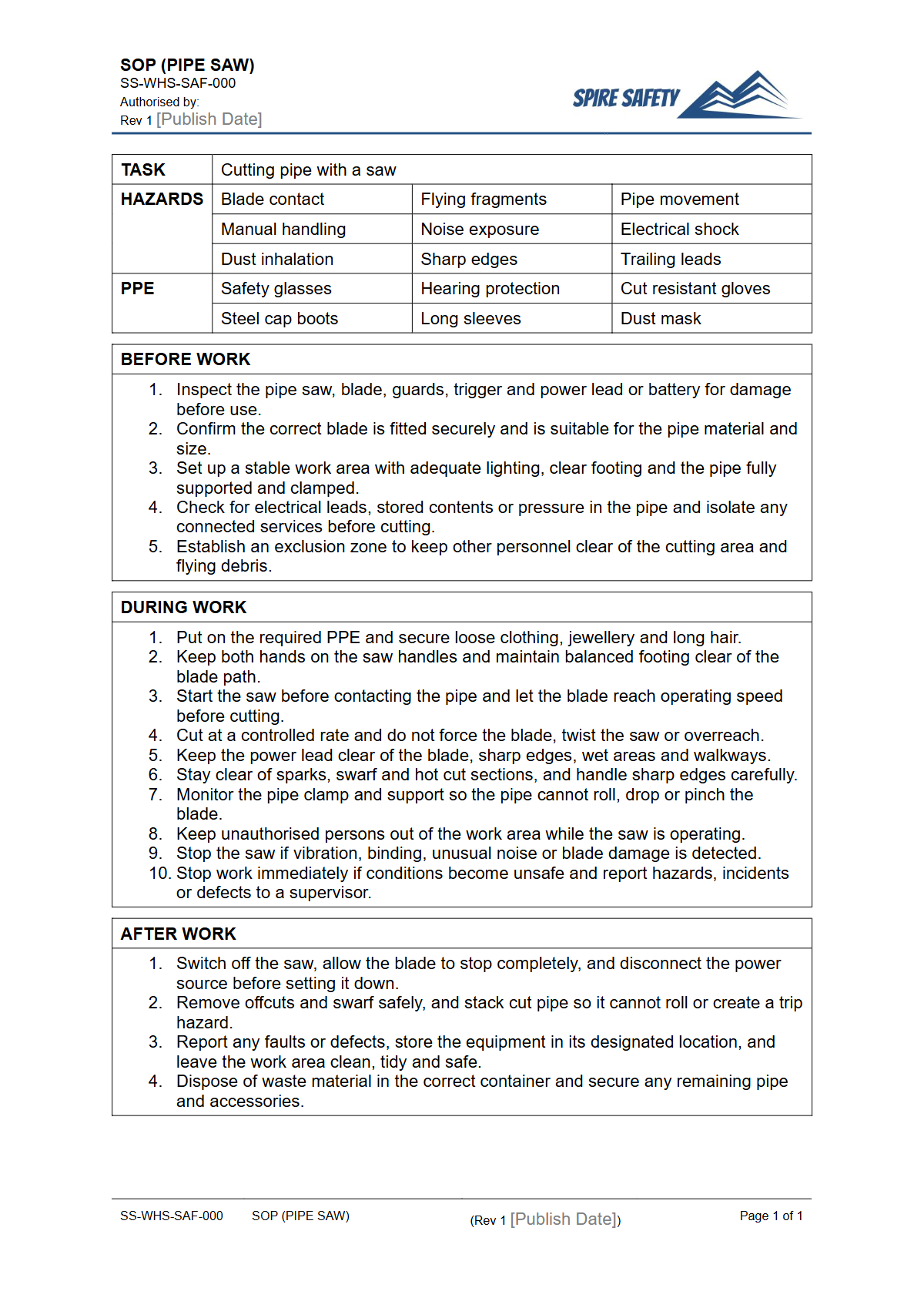
- PPE Requirements: Specify the exact Personal Protective Equipment needed, such as safety glasses or goggles, hearing protection (earmuffs or plugs), respiratory protection (e.g., P2 respirator for silica dust), steel-capped boots, and cut-resistant gloves.
- Pre-Operational Checks: Detail the daily checks operators must perform. This includes inspecting the blade for damage or wear, ensuring safety guards are in place and functional, checking power cords or fuel lines, and verifying the water suppression system (if applicable) is working.
- Operating Steps: Clearly outline the sequence for a safe cut. This should cover securing the pipe, establishing a correct and stable operator stance, starting the saw, applying steady pressure, and completing the cut without forcing the blade.
- Post-Operational Tasks: List the required actions after use, such as powering down, cleaning the equipment, and storing it correctly.
When to use it
A Safe Operating Procedure for a pipe saw should be used consistently as part of your daily work processes. It is a critical document for worker inductions, ensuring new team members understand the established safe method from day one.
It should also be a central reference point during toolbox talks, refresher training, and any time a new type of pipe material or saw model is introduced. If a task involves more than just the saw, such as excavation, you might also need a dedicated Trencher SOP.
Who should use it
This SOP is intended for several groups within an organisation. Primarily, it is for Operators (such as plumbers, pipefitters, and civil construction workers) as a direct guide for their work.
Supervisors and Managers must use the SOP to supervise work, enforce safety standards, and conduct workplace inspections. It forms the benchmark against which performance is measured, which is a key part of any WHS compliance auditing process.
WHS Personnel and Trainers will use the document to develop training programs, assess competency, and investigate any incidents or near misses involving pipe saws.
This procedure is a foundational element in a suite of safety documents. For example, if a telehandler is used to position large pipes for cutting, a specific Telehandler SOP must also be followed.
You can find this and many other templates in our free WHS resources library to build out your safety system.
Common mistakes
Common mistakes to avoid
- Using a dull, damaged, or incorrect blade for the material, increasing the risk of binding and kickback.
- Failing to properly secure the pipe before starting the cut, leading to movement and loss of control.
- Neglecting to wear appropriate PPE, especially eye, hearing, and respiratory protection.
- Attempting to bypass or remove safety guards to make a difficult or angled cut.
Legal references
Legal considerations
The following legal requirements may be relevant to this type of work.
- Work Health and Safety Act (Harmonised) — Provides the primary duties for protecting workers and other people from work health and safety risks.
- Work Health and Safety Regulations (Harmonised) — Sets out requirements supporting the management of workplace hazards and risks.
The following codes may be relevant to this type of work.
- Managing WHS Risks Code of Practice — Provides practical guidance on identifying hazards, assessing risks and applying effective controls.
- Work Health and Safety Consultation, Cooperation and Coordination Code of Practice — Provides practical guidance on consulting workers and coordinating with other duty holders.
- Managing the Work Environment and Facilities Code of Practice — Provides practical guidance on safe work environments, workplace facilities and related controls.
Did you know
Material Matters
Different pipe materials like PVC, ductile iron, and steel require different blades and cutting speeds. Using the wrong blade is a common cause of accidents, kickback, and equipment damage.
Dust Hazards
Cutting concrete or fibre-cement pipes can release crystalline silica dust, a serious respiratory hazard. Water suppression systems are a key engineering control to minimise airborne dust.
FAQ
Frequently asked questions
01Is a Safe Operating Procedure a legal requirement for a pipe saw in Australia?
02How often should our pipe saw SOP be reviewed?
03Can I use this template for different models of pipe saw?
04What is the difference between an SOP and a SWMS?
Share this resource
Free Safe Operating Procedure (Pipe Saw) Template
Browse Categories
How To Use It
- 1Download and open in Word or PDF.
- 2Replace the placeholders with your business details.
- 3Get it reviewed by a WHS specialist before rollout.
Need it customised?
Our WHS consultants can adapt this template to your site, run a gap analysis, or audit what you already have in place.
Book a Free Consultation WHS consulting servicesor call 1300 156 382
Related templates
- Free Safe Operating Procedure (Pipe Stand) Template
- Free Safe Operating Procedure (Pipe Threader) Template
- Free Safe Operating Procedure (Pipe Vice) Template
- Free Safe Operating Procedure (Pipette Use) Template
- Free Safe Operating Procedure (Pizza Cutter) Template
- Free Safe Operating Procedure (Pizza Paddle Use) Template