
Free Safe Operating Procedure (Pipe Stand) Template
Download our free Safe Operating Procedure (Pipe Stand) Template to manage hazards associated with pipe handling. This structured DOCX is an ideal start.
Free Safe Operating Procedure (Pipe Stand) Template
DOCX • 126 KB + PDF
Updated Oct 2026
No signup required
Purpose of the Free Safe Operating Procedure (Pipe Stand) Template
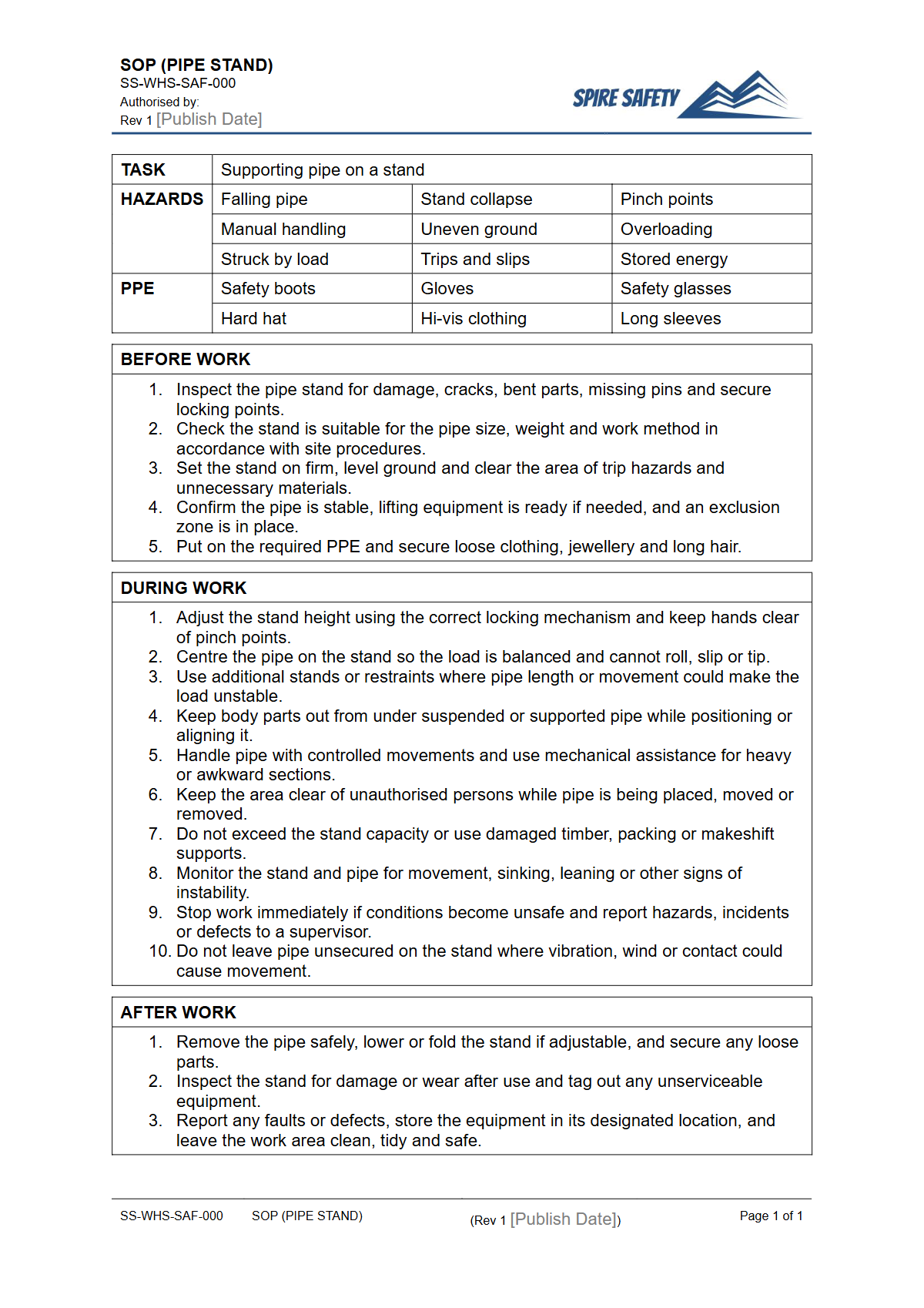
Using a pipe stand may seem straightforward, but it involves significant risks if not managed correctly. This Free Safe Operating Procedure (Pipe Stand) Template provides a structured framework for documenting the required safety controls and work steps.
It helps organisations meet their duty of care by addressing common hazards like pipe instability, manual handling injuries, and pinch points. The primary goal is to ensure workers can set up, use, and pack away pipe stands in a controlled and safe manner, minimising the risk of incidents or injuries.
An effective SOP is a critical component for any organisation committed to safety. It serves as a clear training tool for new employees and a consistent reference for experienced workers.
By formalising the procedure, you create a clear standard for performance and safety, which is a cornerstone of developing robust WHS management systems. This template, aligned with Australian WHS principles, guides you in outlining pre-operational checks, step-by-step operational instructions, and post-work clean-up, ensuring all aspects of the task are considered.
Video walkthrough
How to use the Free Safe Operating Procedure (Pipe Stand) Template
This resource is available for download in both DOCX and PDF formats. The DOCX version is fully editable, allowing you to tailor the content directly to your workplace's specific equipment, environment, and procedural needs.
The PDF version is useful for quick reference or printing. Start by reviewing the template's sections, which include personal protective equipment (PPE) requirements, potential hazards, risk controls, and a sequential guide to performing the task safely.
It is crucial to adapt this document to reflect your unique operational context. We have provided a structured starting point, but you must conduct a site-specific risk assessment and incorporate control measures relevant to your tasks.
Involve your workers in the customisation process; their direct experience is invaluable for creating a practical and effective SOP. Regular review and updates are also essential for maintaining relevance and effectiveness.
When to use a Pipe Stand SOP
A Safe Operating Procedure for pipe stands should be developed and implemented before workers are assigned the task. It is an essential document for training and induction, ensuring everyone understands the established safety protocols from the beginning.
The SOP should be readily available at the point of work for easy reference. It is also a critical document to review during toolbox talks or following any changes to equipment, procedures, or after an incident or near miss occurs.
Using it consistently reinforces safe work behaviour and helps maintain a high standard of safety awareness across the team.
Furthermore, the tasks performed on a pipe stand often involve other equipment with their own inherent risks, such as power tools for cutting or grinding. Integrating this procedure with others, like a circular saw SOP, creates a more comprehensive safety picture for workers completing complex jobs.
This holistic approach ensures that safety is considered at every step of the process, not just in isolation.
Key Hazards and Control Measures
The operation of pipe stands introduces several key hazards that must be controlled. A thorough SOP will detail these risks and the specific measures to mitigate them. Common hazards include:
- Instability and Toppling: Placing stands on uneven, soft, or sloping ground can cause them to become unstable and topple, especially under load. Control measures include selecting a firm, level surface and never exceeding the manufacturer's specified load capacity.
- Manual Handling: Lifting heavy pipes onto the stand, as well as carrying and setting up the stands themselves, poses a risk of musculoskeletal injury. Controls involve using mechanical aids where possible, team lifting, and training workers in correct lifting techniques.
- Pinch Points: Adjusting the height of the stand or the position of the roller head can create pinch points for fingers and hands. Workers should wear appropriate gloves and be trained to keep hands clear during adjustments.
- Stored Energy: Heavy pipes hold significant potential energy. A sudden shift or fall can release this energy unexpectedly, leading to severe impact or crush injuries. Securing the pipe correctly and ensuring the stand is stable are critical controls.
Beyond the stand itself, consider the environment and associated tasks. For instance, a workshop environment might have multiple concurrent activities.
Ensuring adequate spacing and clear communication is vital, just as having a specific air compressor SOP is for managing its unique risks. The effectiveness of these controls should be verified through supervision and periodic WHS compliance auditing to ensure they are being followed correctly.
By systematically addressing these hazards within the SOP, you provide workers with the knowledge they need to perform their jobs safely. For more templates covering a wide range of equipment and tasks, consider exploring our complete free WHS resources library.
Common mistakes
Common mistakes to avoid
- Using stands on uneven, soft, or sloped ground, compromising their stability.
- Exceeding the stand's specified maximum weight capacity, leading to structural failure.
- Failing to inspect the stand for damage, such as cracks, bends, or worn parts, before use.
- Using mismatched stands or improvising supports, creating an unstable setup.
Legal references
Legal considerations
The following legal requirements may be relevant to this type of work.
- Work Health and Safety Act (Harmonised) — Provides the primary duties for protecting workers and other people from work health and safety risks.
- Work Health and Safety Regulations (Harmonised) — Sets out requirements supporting the management of workplace hazards and risks.
The following codes may be relevant to this type of work.
- Managing WHS Risks Code of Practice — Provides practical guidance on identifying hazards, assessing risks and applying effective controls.
- Work Health and Safety Consultation, Cooperation and Coordination Code of Practice — Provides practical guidance on consulting workers and coordinating with other duty holders.
- Managing the Work Environment and Facilities Code of Practice — Provides practical guidance on safe work environments, workplace facilities and related controls.
Did you know
Manual Handling Risk
Musculoskeletal disorders from hazardous manual tasks are a leading cause of workplace injury claims in Australia. Even seemingly simple actions like positioning pipes on a stand can contribute to cumulative strain if not performed correctly.
Load Capacity
The stated weight capacity of a pipe stand is for a static, evenly distributed load. Dynamic forces, such as those from dropping a pipe onto the stand or from machine vibrations during cutting, can momentarily exceed this capacity and lead to failure.
FAQ
Frequently asked questions
01What are the main hazards of using a pipe stand?
02Is a Safe Operating Procedure for a pipe stand legally required in Australia?
03Who is responsible for developing an SOP for pipe stands?
04How often should a pipe stand SOP be reviewed?
Share this resource
Free Safe Operating Procedure (Pipe Stand) Template
Browse Categories
How To Use It
- 1Download and open in Word or PDF.
- 2Replace the placeholders with your business details.
- 3Get it reviewed by a WHS specialist before rollout.
Need it customised?
Our WHS consultants can adapt this template to your site, run a gap analysis, or audit what you already have in place.
Book a Free Consultation WHS consulting servicesor call 1300 156 382
Related templates
- Free Safe Operating Procedure (Pipe Threader) Template
- Free Safe Operating Procedure (Pipe Vice) Template
- Free Safe Operating Procedure (Pipette Use) Template
- Free Safe Operating Procedure (Pizza Cutter) Template
- Free Safe Operating Procedure (Pizza Paddle Use) Template
- Free Safe Operating Procedure (Plant Division) Template