
Free Safe Operating Procedure (Pipe Facing Machine) Template
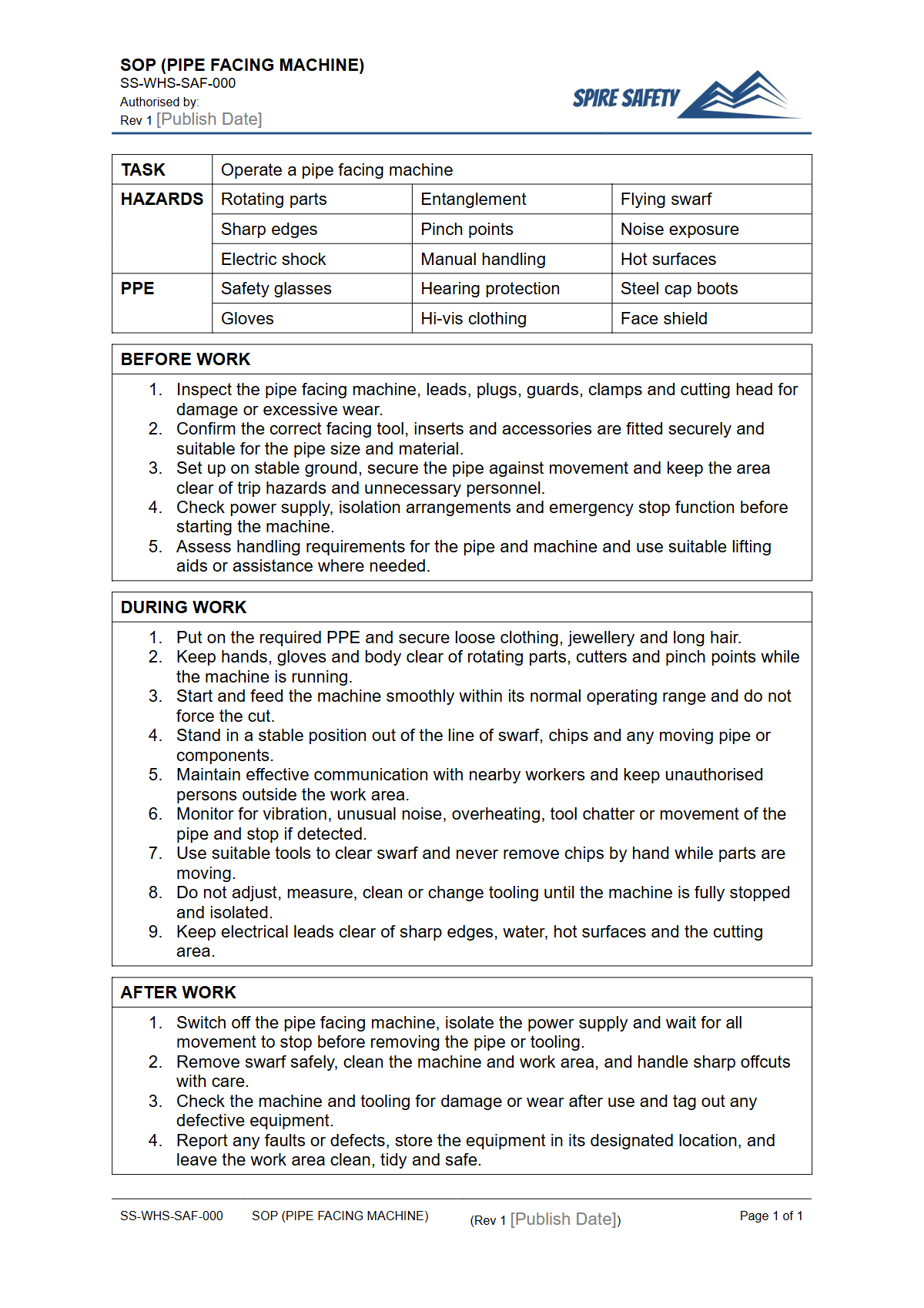
Our free Safe Operating Procedure (Pipe Facing Machine) Template provides a structured framework for documenting safety protocols.
Free Safe Operating Procedure (Pipe Facing Machine) Template
DOCX • 126 KB + PDF
Updated Oct 2026
No signup required
Purpose of the Free Safe Operating Procedure (Pipe Facing Machine) Template
A pipe facing machine is a powerful tool used to machine a flat, perpendicular surface on the end of a pipe, essential for welding and fitting. Due to the high-speed rotating components and sharp cutting tools involved, its operation presents significant risks.
This free Safe Operating Procedure (Pipe Facing Machine) Template provides a structured starting point for your business to document the required steps for operating this equipment safely.
Using a detailed SOP helps in clearly outlining pre-start checks, operational steps, shutdown procedures, and required Personal Protective Equipment (PPE). It serves as a vital training tool for new operators and a consistent reference for experienced workers, helping to standardise safe work practices across your team.
Implementing a robust SOP is a key part of managing workplace risks, similar to procedures documented in our Air Compressor SOP for other common industrial equipment.
What's included in the template?
This template is formatted for easy customisation and includes sections for:
- Designated responsible persons
- Required training and competency records
- A comprehensive risk assessment matrix for identifying hazards
- Step-by-step instructions for pre-operational checks, operation, and post-operational tasks
- Emergency procedures
- A review and consultation log
Properly implemented, this document forms a critical component of your overall safety management system, demonstrating a commitment to worker health and safety.
Video walkthrough
How to use the Free Safe Operating Procedure (Pipe Facing Machine) Template
This template is available for download in both DOCX and PDF formats. The DOCX version is fully editable, allowing you to tailor the content directly to your operational needs.
The PDF version is useful for quick printing and distribution once your customisations are complete.
It is crucial that you customise this template to reflect your specific workplace, including the exact model of pipe facing machine in use, the materials being worked on, and your site-specific environmental conditions. We provide this document as a starting point, not a finished product.
A generic procedure is not sufficient to control risks effectively.
Your customisation should be done in consultation with the workers who actually operate the equipment. Their direct experience is invaluable for identifying practical hazards and effective control measures. This collaborative approach ensures the final SOP is both practical and comprehensive, forming one part of your organisation's comprehensive WHS management systems.
When to use it
A Safe Operating Procedure for a pipe facing machine should be used as a primary reference document in several key situations. It must be integrated into the initial training and competency assessment for any new operator.
It should also be readily available in the work area for workers to reference at any time.
The SOP is also a critical tool for conducting refresher training, ensuring that safety standards do not slip over time. It should be formally reviewed following any incident or near-miss involving the machine to identify and incorporate any necessary changes.
We also recommend scheduling regular reviews, for example annually, or whenever there is a change in the equipment, process, or relevant safety legislation. For complex sites, a formal procedure for handling materials around the work area, such as a Telehandler SOP, can complement this document.
Who should use it
This Safe Operating Procedure is intended for several key roles within an organisation. Primarily, machine operators must use it to understand and follow the established safe work method.
Their adherence to the SOP is fundamental to preventing injuries.
Supervisors and team leaders are responsible for enforcing the procedure, ensuring operators are trained and competent, and conducting spot-checks to verify compliance. This process can be supported through regular WHS compliance auditing to ensure procedures are being followed effectively.
WHS managers and officers will use the SOP as a key document within the broader safety framework. They oversee its development, review, and integration with other safety initiatives, like the procedures found in our Conveyer System SOP. If you require further guidance on tailoring these documents, our WHS consulting services can provide expert assistance. For more templates and checklists, browse our complete free WHS resources library.
Common mistakes
Common mistakes to avoid
- Using the template as-is without customising it for the specific machine and workplace.
- Failing to conduct and document thorough pre-start checks before every use.
- Not ensuring the pipe is properly and securely clamped before starting the machine.
- Inadequate use of PPE, particularly forgetting mandatory eye, hearing, and hand protection.
Legal references
Legal considerations
The following legal requirements may be relevant to this type of work.
- Work Health and Safety Act (Harmonised) — Provides the primary duties for protecting workers and other people from work health and safety risks.
- Work Health and Safety Regulations (Harmonised) — Sets out requirements supporting the management of workplace hazards and risks.
The following codes may be relevant to this type of work.
- Managing WHS Risks Code of Practice — Provides practical guidance on identifying hazards, assessing risks and applying effective controls.
- Work Health and Safety Consultation, Cooperation and Coordination Code of Practice — Provides practical guidance on consulting workers and coordinating with other duty holders.
- Managing the Work Environment and Facilities Code of Practice — Provides practical guidance on safe work environments, workplace facilities and related controls.
Did you know
Precision is Key
Pipe facing creates a precise, flat surface known as a 'land' on the pipe end. This is critical for ensuring the integrity of welded joints; even minor imperfections can lead to catastrophic joint failure under pressure.
Noise Hazard
Depending on the model and the material being cut, pipe facing machines can easily generate noise levels well above the 85 dB(A) exposure standard, making hearing protection a mandatory piece of PPE for operators.
FAQ
Frequently asked questions
01What are the main hazards associated with using a pipe facing machine?
02Does this SOP template cover all models of pipe facing machines?
03How often should a Pipe Facing Machine SOP be reviewed?
04Who is responsible for creating a Safe Operating Procedure?
Share this resource
Free Safe Operating Procedure (Pipe Facing Machine) Template
Browse Categories
How To Use It
- 1Download and open in Word or PDF.
- 2Replace the placeholders with your business details.
- 3Get it reviewed by a WHS specialist before rollout.
Need it customised?
Our WHS consultants can adapt this template to your site, run a gap analysis, or audit what you already have in place.
Book a Free Consultation WHS consulting servicesor call 1300 156 382
Related templates
- Free Safe Operating Procedure (Pipe Freezer) Template
- Free Safe Operating Procedure (Pipe Groover) Template
- Free Safe Operating Procedure (Pipe Locator) Template
- Free Safe Operating Procedure (Pipe Pressure Test) Template
- Free Safe Operating Procedure (Pipe Reamer) Template
- Free Safe Operating Procedure (Pipe Saw) Template