
Free Safe Operating Procedure (Pipe Freezer) Template
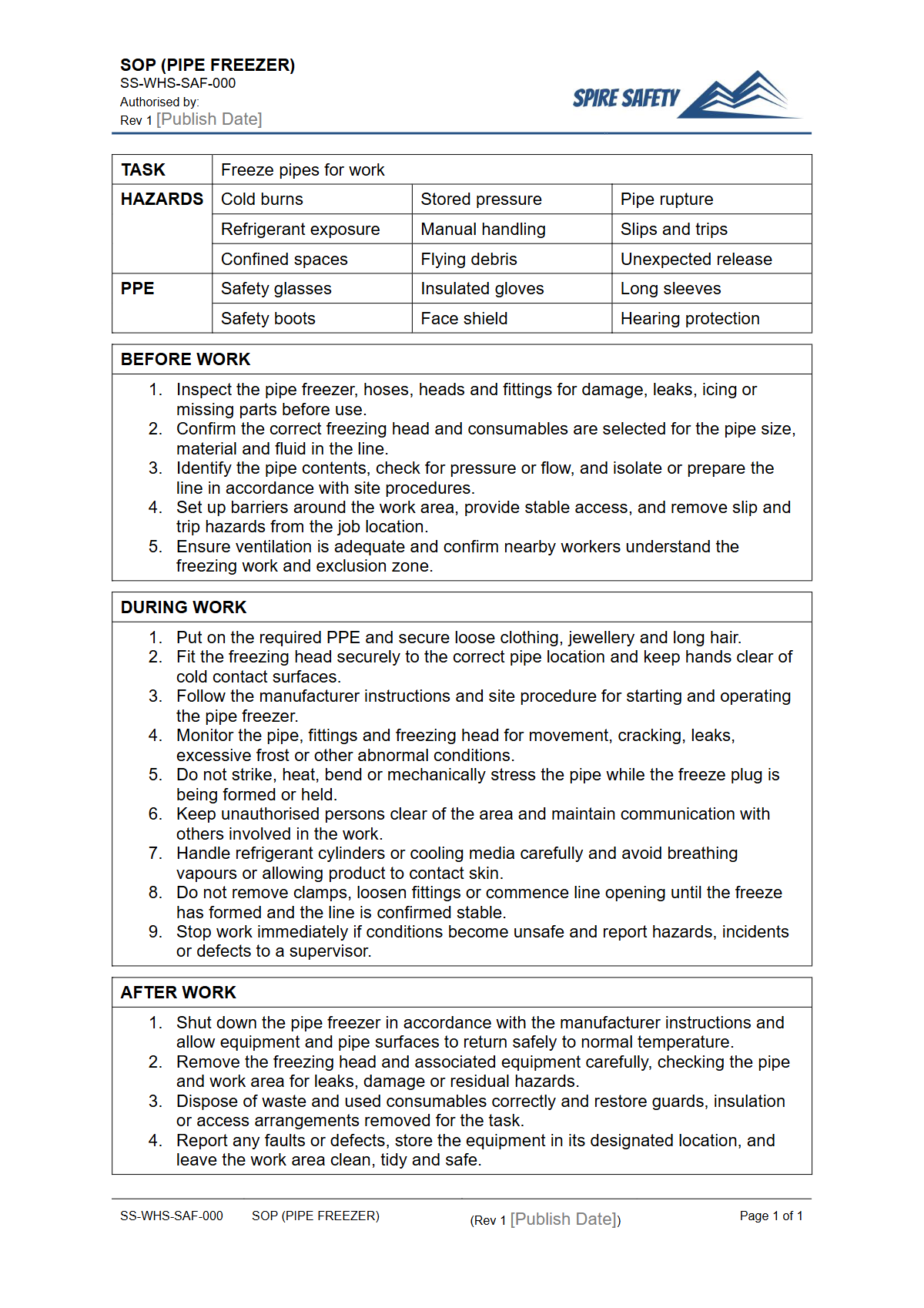
Download our Free Safe Operating Procedure for pipe freezers to define safe work methods. This template provides a structured starting point for your business.
Free Safe Operating Procedure (Pipe Freezer) Template
DOCX • 126 KB + PDF
Updated Oct 2026
No signup required
Purpose of the Free Safe Operating Procedure (Pipe Freezer) Template
Operating a pipe freezer involves significant hazards, including extreme cold, high pressure, and potential asphyxiation. This Free Safe Operating Procedure (Pipe Freezer) Template provides a structured framework for outlining the required steps to perform this task safely.
Using an SOP helps control risks associated with cryogenic agents like liquid nitrogen or carbon dioxide, ensuring workers understand the pre-operational checks, correct application, monitoring, and shutdown processes. A documented procedure is a fundamental part of robust WHS management systems, helping to meet your duty of care obligations.
Video walkthrough
How to use the Free Safe Operating Procedure (Pipe Freezer) Template
To effectively implement this Safe Operating Procedure, download the DOCX or PDF file and integrate it into your organisation’s safety documentation. It is designed as a comprehensive starting point, but it must be adapted to your specific circumstances.
Review each section and add details relevant to the make and model of your pipe freezer, the type of refrigerant used, the specific work environments it will be used in, and your state or territory’s WHS regulations. For other plant that involves pressurised systems, you may also find our Free Air Compressor SOP (Safe Operating Procedure) Template a useful reference.
A Note on Customisation
It is crucial to remember that this template is a guide, not a finished document. We have developed it to align with Australian WHS principles, but you must customise it to reflect your unique operational context.
A generic SOP that doesn't account for your specific workplace hazards and control measures will not be effective in preventing incidents and may not satisfy your legal obligations.
When to use this Safe Operating Procedure
A pipe freezer SOP should be used as a primary reference tool for all personnel involved in the task. It is essential for inducting new workers and providing refresher training for existing staff.
The procedure should be reviewed and referenced before starting any pipe freezing job, particularly in non-routine situations or unfamiliar environments. It also serves as a critical document during safety meetings, incident investigations, and periodic WHS compliance auditing to verify that safe work practices are being followed consistently.
Who should use this Safe Operating Procedure
This document is intended for use by competent personnel, such as qualified plumbers, pipefitters, and maintenance technicians who are required to perform pipe isolation using freezing techniques. Supervisors and managers should also use the SOP to ensure they are providing adequate training, supervision, and resources.
Persons Conducting a Business or Undertaking (PCBUs) can use this template to formalise their processes and demonstrate that a safe system of work is in place for this high-risk activity. Documenting procedures for all types of hazardous equipment, from pipe freezers to power tools, is a key responsibility, and our FREE Circular Saw SOP (Safe Operating Procedure) Template is another example of how to structure these controls.
By establishing a clear, step-by-step procedure, organisations can significantly reduce the risk of cryogenic burns, asphyxiation, or equipment failure. If you require assistance in developing complex risk assessments or integrating this SOP into your broader safety framework, consider engaging professional WHS consulting services. For more templates and guides, browse our complete free WHS resources library.
Common mistakes
Common mistakes to avoid
- Failing to adequately ventilate the work area, leading to a dangerous oxygen-deficient atmosphere.
- Using incorrect or damaged PPE, such as standard leather gloves instead of cryogenic gloves, resulting in severe cold burns.
- Not allowing for pressure relief between the ice plug and a closed valve, causing pipe or fitting rupture.
- Attempting to freeze a pipe with even a minimal flow of water, which prevents a solid ice plug from forming.
Legal references
Legal considerations
The following legal requirements may be relevant to this type of work.
- Work Health and Safety Act (Harmonised) — Provides the primary duties for protecting workers and other people from work health and safety risks.
- Work Health and Safety Regulations (Harmonised) — Sets out requirements supporting the management of workplace hazards and risks.
The following codes may be relevant to this type of work.
- Managing WHS Risks Code of Practice — Provides practical guidance on identifying hazards, assessing risks and applying effective controls.
- Work Health and Safety Consultation, Cooperation and Coordination Code of Practice — Provides practical guidance on consulting workers and coordinating with other duty holders.
- Managing the Work Environment and Facilities Code of Practice — Provides practical guidance on safe work environments, workplace facilities and related controls.
Did you know
Extreme Temperatures
The two most common agents for pipe freezing are liquid nitrogen and carbon dioxide (dry ice). Liquid nitrogen boils at -196°C, while solid CO2 sublimates at -78.5°C, enabling the rapid formation of a solid ice plug.
Expansion Hazard
As water freezes into ice, it expands in volume by approximately 9%. This expansion can generate immense hydraulic pressure within a sealed pipe section, potentially exceeding 17,000 kPa (2,500 psi) if not properly managed with a pressure relief point.
FAQ
Frequently asked questions
01What are the main hazards associated with pipe freezing?
02Is a Safe Operating Procedure legally required for a pipe freezer in Australia?
03What personal protective equipment (PPE) is needed for pipe freezing?
04Can I use this template for both liquid nitrogen and CO2 pipe freezers?
Share this resource
Free Safe Operating Procedure (Pipe Freezer) Template
Browse Categories
How To Use It
- 1Download and open in Word or PDF.
- 2Replace the placeholders with your business details.
- 3Get it reviewed by a WHS specialist before rollout.
Need it customised?
Our WHS consultants can adapt this template to your site, run a gap analysis, or audit what you already have in place.
Book a Free Consultation WHS consulting servicesor call 1300 156 382
Related templates
- Free Safe Operating Procedure (Pipe Groover) Template
- Free Safe Operating Procedure (Pipe Locator) Template
- Free Safe Operating Procedure (Pipe Pressure Test) Template
- Free Safe Operating Procedure (Pipe Reamer) Template
- Free Safe Operating Procedure (Pipe Saw) Template
- Free Safe Operating Procedure (Pipe Stand) Template