
Free Safe Operating Procedure (Pipe Groover) Template
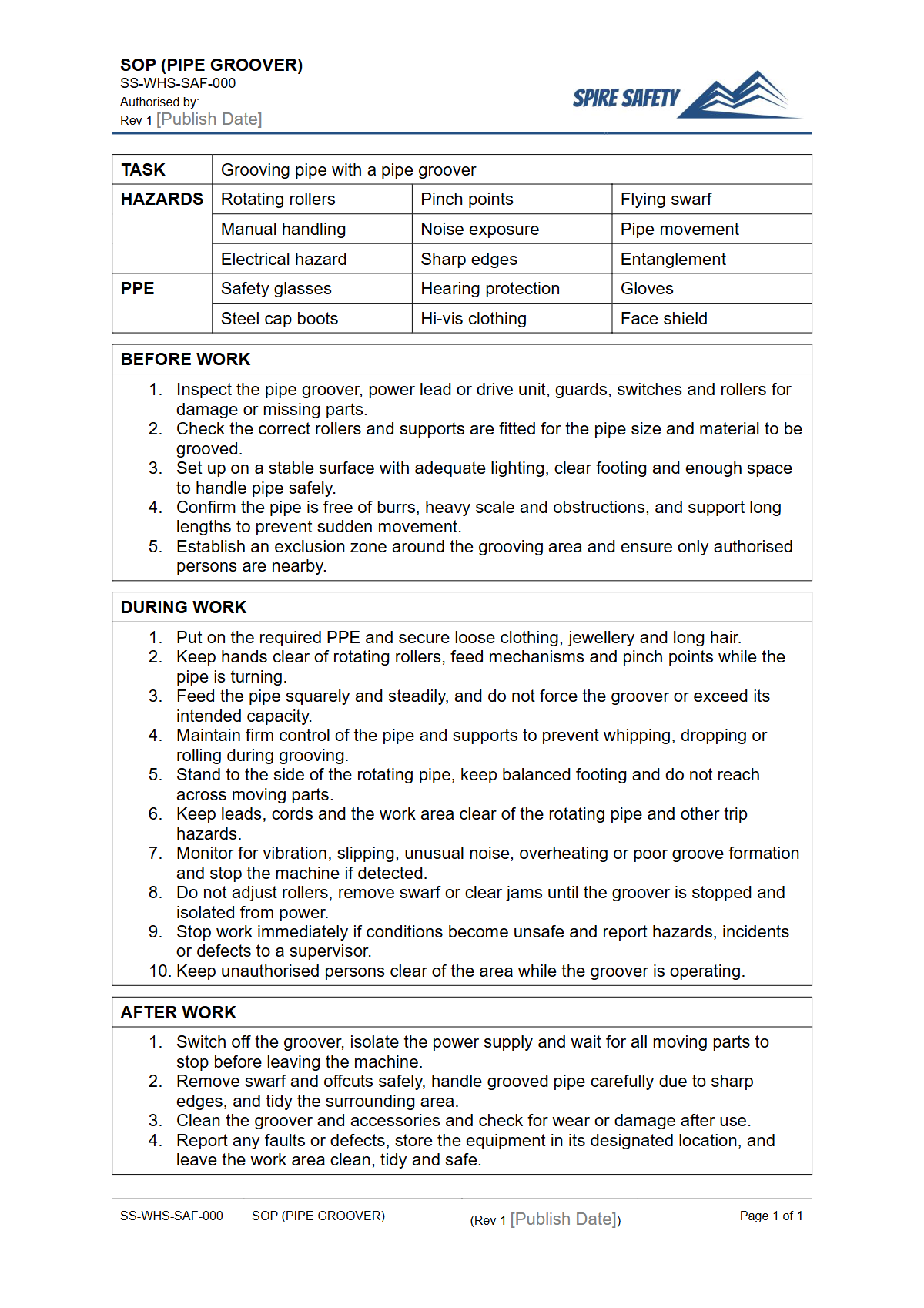
Download our free Safe Operating Procedure (Pipe Groover) template. This document helps you outline step-by-step safety controls for pipe grooving tasks.
Free Safe Operating Procedure (Pipe Groover) Template
DOCX • 126 KB + PDF
Updated Oct 2026
No signup required
Purpose of the Free Safe Operating Procedure (Pipe Groover) Template
This Free Safe Operating Procedure (Pipe Groover) Template provides a structured starting point for documenting the safety requirements for operating a pipe grooving machine. A Safe Operating Procedure (SOP) is a fundamental risk control document that details a step-by-step process for a specific task, aiming to minimise the risk of injury or incident.
Pipe groovers, with their powerful rotating components, present significant hazards, including entanglement, crushing, and lacerations. Using this template helps your organisation meet its duty of care by providing clear instructions for workers.
Developing a comprehensive SOP is a key component of effective safety management. It integrates hazard identification, risk assessment, and control measures into a practical, easy-to-follow guide for employees.
This process ensures that safety isn't an afterthought but is built into the way work is performed. An SOP also serves as a critical training tool for new operators and a benchmark for refresher training and competency assessments.
Video walkthrough
How to use the Free Safe Operating Procedure (Pipe Groover) Template
Our template is provided in both DOCX and PDF formats for your convenience. To create a site-specific document, download the DOCX file and adapt it to your unique operational context.
It is crucial to customise this template thoroughly. Your final SOP must reflect the specific make and model of the pipe groover in use, the types of pipes being processed, and the unique environmental conditions of your workshop or site.
Important: This document is a template only. We cannot guarantee it will be suitable for your specific circumstances.
You must customise the information to align with your equipment, operational risks, and internal procedures. Always consult the manufacturer’s operating manual and conduct a site-specific risk assessment.
For tasks involving other workshop equipment, you may also find our free Air Compressor SOP useful for standardising associated procedures.
When to use a Pipe Groover Safe Operating Procedure
A Safe Operating Procedure for a pipe groover should be used consistently as a reference and control measure. It is essential during the induction and training of new operators to establish safe work habits from the start.
The SOP should be readily available near the machine for quick reference before and during operation, especially for non-routine tasks. It is also a vital tool for supervisors conducting pre-start checks or safety observations, and for reviewing work practices following an incident or near-miss.
Regular reviews of the SOP are also critical. The procedure should be revisited and updated whenever a new model of pipe groover is introduced, when the process changes, or at scheduled intervals as part of a continuous improvement cycle within your safety framework.
Establishing these review triggers helps ensure your safety documentation remains relevant and effective. This proactive approach is a cornerstone of robust WHS management systems.
Who should use this Safe Operating Procedure
This SOP is intended for a range of personnel within organisations that utilise pipe grooving equipment, common in plumbing, fire protection, and mechanical services industries. Primary users include the machine operators themselves, who must follow the procedure to ensure their own safety and that of others nearby.
Supervisors and team leaders are responsible for enforcing the SOP, providing training, and ensuring operator competency.
Work Health and Safety (WHS) managers and coordinators will use this template as a foundation for developing and integrating machine-specific procedures into the broader company safety system. It can also be a valuable resource for maintenance personnel, outlining safe procedures for isolation, lockout-tagout (LOTO), and servicing.
For other high-risk tools on site, consider implementing similar documents, such as our Circular Saw SOP, to maintain a consistent approach to safety.
Implementing and Reviewing your SOP
Once you have customised your pipe groover SOP, its implementation is the next step. Ensure all relevant workers are trained on the new procedure and understand its importance.
A practical demonstration is often more effective than just reading the document. Store the finalised SOP in a location where it is easily accessible to all operators.
Periodic reviews ensure the SOP remains a living document. A formal process of WHS compliance auditing can help verify that the documented procedures are being followed in practice and are still effective at controlling risks.
Remember to consult with your workers during the review process; their direct experience operating the machinery provides invaluable feedback for improving safety. If your operations involve extensive site work, you might also require procedures for other plant, such as our Trencher SOP template.
By consistently applying, reviewing, and improving your safe work procedures, you foster a proactive safety culture. For more templates and guidance documents, feel free to browse our free WHS resources library.
Common mistakes
Common mistakes to avoid
- Failing to securely clamp the pipe in the machine before starting the operation.
- Wearing loose clothing, untied long hair, or jewellery that can become entangled.
- Attempting to clear swarf or adjust the machine while it is still running.
- Using the incorrect size or type of grooving roll set for the pipe diameter and material.
Legal references
Legal considerations
The following legal requirements may be relevant to this type of work.
- Work Health and Safety Act (Harmonised) — Provides the primary duties for protecting workers and other people from work health and safety risks.
- Work Health and Safety Regulations (Harmonised) — Sets out requirements supporting the management of workplace hazards and risks.
The following codes may be relevant to this type of work.
- Managing WHS Risks Code of Practice — Provides practical guidance on identifying hazards, assessing risks and applying effective controls.
- Work Health and Safety Consultation, Cooperation and Coordination Code of Practice — Provides practical guidance on consulting workers and coordinating with other duty holders.
- Managing the Work Environment and Facilities Code of Practice — Provides practical guidance on safe work environments, workplace facilities and related controls.
Did you know
Roll Grooving vs. Cut Grooving
Roll grooving is a cold-forming process that displaces pipe material to form a groove, whereas cut grooving removes material. Roll grooving is faster and generally preferred as it doesn't reduce the pipe wall's hydraulic capacity.
Entanglement Risks
Entanglement in rotating machinery is a leading cause of severe hand and finger injuries in workshops. A machine rotating at just one revolution per second can wrap a loose glove or sleeve around a shaft before an operator can react.
FAQ
Frequently asked questions
01What are the main hazards of operating a pipe groover?
02Is a Safe Operating Procedure legally required for a pipe groover?
03How often should a pipe groover SOP be reviewed?
04What Personal Protective Equipment (PPE) is needed for pipe grooving?
Share this resource
Free Safe Operating Procedure (Pipe Groover) Template
Browse Categories
How To Use It
- 1Download and open in Word or PDF.
- 2Replace the placeholders with your business details.
- 3Get it reviewed by a WHS specialist before rollout.
Need it customised?
Our WHS consultants can adapt this template to your site, run a gap analysis, or audit what you already have in place.
Book a Free Consultation WHS consulting servicesor call 1300 156 382
Related templates
- Free Safe Operating Procedure (Pipe Locator) Template
- Free Safe Operating Procedure (Pipe Pressure Test) Template
- Free Safe Operating Procedure (Pipe Reamer) Template
- Free Safe Operating Procedure (Pipe Saw) Template
- Free Safe Operating Procedure (Pipe Stand) Template
- Free Safe Operating Procedure (Pipe Threader) Template