
Free Safe Operating Procedure (Pipe Locator) Template
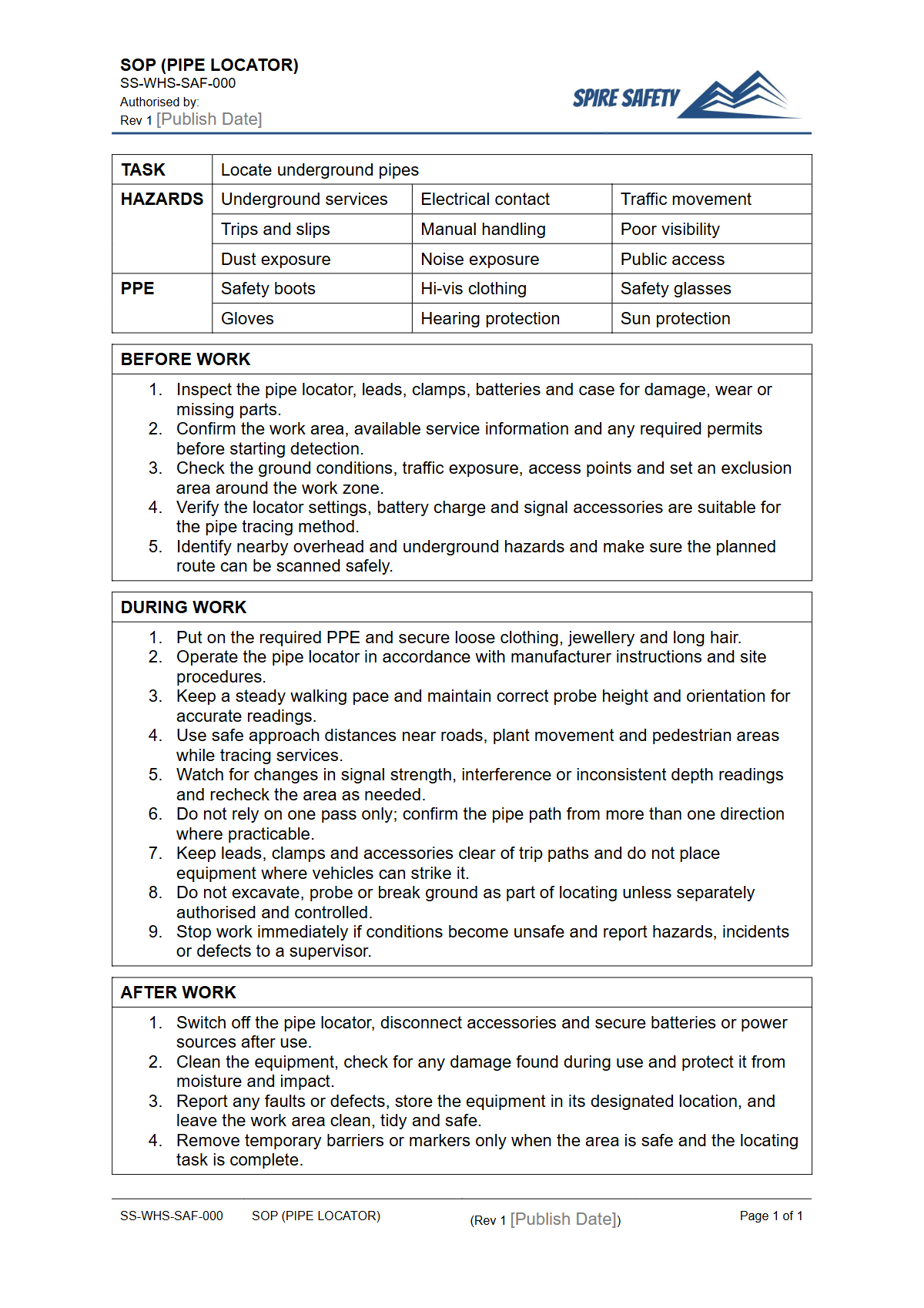
Download our free Safe Operating Procedure (Pipe Locator) Template to formalise safe work practices. This customisable DOCX and PDF helps your team stay safe.
Free Safe Operating Procedure (Pipe Locator) Template
DOCX • 126 KB + PDF
Updated Oct 2026
No signup required
Purpose of the Free Safe Operating Procedure (Pipe Locator) Template
Operating a pipe locator is a critical task for preventing catastrophic damage to underground utilities. Our Free Safe Operating Procedure (Pipe Locator) Template provides a structured framework for outlining safe work methods, managing associated risks, and ensuring operational consistency.
Using a detailed SOP helps protect workers from hazards like electric shock, explosions from gas line breaches, and exposure to hazardous materials, while also preventing costly service disruptions and project delays.
This template is designed to be a foundational document within your broader safety framework. Integrating clear, task-specific SOPs is a key element of effective WHS management systems, demonstrating a proactive approach to risk control and due diligence.
By standardising the process for locating and marking underground assets, you create a safer environment for everyone on site.
What is a Pipe Locator?
A pipe locator, also known as a cable locator or utility detector, is an electronic instrument used to detect and trace underground services. It typically consists of a transmitter and a receiver.
The transmitter applies a specific frequency signal to a conductive utility (like a metal pipe or cable), and the receiver detects the electromagnetic field created by this signal, allowing the operator to pinpoint the asset's location and depth.
Video walkthrough
How to use the Free Safe Operating Procedure (Pipe Locator) Template
This resource is available as a fully editable DOCX file and a print-ready PDF. The DOCX version is designed for easy customisation to suit your specific workplace requirements.
It is essential to adapt this document to your operational context. We have provided a comprehensive starting point, but you must review and modify it to reflect your specific pipe locator models, site conditions, emergency procedures, and organisational policies.
Involving your workers in this customisation process is vital for creating a practical and effective document.
When customising the template, consider:
- Equipment Specifics: Include the make and model of the pipe locators used by your team.
- Site Conditions: Add details about common ground types, potential sources of interference, and site-specific hazards.
- Training and Competency: Specify the training and competency requirements for operators.
- PPE Requirements: List the personal protective equipment required for the task, such as high-visibility clothing and safety footwear.
If you need assistance tailoring this document or developing other safety documentation, our WHS consulting team can provide expert support to ensure your procedures are robust and fit for purpose.
When to use it
A Safe Operating Procedure for a pipe locator should be developed, reviewed, and implemented before any work that involves ground penetration begins. This includes activities such as excavation, drilling, fencing, landscaping, and driving posts or stakes into the ground.
It is a critical risk assessment tool used during the planning stages of civil, construction, and maintenance projects to prevent accidental utility strikes.
The procedure is essential for verifying information obtained from 'Dial Before You Dig' (DBYD) plans. While DBYD provides asset maps, a physical scan with a locator is necessary to confirm the exact position and depth of services on-site.
This SOP should be used in conjunction with any excavation permit-to-work system your organisation has in place. Following this procedure is particularly important before using heavy machinery, as documented in resources like our FREE Trencher SOP Template.
Once established, the SOP serves as a benchmark for operator training, performance monitoring, and incident investigations. Formalised procedures are also a key piece of evidence reviewed during WHS compliance auditing to verify that safe systems of work are being followed correctly.
Who should use it
This SOP is intended for all personnel involved in the detection and marking of underground utilities. This includes:
- Dedicated Utility Locators
- Civil Construction Workers
- Excavator and Plant Operators
- Plumbers and Electricians
- Site Supervisors and Forepersons
- Project Managers
Anyone who operates a pipe locator must be deemed competent and receive specific training on the procedure outlined in the SOP. Supervisors should also be familiar with the document to effectively monitor work, ensure procedures are followed, and intervene if unsafe behaviour is observed.
Having clear SOPs for all high-risk plant and equipment, including items covered by our Free Air Compressor SOP (Safe Operating Procedure) Template, helps build a consistent safety culture across all site activities.
By implementing a clear, well-communicated SOP, you ensure that every team member understands the risks and the required control measures. For more templates and safety documents, browse our complete free WHS resources library.
Common mistakes
Common mistakes to avoid
- Failing to check 'Dial Before You Dig' plans before starting work.
- Relying solely on the locator without visually inspecting the area for signs of utilities (e.g., pits, markers).
- Not accounting for signal distortion or interference from nearby metallic structures or overhead power lines.
- Using an incorrect frequency for the target utility, leading to inaccurate readings or missed assets.
- Forgetting to perform a function test or check battery levels on the locator before use.
Legal references
Legal considerations
The following legal requirements may be relevant to this type of work.
- Work Health and Safety Act (Harmonised) — Provides the primary duties for protecting workers and other people from work health and safety risks.
- Work Health and Safety Regulations (Harmonised) — Sets out requirements supporting the management of workplace hazards and risks.
The following codes may be relevant to this type of work.
- Managing WHS Risks Code of Practice — Provides practical guidance on identifying hazards, assessing risks and applying effective controls.
- Work Health and Safety Consultation, Cooperation and Coordination Code of Practice — Provides practical guidance on consulting workers and coordinating with other duty holders.
- Managing the Work Environment and Facilities Code of Practice — Provides practical guidance on safe work environments, workplace facilities and related controls.
Did you know
Hidden Dangers
Utility strikes are a major industry risk. In Australia, the cost of a single incident involving damage to a major fibre-optic cable or high-pressure gas main can easily exceed hundreds of thousands of dollars in repairs and associated damages.
The Science of Locating
Most pipe locators work using electromagnetic induction. A transmitter energises a metallic pipe or cable with an AC signal, creating an electromagnetic field that can be detected from the surface by a specialised receiver.
FAQ
Frequently asked questions
01What should be included in a Safe Operating Procedure for a pipe locator?
02Why is 'Dial Before You Dig' essential before using a pipe locator?
03How often should pipe locator operators receive training?
04Can a generic SOP be used for all types of pipe locators?
Share this resource
Free Safe Operating Procedure (Pipe Locator) Template
Browse Categories
How To Use It
- 1Download and open in Word or PDF.
- 2Replace the placeholders with your business details.
- 3Get it reviewed by a WHS specialist before rollout.
Need it customised?
Our WHS consultants can adapt this template to your site, run a gap analysis, or audit what you already have in place.
Book a Free Consultation WHS consulting servicesor call 1300 156 382
Related templates
- Free Safe Operating Procedure (Pipe Pressure Test) Template
- Free Safe Operating Procedure (Pipe Reamer) Template
- Free Safe Operating Procedure (Pipe Saw) Template
- Free Safe Operating Procedure (Pipe Stand) Template
- Free Safe Operating Procedure (Pipe Threader) Template
- Free Safe Operating Procedure (Pipe Vice) Template