
Free Safe Operating Procedure (Pipe Camera) Template
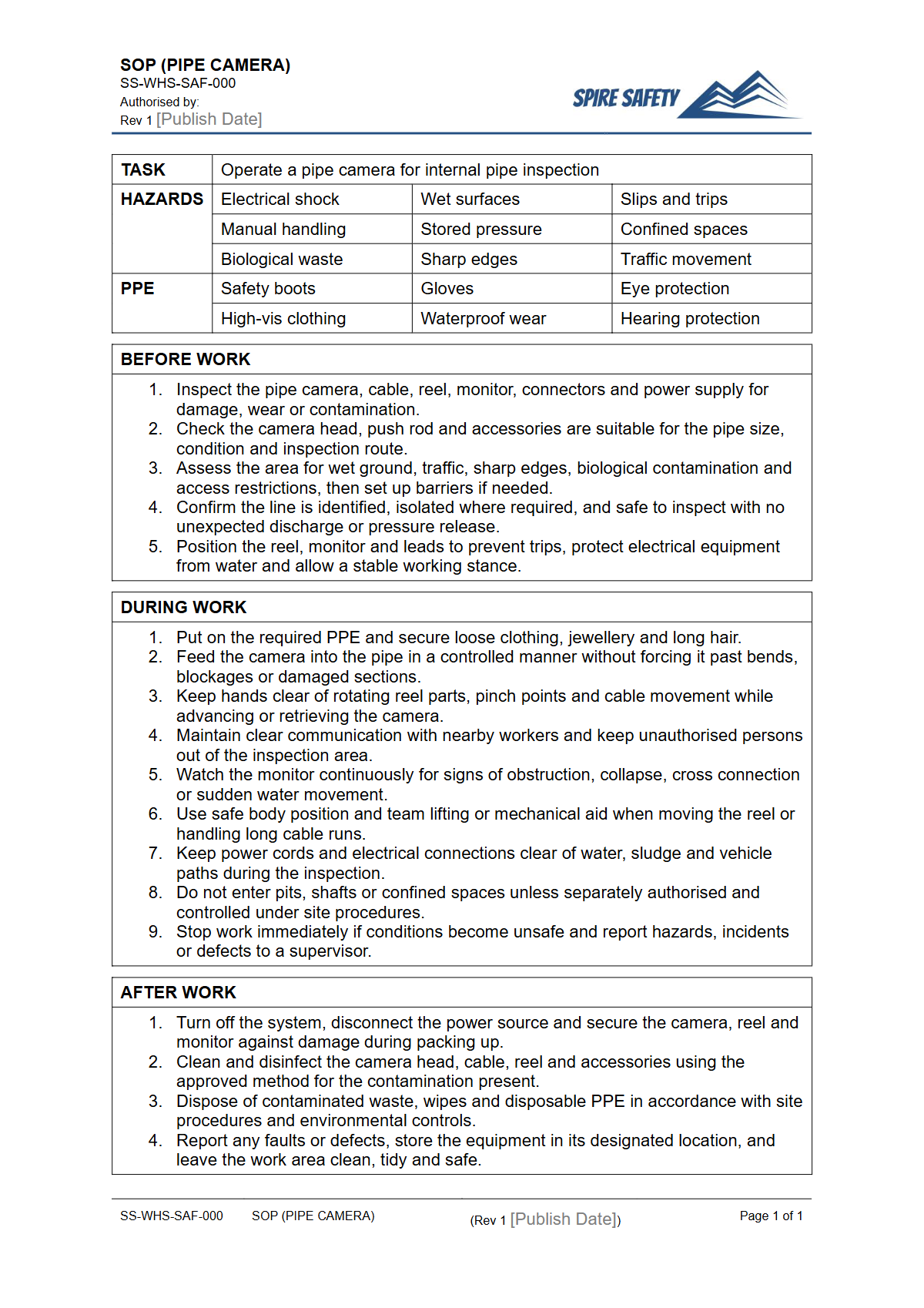
Our free Safe Operating Procedure (Pipe Camera) template provides a structured format for documenting safety steps.
Free Safe Operating Procedure (Pipe Camera) Template
DOCX • 126 KB + PDF
Updated Oct 2026
No signup required
Purpose of the Free Safe Operating Procedure (Pipe Camera) Template
This Safe Operating Procedure (SOP) template outlines a systematic approach to safely operating a pipe inspection camera. Using a detailed free Safe Operating Procedure (Pipe Camera) template is essential for businesses in plumbing, drainage, construction, and asset maintenance to manage risks and ensure worker safety.
It provides a clear, step-by-step guide covering pre-operational checks, safe operation, and post-use procedures to minimise hazards such as electric shock, manual handling injuries, and exposure to biological contaminants.
A well-documented SOP serves as a crucial training tool for new operators and a consistent reference for experienced personnel. It helps standardise work methods, ensuring that safety protocols are consistently applied across all jobs.
Integrating this procedure into your broader safety framework demonstrates a commitment to fulfilling your duty of care under Australian WHS legislation. Documenting procedures for associated activities, like those covered in a free Trencher SOP template, can further enhance site safety during excavation and pipe access works.
Video walkthrough
How to use the Free Safe Operating Procedure (Pipe Camera) Template
This document is a template designed to be a starting point. It is not a complete, ready-to-use procedure.
You must customise this SOP to reflect the specific pipe camera models used in your workplace, the unique environments you operate in, and your organisation's existing safety policies.
To effectively use this template:
- Review and Customise: Add or remove steps to align with the manufacturer's operating manual for your specific camera system. Include details about your equipment's controls, features, and limitations.
- Site-Specific Risks: Incorporate hazards unique to your typical work sites, such as working in confined spaces, near live traffic, or in poor weather conditions. Conduct a risk assessment to identify these hazards.
- Consultation: Involve workers who regularly use the equipment in the customisation process. Their practical experience is invaluable for creating a procedure that is both safe and workable.
- Training: Once finalised, use the SOP as a core document for training and competency assessments for all operators.
- Review: Schedule regular reviews of the SOP (e.g., annually, or after an incident) to ensure it remains current and effective.
Remember, this template is a guide. We have taken care in its development, but its effectiveness depends entirely on how you adapt it to your specific workplace conditions and legal obligations. This process is a fundamental part of building robust WHS management systems that protect your workers and your business.
When to use it
A Pipe Camera SOP should be used every time the equipment is operated. It is not just for complex jobs but forms the baseline for all usage, ensuring safety is never an afterthought. It is particularly critical during:
- Operator Training: As the primary document for inducting and training new or inexperienced workers on the equipment.
- Pre-Start Checks: To guide the operator through a consistent inspection of the camera, cable, monitor, and power supply before starting work.
- Routine Operations: As a reference to reinforce correct procedures for deploying, navigating, and retrieving the camera head.
- Incident Investigations: To provide a benchmark of expected safe practice when investigating an accident or near miss involving the equipment.
- Audits and Inspections: To demonstrate to regulators or internal auditors that a formal, safe system of work is in place for the task.
Standardising procedures for all site machinery is best practice. This approach ensures consistency, whether operators are using a pipe camera or other equipment detailed in documents like a Conveyer System SOP.
Who should use it
This Safe Operating Procedure is intended for all personnel involved with the use and supervision of pipe inspection cameras. This includes:
- Operators: Plumbers, drain technicians, building inspectors, and maintenance workers who physically handle and operate the equipment.
- Supervisors and Managers: Individuals responsible for overseeing work, ensuring procedures are followed, and confirming that operators are competent.
- WHS/HSE Personnel: Safety professionals who develop, implement, and review safety procedures as part of the organisation's overall safety management system.
- Training Coordinators: Those who use the SOP to develop training materials and conduct competency assessments for pipe camera operators.
Regularly reviewing the implementation of SOPs is a key activity in maintaining compliance and identifying areas for improvement. This can be formally assessed through dedicated WHS compliance auditing activities.
By making this procedure accessible to all relevant staff, you foster a proactive safety culture where everyone understands the risks and the controls required for safe operation. For more structured safety documents, explore our complete free WHS resources library.
Common mistakes
Common mistakes to avoid
- Failing to inspect the equipment (cable, camera head, power source) before use.
- Not using appropriate PPE, especially waterproof gloves and eye protection.
- Forcing the camera cable through a blockage, leading to damage or getting it stuck.
- Neglecting to properly clean and sanitise the equipment after use, posing a biological hazard.
Legal references
Legal considerations
The following legal requirements may be relevant to this type of work.
- Work Health and Safety Act (Harmonised) — Provides the primary duties for protecting workers and other people from work health and safety risks.
- Work Health and Safety Regulations (Harmonised) — Sets out requirements supporting the management of workplace hazards and risks.
The following codes may be relevant to this type of work.
- Managing WHS Risks Code of Practice — Provides practical guidance on identifying hazards, assessing risks and applying effective controls.
- Work Health and Safety Consultation, Cooperation and Coordination Code of Practice — Provides practical guidance on consulting workers and coordinating with other duty holders.
- Managing the Work Environment and Facilities Code of Practice — Provides practical guidance on safe work environments, workplace facilities and related controls.
Did you know
Pushing Limits
Some advanced pipe inspection cameras have a push range of over 100 metres and can navigate multiple bends, sending back high-definition video in real-time to the operator.
Beyond Blockages
Pipe cameras are not just for finding blockages. They are critical tools for pre-purchase property inspections, assessing pipe integrity, and mapping out undocumented drainage systems.
FAQ
Frequently asked questions
01What are the main hazards when using a pipe inspection camera?
02How often should a Safe Operating Procedure for a pipe camera be reviewed?
03Is a Safe Operating Procedure a legal requirement in Australia?
04Can this template be used for any brand of pipe camera?
Share this resource
Free Safe Operating Procedure (Pipe Camera) Template
Browse Categories
How To Use It
- 1Download and open in Word or PDF.
- 2Replace the placeholders with your business details.
- 3Get it reviewed by a WHS specialist before rollout.
Need it customised?
Our WHS consultants can adapt this template to your site, run a gap analysis, or audit what you already have in place.
Book a Free Consultation WHS consulting servicesor call 1300 156 382
Related templates
- Free Safe Operating Procedure (Pipe Cutter) Template
- Free Safe Operating Procedure (Pipe Expander) Template
- Free Safe Operating Procedure (Pipe Facing Machine) Template
- Free Safe Operating Procedure (Pipe Freezer) Template
- Free Safe Operating Procedure (Pipe Groover) Template
- Free Safe Operating Procedure (Pipe Locator) Template