
Free Safe Operating Procedure (Pipe Cutter) Template
Download our free Safe Operating Procedure (Pipe Cutter) template to document safe work methods. Get started with this customisable Word and PDF resource today.
Free Safe Operating Procedure (Pipe Cutter) Template
DOCX • 126 KB + PDF
Updated Oct 2026
No signup required
Purpose of the Free Safe Operating Procedure (Pipe Cutter) Template
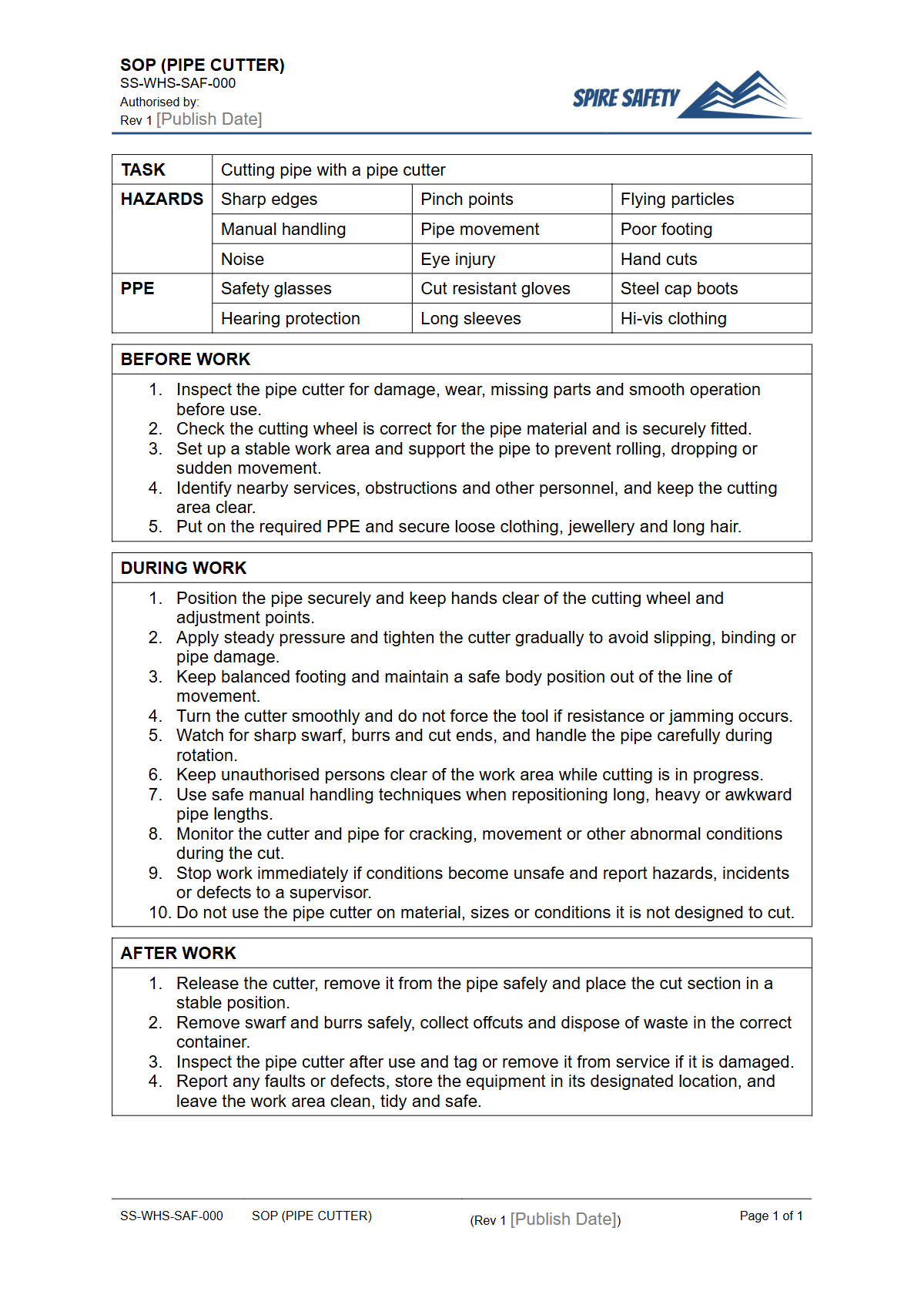
This Free Safe Operating Procedure (Pipe Cutter) Template provides a structured framework for documenting the safe use of manual, electric, and hydraulic pipe cutters. Its primary purpose is to help organisations establish and communicate a consistent, safe method for cutting various types of pipes, minimising risks to operators and bystanders.
By outlining pre-operational checks, step-by-step instructions, and required personal protective equipment (PPE), this SOP helps meet the duty of care to provide a safe system of work. It serves as a critical training tool for new workers and a refresher for experienced personnel, ensuring everyone understands the hazards and control measures associated with the task.
Using a standardised procedure promotes a proactive safety culture and operational consistency. It formalises risk management for a common but potentially hazardous task, covering issues like sharp edges, pinch points, and ergonomic strain.
Documenting these procedures is a fundamental part of developing robust WHS management systems, providing clear evidence of your organisation's commitment to safety. This template is designed to be adapted to different types of pipe cutters and specific workplace environments, from plumbing and HVAC to industrial and civil construction projects.
Video walkthrough
How to use the Free Safe Operating Procedure (Pipe Cutter) Template
Our Safe Operating Procedure (Pipe Cutter) Template is provided as a starting point in both DOCX and PDF formats. To use it effectively, you must customise it to reflect the specific equipment, materials, and working conditions at your site.
Start by downloading the DOCX file and adding your company name, logo, and other relevant details. Walk through each section and replace the placeholder text with information specific to your pipe cutting tasks, including the exact make and model of the cutters used, the types of pipe materials encountered (e.g., copper, PVC, steel), and the environment where the work occurs.
It is crucial to involve workers who regularly use pipe cutters in the customisation process. Their practical experience is invaluable for identifying specific hazards and effective controls.
Once drafted, the SOP should be reviewed and approved by a competent person, such as a supervisor or WHS manager. Ensure the final document is easily accessible to all relevant workers.
Please note: this document is a template only. We are not responsible for its customisation or implementation.
You must adapt it to your specific legal and operational requirements to ensure it is suitable for your workplace.
When to use it
A Safe Operating Procedure for a pipe cutter should be used whenever a worker is required to cut pipes as part of their job. This includes routine maintenance, installation projects, and fabrication tasks.
It is especially important when training new employees or apprentices, as it provides them with a clear, step-by-step guide to follow. The SOP should also be referenced during toolbox talks or pre-start meetings before any pipe cutting work begins.
For high-risk tasks, the SOP can inform the development of a Safe Work Method Statement (SWMS). Procedures should also be reviewed and updated after any incident, when new equipment is introduced, or when processes change.
For tasks involving other powered cutting tools, you may also need specific procedures. Consider using our free Circular Saw SOP template for activities that involve cutting timber, metal, or masonry alongside pipe work.
Who should use it
This SOP is intended for use by any person required to operate a pipe cutter, including plumbers, pipefitters, mechanics, construction workers, and maintenance personnel. Supervisors and managers are responsible for ensuring that workers are trained in the SOP and that its procedures are followed correctly.
WHS personnel can use this template as part of their efforts to standardise safety documentation across the organisation. It is a valuable resource for anyone involved in task planning, risk assessment, and safety training related to pipe cutting operations.
The principles in this SOP can be applied to a variety of tools and equipment. For instance, if your work involves excavation for pipe laying, you might find our FREE Trencher SOP Template a useful complementary resource for managing ground-engaging plant.
A well-drafted SOP is a key part of any safety system, but it must be supported by practical training and supervision. For complex or high-risk projects, you may need broader support from external safety experts.
Engaging professional WHS consulting services can help ensure your safety systems are practical, effective, and aligned with industry best practice.
This template is just one of many documents available in our comprehensive free WHS resources library, which offers a wide range of tools to support your safety management efforts.
Common mistakes
Common mistakes to avoid
- Using the wrong type of cutter for the pipe material (e.g., a plastic pipe cutter on metal).
- Failing to properly deburr the pipe after cutting, leaving sharp edges that pose a laceration hazard.
- Not inspecting the cutting wheel for dullness, chips, or damage before use.
- Applying excessive force, which can damage the tool, deform the pipe, or lead to operator injury.
Legal references
Legal considerations
The following legal requirements may be relevant to this type of work.
- Work Health and Safety Act (Harmonised) — Provides the primary duties for protecting workers and other people from work health and safety risks.
- Work Health and Safety Regulations (Harmonised) — Sets out requirements supporting the management of workplace hazards and risks.
The following codes may be relevant to this type of work.
- Managing WHS Risks Code of Practice — Provides practical guidance on identifying hazards, assessing risks and applying effective controls.
- Work Health and Safety Consultation, Cooperation and Coordination Code of Practice — Provides practical guidance on consulting workers and coordinating with other duty holders.
- Managing the Work Environment and Facilities Code of Practice — Provides practical guidance on safe work environments, workplace facilities and related controls.
Did you know
A Cut Above
Pipe cutters are designed for specific materials. Using a copper pipe cutter on a steel pipe will not only fail to cut the pipe but will also destroy the cutting wheel, creating a significant safety hazard from a potentially shattering wheel.
Ergonomic Design
Many modern manual pipe cutters feature ergonomic designs, such as telescoping handles or ratchet mechanisms, to reduce the physical force required by the operator. This helps to minimise the risk of musculoskeletal disorders associated with repetitive use.
FAQ
Frequently asked questions
01What are the main hazards when using a pipe cutter?
02How often should a Safe Operating Procedure for a pipe cutter be reviewed?
03Does every type of pipe cutter need its own SOP?
04Is a Safe Work Method Statement (SWMS) the same as an SOP for a pipe cutter?
Share this resource
Free Safe Operating Procedure (Pipe Cutter) Template
Browse Categories
How To Use It
- 1Download and open in Word or PDF.
- 2Replace the placeholders with your business details.
- 3Get it reviewed by a WHS specialist before rollout.
Need it customised?
Our WHS consultants can adapt this template to your site, run a gap analysis, or audit what you already have in place.
Book a Free Consultation WHS consulting servicesor call 1300 156 382
Related templates
- Free Safe Operating Procedure (Pipe Expander) Template
- Free Safe Operating Procedure (Pipe Facing Machine) Template
- Free Safe Operating Procedure (Pipe Freezer) Template
- Free Safe Operating Procedure (Pipe Groover) Template
- Free Safe Operating Procedure (Pipe Locator) Template
- Free Safe Operating Procedure (Pipe Pressure Test) Template