
Free Safe Operating Procedure (Pipe Bender) Template
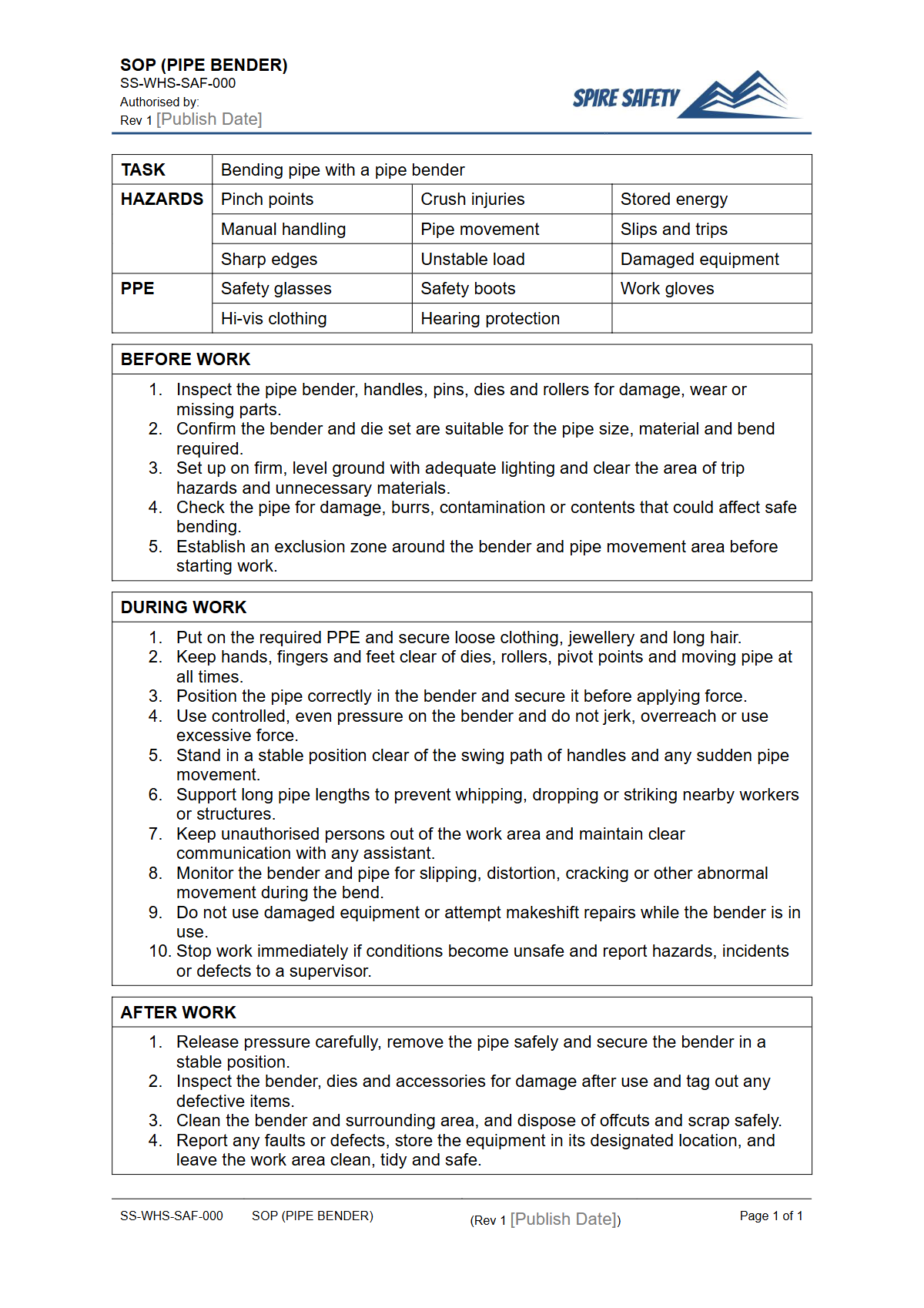
Download our free Safe Operating Procedure (Pipe Bender) Template to formalise your workplace safety protocols. Get your customisable DOCX and PDF now.
Free Safe Operating Procedure (Pipe Bender) Template
DOCX • 126 KB + PDF
Updated Oct 2026
No signup required
Purpose of the Free Safe Operating Procedure (Pipe Bender) Template
Operating a pipe bender, whether manual, hydraulic, or electric, involves significant risks if not managed correctly. This free Safe Operating Procedure (Pipe Bender) Template provides a structured framework for documenting the step-by-step process required to use this equipment safely.
It helps your organisation detail critical safety information, including pre-operational checks, personal protective equipment (PPE) requirements, and emergency responses. By implementing a clear and specific SOP, you can effectively manage hazards like crushing, entanglement, ergonomic strain, and electrical shock, which are common with pipe bending tasks.
Formalising your procedures is a fundamental component of effective safety management. A well-developed SOP for pipe benders demonstrates a commitment to worker safety and serves as a vital record for training, inductions, and risk assessments.
Integrating specific procedures like this into broader WHS management systems ensures a consistent and systematic approach to controlling risks across all of your business operations.
Video walkthrough
How to Use the Free Safe Operating Procedure (Pipe Bender) Template
Our template is designed for ease of use and customisation. Simply download the resource in your preferred format (DOCX or PDF) and adapt it to your specific workplace needs.
The document is structured with clear headings covering every stage of the pipe bending process, from initial setup to shutdown and cleaning. You can easily add, remove, or modify sections to align with the particular make and model of your equipment and the types of materials you work with.
IMPORTANT: This document is a template and not a finished Safe Operating Procedure. To be effective and meet your legal obligations, you must consult with your workers and customise the content for your specific machinery, tasks, and environment.
A generic procedure is insufficient for ensuring safety. For example, the power source and setup for your pipe bender may be different from that of other equipment, just as our Free Air Compressor SOP (Safe Operating Procedure) Template outlines different specific hazards related to compressed air systems.
When to Use This Safe Operating Procedure
A Safe Operating Procedure for a pipe bender should be a living document that is used consistently throughout your operations. It is not a 'set and forget' policy.
It should be used as the primary training document for any worker before they are authorised to use the equipment. It also serves as a critical tool during routine supervision and for conducting refresher training to prevent skill fade or complacency.
Furthermore, this SOP should be referenced when conducting a risk assessment on pipe bending tasks or when investigating an incident or near miss. Regular reviews of the procedure are also essential, especially after any changes to equipment, personnel, or processes.
These activities are often scrutinised during formal safety evaluations, making robust documentation a key part of your preparation for a WHS compliance auditing process.
Who Should Use This Safe Operating Procedure
This SOP is intended for multiple roles within an organisation. Primarily, it is for the operators of the pipe bender, providing them with clear, unambiguous instructions to perform their work safely.
Supervisors and managers must also use the SOP to ensure workers are trained correctly, are following the procedure, and are competent to operate the machinery without direct supervision.
Work Health and Safety (WHS) managers or representatives will use this template as a foundational element for building a safe system of work for plant and equipment. It provides a basis for risk control, consultation, and record-keeping.
If you require assistance tailoring this document or developing a broader safety framework, consider seeking expert guidance through professional WHS consulting services.
What's Inside the Template?
This comprehensive template provides prompts and sections to help you build a thorough SOP. It covers the full lifecycle of a typical pipe bending task and is organised for clarity and ease of use. Key sections you will find inside include:
- Required Personal Protective Equipment (PPE): Specifies the minimum PPE required, such as safety glasses, gloves, and protective footwear.
- Pre-Operational Safety Checks: A checklist of inspections to perform on the machine before starting work, including checking hydraulic lines, guards, and controls. This process is similar to the pre-start checks you would find in our FREE Circular Saw SOP (Safe Operating Procedure) Template.
- Step-by-Step Operating Procedures: A logical sequence for safely setting up the machine, securing the workpiece, performing the bend, and removing the finished piece.
- Post-Operational Procedures: Outlines the required steps for powering down the machine, cleaning the work area, and storing equipment correctly.
- Emergency Procedures: Clear instructions on how to respond to an emergency, such as an equipment malfunction, injury, or hydraulic fluid spill.
This template provides the structure you need to create a robust and practical safety document. For more templates and safety resources covering a wide range of equipment and tasks, be sure to explore our complete free WHS resources library.
Common mistakes
Common mistakes to avoid
- Failing to use the correct size of die and former for the pipe diameter, leading to pipe damage or machine failure.
- Neglecting to inspect the pipe bender for hydraulic leaks, damaged parts, or faulty controls before use.
- Not securing the pipe correctly in the machine, allowing it to slip or spring back unexpectedly during the bending process.
- Using a generic SOP that doesn't reflect the specific model of pipe bender or the tasks performed in the workplace.
Legal references
Legal considerations
The following legal requirements may be relevant to this type of work.
- Work Health and Safety Act (Harmonised) — Provides the primary duties for protecting workers and other people from work health and safety risks.
- Work Health and Safety Regulations (Harmonised) — Sets out requirements supporting the management of workplace hazards and risks.
The following codes may be relevant to this type of work.
- Managing WHS Risks Code of Practice — Provides practical guidance on identifying hazards, assessing risks and applying effective controls.
- Work Health and Safety Consultation, Cooperation and Coordination Code of Practice — Provides practical guidance on consulting workers and coordinating with other duty holders.
- Managing the Work Environment and Facilities Code of Practice — Provides practical guidance on safe work environments, workplace facilities and related controls.
Did you know
Hydraulic Power
Many modern pipe benders use hydraulic systems that can exert forces exceeding 10 tonnes. This power is what allows them to bend thick steel pipe, but it also creates significant crush hazards.
Cold Bending
Most workshop pipe benders use a 'cold bending' process, which shapes the metal without pre-heating. This maintains the material's temper but requires precise control to avoid cracking or weakening the pipe at the bend.
FAQ
Frequently asked questions
01What are the common hazards associated with using a pipe bender?
02Is a Safe Operating Procedure a legal requirement for a pipe bender in Australia?
03How often should a pipe bender SOP be reviewed?
04Who is responsible for training workers on the pipe bender SOP?
Share this resource
Free Safe Operating Procedure (Pipe Bender) Template
Browse Categories
How To Use It
- 1Download and open in Word or PDF.
- 2Replace the placeholders with your business details.
- 3Get it reviewed by a WHS specialist before rollout.
Need it customised?
Our WHS consultants can adapt this template to your site, run a gap analysis, or audit what you already have in place.
Book a Free Consultation WHS consulting servicesor call 1300 156 382
Related templates
- Free Safe Operating Procedure (Pipe Beveler) Template
- Free Safe Operating Procedure (Pipe Camera) Template
- Free Safe Operating Procedure (Pipe Cutter) Template
- Free Safe Operating Procedure (Pipe Expander) Template
- Free Safe Operating Procedure (Pipe Facing Machine) Template
- Free Safe Operating Procedure (Pipe Freezer) Template