
Free Safe Operating Procedure (Piezometer) Template
Download our Free Safe Operating Procedure (Piezometer) Template to formalise your safety processes.
Free Safe Operating Procedure (Piezometer) Template
DOCX • 126 KB + PDF
Updated Oct 2026
No signup required
Purpose of the Free Safe Operating Procedure (Piezometer) Template
This Free Safe Operating Procedure (Piezometer) Template provides a structured framework for documenting the safe installation, monitoring, and decommissioning of piezometers. Piezometers are essential instruments in geotechnical engineering, construction, and mining for monitoring pore water pressure in soil and rock.
Establishing a clear SOP helps organisations manage the inherent risks associated with ground disturbance, drilling, and working near water, ensuring tasks are completed safely and consistently. This template is aligned with Australian WHS principles and is designed to be adapted to your specific operational needs.
Video walkthrough
How to use the Free Safe Operating Procedure (Piezometer) Template
This template is available for download as a DOCX file for easy editing and a PDF for straightforward printing and distribution. After downloading, a competent person must thoroughly customise the document to reflect your workplace's specific piezometer models, installation methods, site conditions, and risk control measures.
Generic procedures are insufficient for ensuring safety; this document must be made site-specific to be effective.
A Note on Customisation
IMPORTANT: This document is a template only. You must review and customise it to suit the specific equipment, chemicals, and processes used in your workplace.
We cannot be held responsible for its application. A thorough risk assessment should always be conducted before implementing any new procedure.
The final SOP must be developed in consultation with the workers who will be performing the task.
What is Included in the Template?
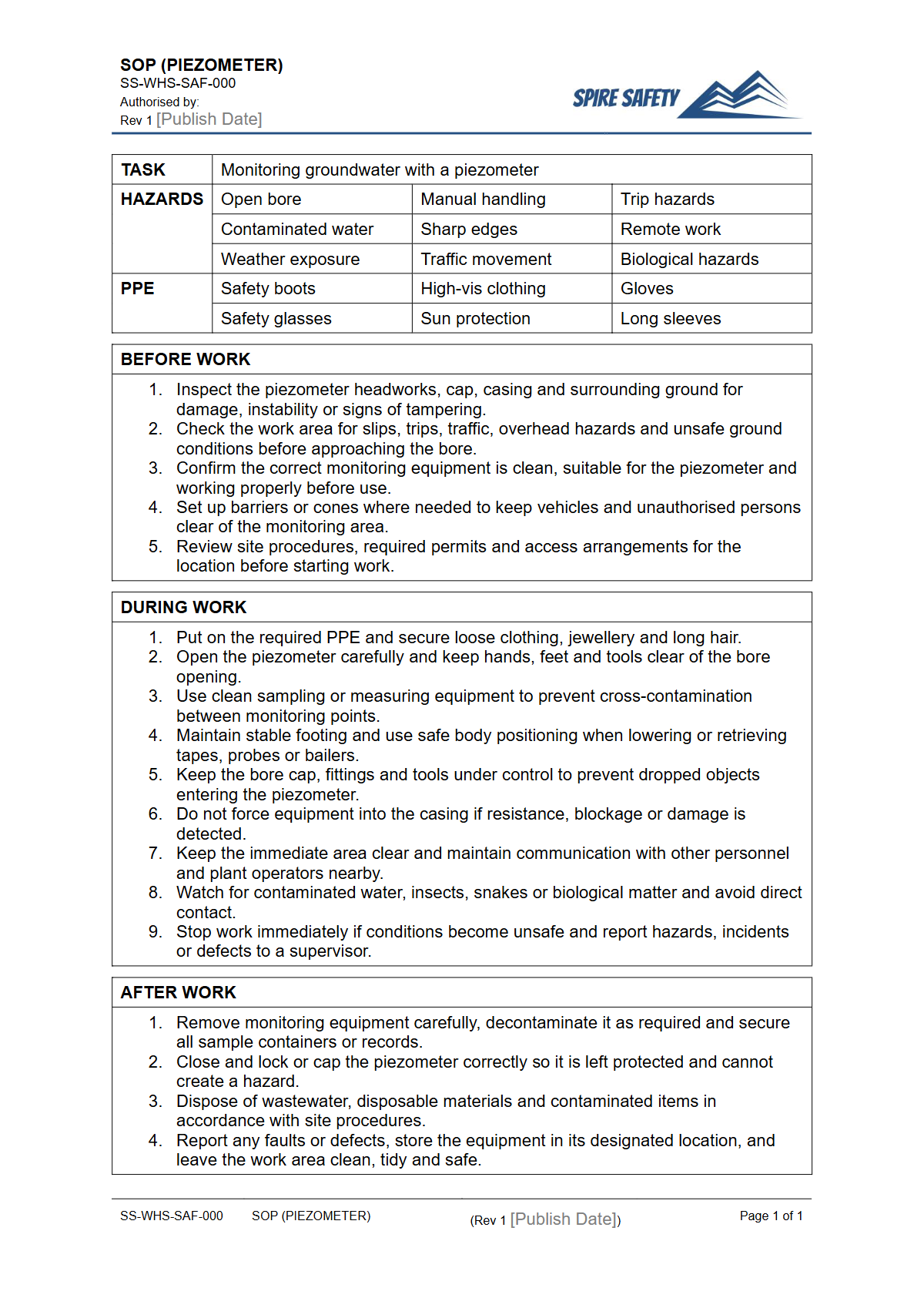
Our Piezometer SOP template is designed to be comprehensive, providing clear sections to guide you through the process of creating a robust safety document. Key sections include:
- Hazard Identification: A table to list potential hazards (e.g., underground services, soil collapse, manual handling) and corresponding control measures.
- Personal Protective Equipment (PPE): Specifies the required PPE for all stages of the task, such as hard hats, safety glasses, steel-capped boots, and high-visibility clothing.
- Step-by-Step Procedure: A logical sequence of tasks covering pre-start checks, site preparation, installation, data collection, and decommissioning.
- Training and Competency Requirements: Outlines the necessary training and qualifications for personnel involved.
- Emergency Procedures: Details the response plan in case of an incident or emergency.
A well-defined procedure is crucial, especially when the work involves related high-risk activities such as excavation. For tasks involving ground-breaking equipment, you may also need a FREE Trencher SOP Template to manage associated machinery risks.
When to Use a Piezometer SOP
A Safe Operating Procedure for piezometers should be developed, implemented, and communicated to all relevant workers before any installation or monitoring work begins. It forms a critical component of the project planning phase and should be integrated into broader site safety documentation. Using this SOP helps ensure that safety considerations are front-of-mind from the outset and that all activities are aligned with your organisation's WHS management systems.
Who Should Use This Safe Operating Procedure
This SOP is intended for use by a range of personnel involved in geotechnical and environmental projects. This includes:
- Geotechnical Engineers and Technicians
- Environmental Scientists and Consultants
- Construction Site Managers and Supervisors
- Drilling Contractors
- Work Health and Safety (WHS) Advisors and Managers
It serves as a vital tool for supervisors to induct and train workers, and for the workers themselves to understand the approved, safe method for completing their tasks. Should your organisation require external support, our WHS consulting services can provide expert guidance on developing and implementing effective safety procedures.
Maintaining Your SOP for Ongoing Effectiveness
An SOP is not a 'set and forget' document. To remain effective, it must be a living document that accurately reflects current practices and risks. It is essential to review and update your Piezometer SOP regularly, typically on an annual basis, or more frequently if there are changes to legislation, equipment, personnel, or following an incident. Scheduling regular reviews as part of a formal WHS compliance auditing program ensures that your safety documentation keeps pace with operational changes and continues to provide robust protection for your team. You can find more templates and checklists in our free WHS resources library to support your safety system.
Common mistakes
Common mistakes to avoid
- Failing to identify and control risks from underground services before drilling or excavation.
- Using a generic procedure that doesn't account for specific site geology or groundwater conditions.
- Inadequate training for personnel on the correct installation, reading, and maintenance of the specific piezometer model.
- Neglecting to decommission the piezometer correctly, potentially creating a pathway for contaminants.
Legal references
Legal considerations
The following legal requirements may be relevant to this type of work.
- Work Health and Safety Act (Harmonised) — Provides the primary duties for protecting workers and other people from work health and safety risks.
- Work Health and Safety Regulations (Harmonised) — Sets out requirements supporting the management of workplace hazards and risks.
The following codes may be relevant to this type of work.
- Managing WHS Risks Code of Practice — Provides practical guidance on identifying hazards, assessing risks and applying effective controls.
- Work Health and Safety Consultation, Cooperation and Coordination Code of Practice — Provides practical guidance on consulting workers and coordinating with other duty holders.
- Managing the Work Environment and Facilities Code of Practice — Provides practical guidance on safe work environments, workplace facilities and related controls.
Did you know
Geotechnical Roots
Piezometers have their origins in the 19th century but became crucial tools in the 20th century for major civil engineering projects like dams and tunnels, helping prevent catastrophic failures by monitoring water pressure.
FAQ
Frequently asked questions
01What is a piezometer and why does its use require a Safe Operating Procedure?
02Who is responsible for customising this Piezometer SOP template?
03How often should a Safe Operating Procedure for a piezometer be reviewed?
04Does this template cover all types of piezometers and installation methods?
Share this resource
Free Safe Operating Procedure (Piezometer) Template
Browse Categories
How To Use It
- 1Download and open in Word or PDF.
- 2Replace the placeholders with your business details.
- 3Get it reviewed by a WHS specialist before rollout.
Need it customised?
Our WHS consultants can adapt this template to your site, run a gap analysis, or audit what you already have in place.
Book a Free Consultation WHS consulting servicesor call 1300 156 382
Related templates
- Free Safe Operating Procedure (Pile Cropper) Template
- Free Safe Operating Procedure (Piling Hammer) Template
- Free Safe Operating Procedure (Pipe Bender) Template
- Free Safe Operating Procedure (Pipe Beveler) Template
- Free Safe Operating Procedure (Pipe Camera) Template
- Free Safe Operating Procedure (Pipe Cutter) Template