
Free Safe Operating Procedure (Pile Cropper) Template
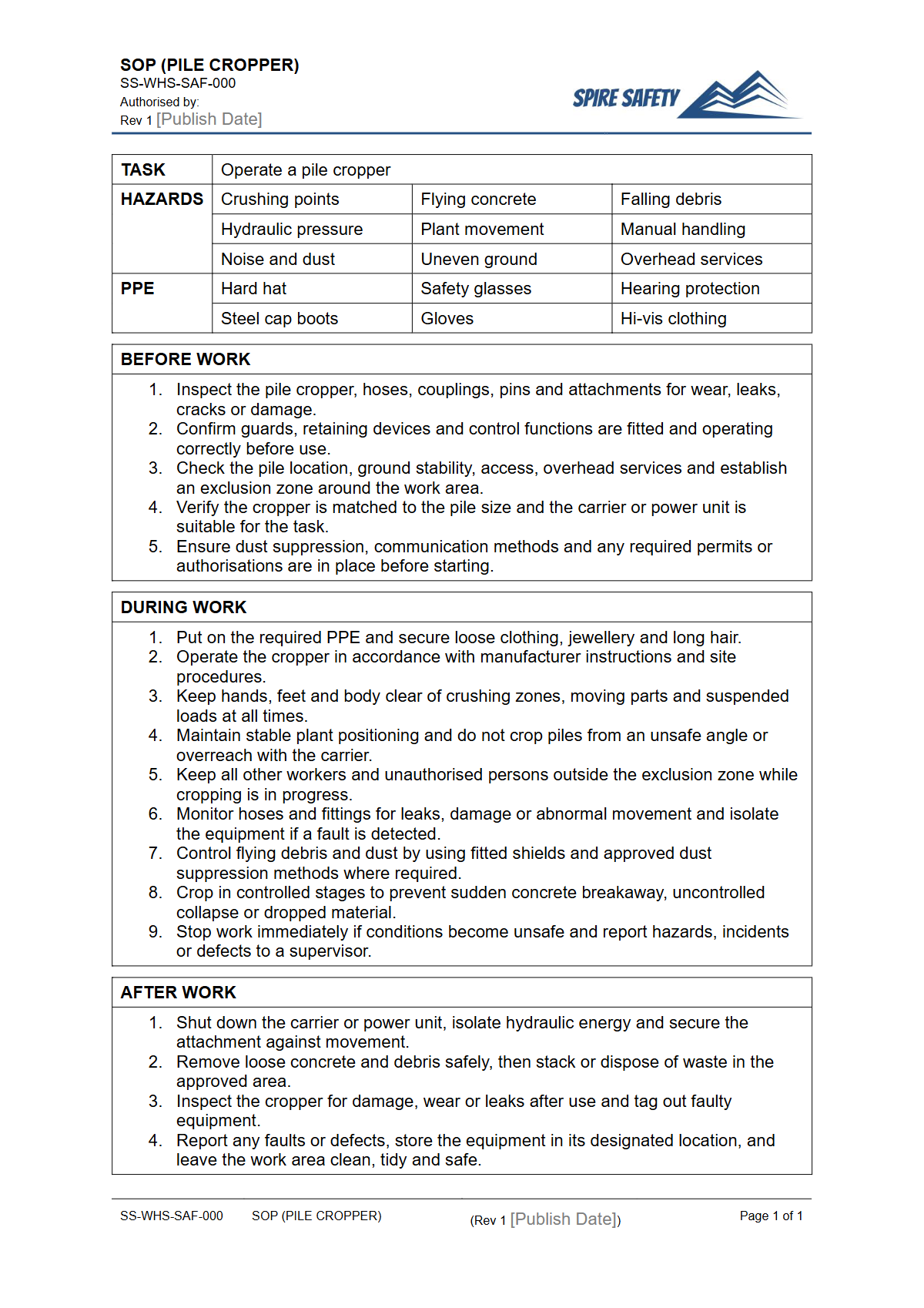
Download our free Safe Operating Procedure for pile croppers. This template helps you document safety steps and controls for operating pile cropping equipment.
Free Safe Operating Procedure (Pile Cropper) Template
DOCX • 126 KB + PDF
Updated Oct 2026
No signup required
Purpose of the Free Safe Operating Procedure (Pile Cropper) Template
Operating a pile cropper involves significant risks that must be carefully managed. Our Free Safe Operating Procedure (Pile Cropper) Template provides a structured framework to document the hazards and control measures associated with this specialised task.
Pile cropping, the process of demolishing concrete piles to a specific level, exposes workers to hazards such as high-pressure hydraulic fluid, falling concrete, uncontrolled movement of the attachment, loud noise, and vibration. A formal SOP is a critical tool for ensuring every operator understands the required steps to perform the job safely, minimising the risk of serious injury.
This document serves as a key component of a safe system of work. It helps businesses meet their duty of care by providing clear, step-by-step instructions for pre-start checks, operation, and shutdown.
By systematically outlining safety requirements, you create a consistent and repeatable process that enhances workplace safety. Just as a FREE Trencher SOP Template outlines steps for safe excavation, this document focuses specifically on the risks of pile reduction, helping you formalise your organisation's safety protocols.
Video walkthrough
How to use the Free Safe Operating Procedure (Pile Cropper) Template
Begin by downloading the template in your preferred format (DOCX for easy editing or PDF). The next step is to customise the content to align with your specific operational context.
This is not a generic, one-size-fits-all solution; it is a starting point that requires site-specific information to be effective.
Key customisation steps:
- Site and Equipment Details: Add your company name, site location, and the specific make and model of the host machine (e.g., excavator) and the pile cropper attachment.
- Risk Assessment Findings: Integrate findings from your own risk assessment. Identify controls for unique hazards present at your worksite, such as overhead powerlines, underground services, or difficult ground conditions.
- Consultation: Involve the workers who will be using the equipment. Consultation is a legal requirement and ensures the SOP is practical and reflects how the work is actually done. Their feedback is invaluable for creating a useful and effective document.
- PPE and Emergency Procedures: Clearly define the mandatory Personal Protective Equipment (PPE), including hard hats, steel-capped boots, high-visibility clothing, safety glasses, and hearing protection. Detail your site's specific emergency response and first aid procedures.
It is critical to remember that this is a template, not a finished document. We strongly advise you to customise it thoroughly to reflect your specific equipment, site conditions, and legal obligations.
This process ensures the SOP is integrated into your broader WHS management systems, rather than being a standalone document.
When to use it
A Safe Operating Procedure for a pile cropper is a dynamic document used throughout the lifecycle of a task. It should be used as a primary reference during worker training and for verifying competency before an operator is authorised to use the equipment.
It is also an essential tool for daily pre-start meetings or toolbox talks, allowing supervisors to review hazards and reinforce safety standards with the work crew before activity commences.
Furthermore, the SOP serves as a benchmark for workplace inspections and safety observations. Supervisors can use it to confirm that the documented safety procedures are being followed correctly.
In the unfortunate event of an incident or near miss, the SOP provides a baseline for the investigation, helping to identify any procedural gaps or non-conformance. This SOP can be used alongside other key documents, such as a FREE Telehandler SOP Template, to build a comprehensive safety file for your construction project.
Who should use it
Various personnel on a construction or civil worksite have a role related to this Safe Operating Procedure:
- Plant Operators: The primary users of the SOP. They must understand and follow every step outlined in the document to ensure their own safety and that of those around them.
- Spotters and Ground Crew: Workers in the vicinity of the operation must be familiar with the SOP, particularly the sections on exclusion zones, communication signals, and emergency responses.
- Supervisors and Forepersons: Responsible for ensuring that operators are trained on the SOP and that the procedures are consistently implemented on site. They use it as a tool for instruction, monitoring, and enforcement.
- Project Managers and WHS Advisors: These roles are responsible for ensuring a suitable and sufficient SOP is developed, approved, and reviewed regularly. They ensure the document aligns with the project's overall safety plan.
If you are unsure how to assign these responsibilities or implement effective safety procedures, our WHS consulting services can provide expert guidance. By systematically addressing risks, this SOP becomes a valuable asset for your operational safety.
Explore our entire free WHS resources library for more templates to support your safety goals.
Common mistakes
Common mistakes to avoid
- Failing to establish and enforce a clearly marked exclusion zone around the pile cropping operation.
- Using the SOP without customising it for the specific excavator and attachment combination.
- Neglecting pre-start checks of hydraulic hoses and connections for leaks or damage.
- Inadequate communication and hand signals between the operator and the ground crew or spotter.
Legal references
Legal considerations
The following legal requirements may be relevant to this type of work.
- Work Health and Safety Act (Harmonised) — Provides the primary duties for protecting workers and other people from work health and safety risks.
- Work Health and Safety Regulations (Harmonised) — Sets out requirements supporting the management of workplace hazards and risks.
The following codes may be relevant to this type of work.
- Managing WHS Risks Code of Practice — Provides practical guidance on identifying hazards, assessing risks and applying effective controls.
- Work Health and Safety Consultation, Cooperation and Coordination Code of Practice — Provides practical guidance on consulting workers and coordinating with other duty holders.
- Managing the Work Environment and Facilities Code of Practice — Provides practical guidance on safe work environments, workplace facilities and related controls.
Did you know
Hydraulic Power
Pile croppers use immense hydraulic pressure, often exceeding 300 bar (4,350 psi), to cleanly break reinforced concrete. This stored energy, if released unexpectedly, poses a significant hazard.
Noise Levels
The process of cropping concrete piles can generate noise levels well above 100 dBA. This makes mandatory hearing protection and strict exclusion zones essential for protecting all workers in the vicinity.
FAQ
Frequently asked questions
01What are the main hazards of using a pile cropper?
02Is a Safe Operating Procedure a legal requirement for pile croppers in Australia?
03How often should a pile cropper SOP be reviewed?
04Can this template be used for different types of pile croppers?
Share this resource
Free Safe Operating Procedure (Pile Cropper) Template
Browse Categories
How To Use It
- 1Download and open in Word or PDF.
- 2Replace the placeholders with your business details.
- 3Get it reviewed by a WHS specialist before rollout.
Need it customised?
Our WHS consultants can adapt this template to your site, run a gap analysis, or audit what you already have in place.
Book a Free Consultation WHS consulting servicesor call 1300 156 382
Related templates
- Free Safe Operating Procedure (Piling Hammer) Template
- Free Safe Operating Procedure (Pipe Bender) Template
- Free Safe Operating Procedure (Pipe Beveler) Template
- Free Safe Operating Procedure (Pipe Camera) Template
- Free Safe Operating Procedure (Pipe Cutter) Template
- Free Safe Operating Procedure (Pipe Expander) Template