
Free Safe Operating Procedure (Piling Hammer) Template
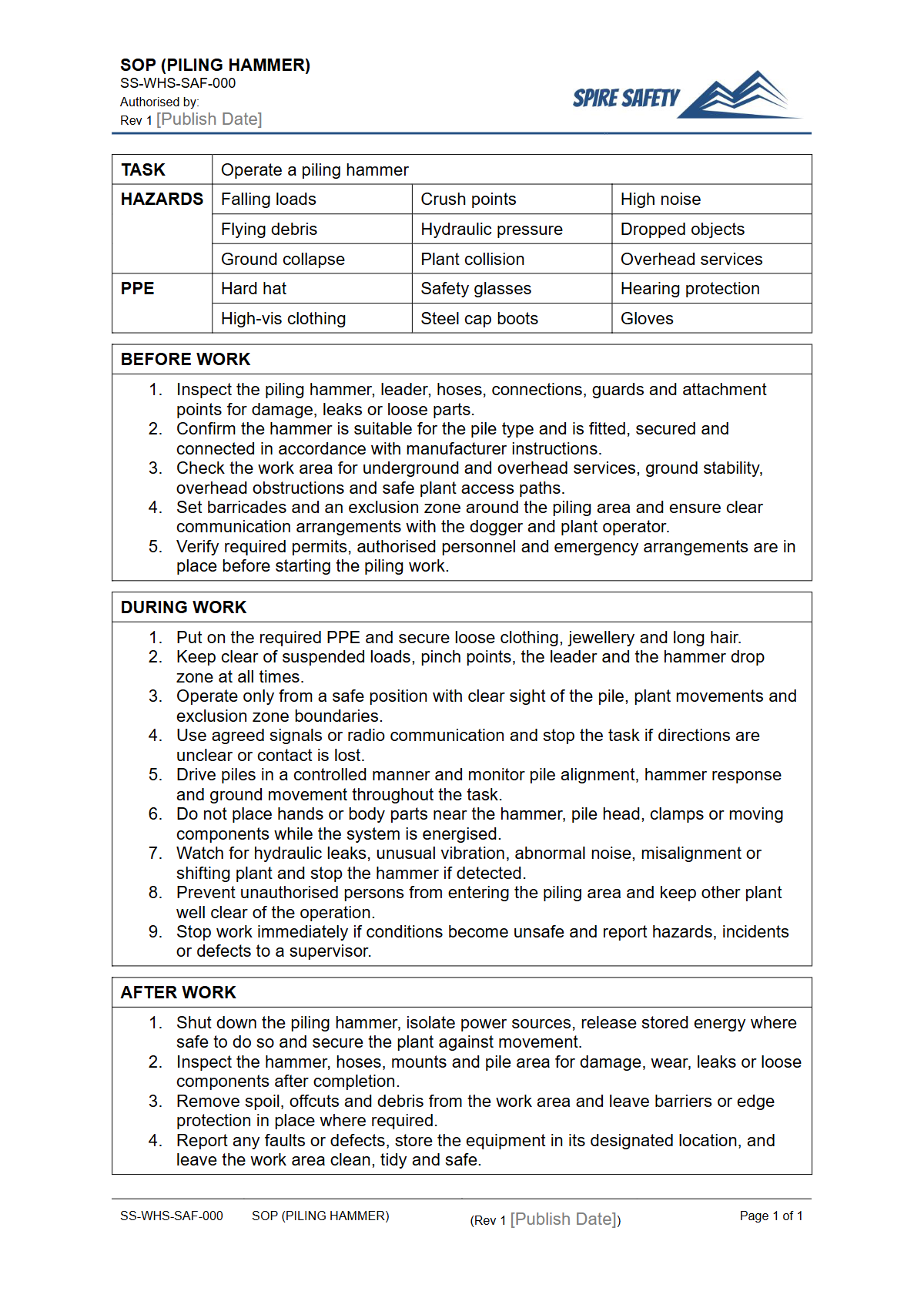
Our Safe Operating Procedure (Piling Hammer) template provides a structured format for documenting key safety steps. Download your free DOCX and PDF today.
Free Safe Operating Procedure (Piling Hammer) Template
DOCX • 126 KB + PDF
Updated Oct 2026
No signup required
Purpose of the Free Safe Operating Procedure (Piling Hammer) Template
Piling hammers are powerful and inherently hazardous pieces of equipment used in construction and civil engineering. Operating them safely requires clear, documented procedures.
This Free Safe Operating Procedure (Piling Hammer) Template provides a structured starting point for your business to outline the required steps for the safe use of vibratory, hydraulic, or diesel piling hammers. It is designed to help you identify hazards, document control measures, and establish a repeatable, safe system of work for your operators.
Developing a comprehensive SOP is a critical component of risk management. It helps your organisation meet its primary duty of care under WHS legislation by managing risks associated with high-impact machinery.
A well-defined SOP forms a foundational element of your overall WHS management systems, integrating procedural safety into your daily operations.
Video walkthrough
How to use the Free Safe Operating Procedure (Piling Hammer) Template
This Safe Operating Procedure is provided as a fully editable DOCX file and a ready-to-print PDF. After downloading, you must review and customise the content to align with your specific operational context.
This includes detailing the make and model of your piling equipment, the ground conditions on your site, and the specific tasks your team performs.
Important: This is a template, not a finished document. We have provided a structured guide, but it is essential that you customise this Safe Operating Procedure to reflect the unique hazards and control measures relevant to your workplace.
You must consult with your workers, supervisors, and other relevant parties during the customisation process to ensure the final document is practical and effective. After implementation, ongoing verification is key; regular WHS compliance auditing can confirm that your documented procedures are being followed correctly in practice.
When to use a Piling Hammer Safe Operating Procedure
A Safe Operating Procedure for a piling hammer should be developed and implemented before any piling work begins on a site. It serves as a core document for multiple WHS processes, including:
- Worker Training and Induction: Use the SOP as a primary training tool to ensure all operators understand the required safety protocols before using the equipment.
- Risk Assessments: The SOP supports the risk assessment process by documenting established controls for identified hazards.
- Incident Investigations: In the event of a near miss or incident, the SOP serves as a benchmark to review whether established procedures were followed.
- Refresher Training: It should be used during periodic refresher training sessions to reinforce safe work habits and communicate any updates to the procedure.
While this document focuses on piling hammers, the same principles of documenting safe work methods apply to other heavy equipment. For instance, our FREE Telehandler SOP Template provides a similar framework for managing the risks of specialised lifting equipment.
Who should use this template
This template is designed for use by various personnel within an organisation who hold responsibilities for workplace safety and equipment operation. Key users include:
- Persons Conducting a Business or Undertaking (PCBUs): To assist in fulfilling their duty of care to provide safe systems of work.
- WHS Managers and Advisors: As a tool to standardise procedures and integrate them into the broader safety management system.
- Site Managers and Supervisors: To train workers, enforce safe practices, and supervise high-risk piling operations.
- Plant Operators: As a clear, step-by-step guide for performing their tasks safely.
Documenting procedures for all major plant is a cornerstone of site safety. If your operations involve other earthmoving machinery, you may also find our FREE Trencher SOP Template to be a useful resource for standardising your documentation.
Integrating SOPs with Broader Safety Practices
A Safe Operating Procedure does not exist in isolation. It should be referenced in relevant Safe Work Method Statements (SWMS) for high-risk construction work and be supported by a regular plant inspection and maintenance schedule.
Pairing this procedural document with practical, hands-on training and competency assessments ensures that safety knowledge is effectively transferred to your team. For other types of heavy machinery, documents like the FREE Grader SOP Template can also be integrated into your training programs.
By building a comprehensive suite of safety documents, you create a more resilient and safety-conscious work environment. You can explore our complete collection of downloadable guides and templates in our free WHS resources library to further support your safety objectives.
Common mistakes
Common mistakes to avoid
- Failing to customise the template for specific equipment, tasks, and site conditions.
- Not involving equipment operators and supervisors in the drafting and review process.
- Treating the SOP as a box-ticking exercise instead of an active operational and training tool.
- Neglecting to include clear procedures for emergency shutdown and incident response.
Legal references
Legal considerations
The following legal requirements may be relevant to this type of work.
- Work Health and Safety Act (Harmonised) — Provides the primary duties for protecting workers and other people from work health and safety risks.
- Work Health and Safety Regulations (Harmonised) — Sets out requirements supporting the management of workplace hazards and risks.
The following codes may be relevant to this type of work.
- Managing WHS Risks Code of Practice — Provides practical guidance on identifying hazards, assessing risks and applying effective controls.
- Work Health and Safety Consultation, Cooperation and Coordination Code of Practice — Provides practical guidance on consulting workers and coordinating with other duty holders.
- Managing the Work Environment and Facilities Code of Practice — Provides practical guidance on safe work environments, workplace facilities and related controls.
Did you know
Vibration Risks
Prolonged exposure to the high levels of whole-body vibration from operating equipment like piling hammers can lead to serious long-term health issues, including musculoskeletal and neurological disorders.
Ancient Origins
Piling technology dates back to ancient times. The Romans used manual and animal-powered drop hammers to drive timber piles for bridges and foundations, a basic principle still seen in modern equipment.
FAQ
Frequently asked questions
01What hazards should a piling hammer SOP address?
02How often do I need to review a Safe Operating Procedure?
03Is a Safe Operating Procedure the same as a SWMS?
04Can I use this template for any type of piling hammer?
Share this resource
Free Safe Operating Procedure (Piling Hammer) Template
Browse Categories
How To Use It
- 1Download and open in Word or PDF.
- 2Replace the placeholders with your business details.
- 3Get it reviewed by a WHS specialist before rollout.
Need it customised?
Our WHS consultants can adapt this template to your site, run a gap analysis, or audit what you already have in place.
Book a Free Consultation WHS consulting servicesor call 1300 156 382
Related templates
- Free Safe Operating Procedure (Pipe Bender) Template
- Free Safe Operating Procedure (Pipe Beveler) Template
- Free Safe Operating Procedure (Pipe Camera) Template
- Free Safe Operating Procedure (Pipe Cutter) Template
- Free Safe Operating Procedure (Pipe Expander) Template
- Free Safe Operating Procedure (Pipe Facing Machine) Template