
Free Safe Operating Procedure (pH Meter) Template
Document safe work practices for using pH meters with our free template. This customisable Safe Operating Procedure helps manage risks.
Free Safe Operating Procedure (pH Meter) Template
DOCX • 126 KB + PDF
Updated Oct 2026
No signup required
Purpose of the Free Safe Operating Procedure (pH Meter) Template
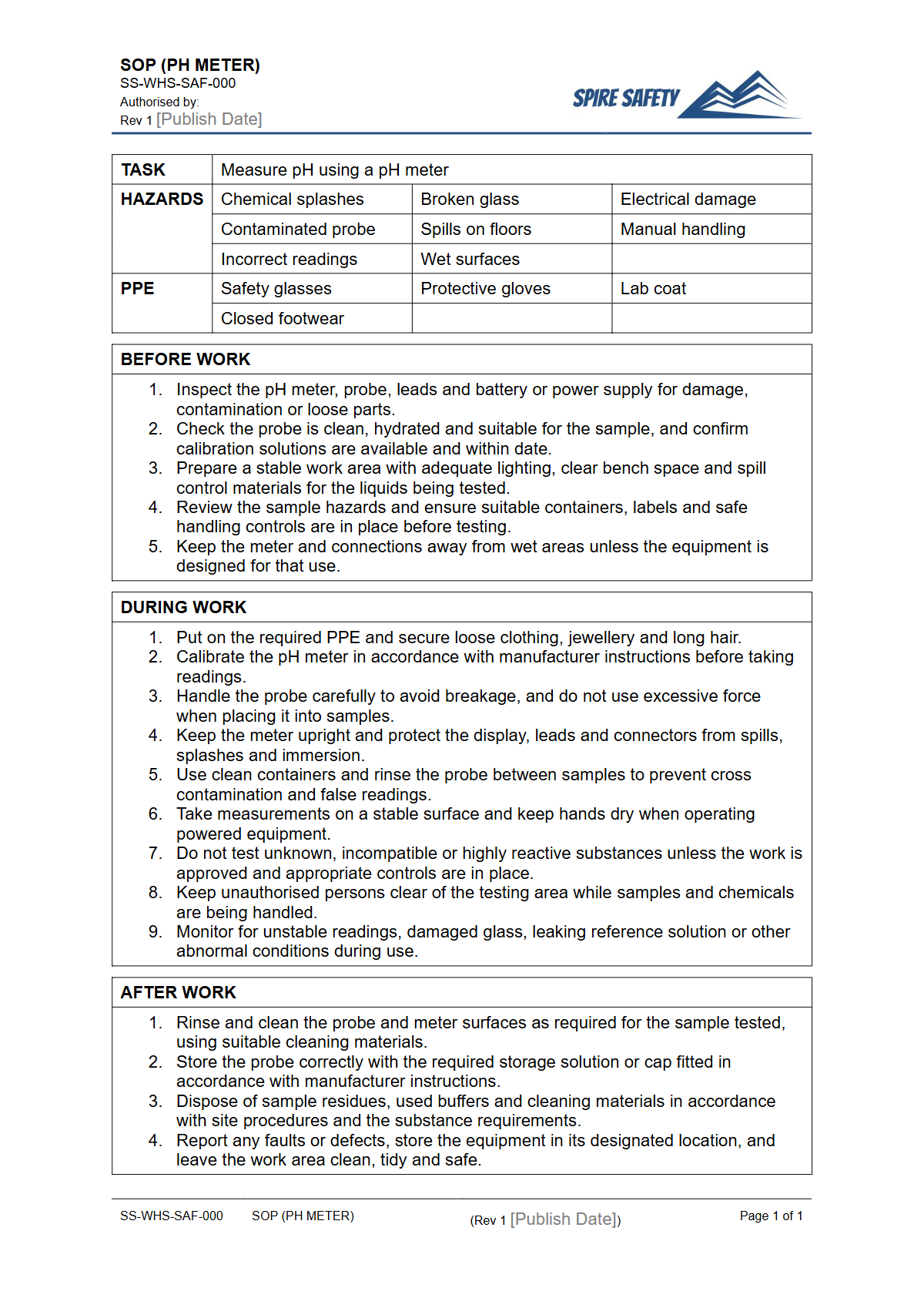
Operating a pH meter, whether in a laboratory, food production facility, or field setting, requires precision and adherence to safety protocols. This Free Safe Operating Procedure (pH Meter) Template provides a structured framework for documenting the step-by-step process for safe use, calibration, and maintenance.
It helps ensure consistent and safe work practices, reducing the risk of inaccurate readings and exposure to hazardous chemicals used for calibration or cleaning. Using a standardised SOP is a practical way to manage hazards and is a key part of robust WHS management systems that protect both workers and the integrity of your processes.
Video walkthrough
How to use the Free Safe Operating Procedure (pH Meter) Template
This document is a comprehensive starting point, not a finished procedure. It is essential that you customise this Safe Operating Procedure to reflect the specific equipment, chemicals, and work environment at your organisation. We recommend a collaborative approach to ensure the final document is practical and effective:
- Download the DOCX file and begin by filling in your company details.
- Consult with workers who regularly use the pH meters to gather their input on the practical steps and challenges of the task.
- Identify the make and model of your equipment and detail its specific operating, cleaning, and storage instructions.
- List the exact buffer solutions and cleaning agents used, and ensure you have current Safety Data Sheets (SDS) available for them.
- Specify the required Personal Protective Equipment (PPE), such as safety glasses and chemical-resistant gloves.
- Outline your site-specific procedures for storing the meter, handling chemical waste, and managing spills.
Once customised, the SOP should be reviewed and approved by a competent person before being used to train workers. It can be used alongside procedures for other common workplace equipment, similar to our free Air Compressor SOP.
When to use this Safe Operating Procedure
A Safe Operating Procedure for a pH meter should be a core part of your safety framework. It is essential during the induction and training of new team members to ensure they understand the correct procedures from day one.
It should also be readily available in the work area as a quick reference guide for all operators. Furthermore, the SOP is a critical tool for conducting periodic refresher training and for reviewing operational practices after any incident or near miss involving the equipment.
Regular reviews of the procedure, often as part of a scheduled WHS compliance auditing program, ensure it remains current with any changes in equipment, chemicals, or workplace practices.
Who should use this Safe Operating Procedure
This Safe Operating Procedure is designed for use by anyone who operates, calibrates, or maintains a pH meter. This includes a wide range of roles such as laboratory technicians, quality assurance personnel, environmental scientists, field researchers, food and beverage production workers, and students in educational settings.
Supervisors and managers will also find it invaluable for training staff, assessing competency, and conducting workplace inspections. For complex laboratory environments, integrating this SOP into a broader safety framework may benefit from specialist WHS consulting to ensure all risks are systematically addressed. To find more templates for a variety of tasks and equipment, you can explore our free WHS resources library.
Common mistakes
Common mistakes to avoid
- Using expired or contaminated buffer solutions for calibration.
- Failing to properly clean the electrode with distilled or deionised water between measurements.
- Storing the electrode dry or in plain water instead of the recommended storage solution.
- Not allowing the reading to fully stabilise before recording the measurement.
Legal references
Legal considerations
The following legal requirements may be relevant to this type of work.
- Work Health and Safety Act (Harmonised) — Provides the primary duties for protecting workers and other people from work health and safety risks.
- Work Health and Safety Regulations (Harmonised) — Sets out requirements supporting the management of workplace hazards and risks.
The following codes may be relevant to this type of work.
- Managing WHS Risks Code of Practice — Provides practical guidance on identifying hazards, assessing risks and applying effective controls.
- Work Health and Safety Consultation, Cooperation and Coordination Code of Practice — Provides practical guidance on consulting workers and coordinating with other duty holders.
- Managing the Work Environment and Facilities Code of Practice — Provides practical guidance on safe work environments, workplace facilities and related controls.
Did you know
Electrode Health
The glass bulb on a pH electrode is designed to stay hydrated. If it dries out, its performance degrades significantly, leading to slow response times and inaccurate readings. Proper storage in a specified solution is critical for its lifespan.
Temperature Matters
The pH of a solution changes with temperature. Modern pH meters have Automatic Temperature Compensation (ATC) probes to correct for this, ensuring a more accurate reading regardless of the sample's temperature.
FAQ
Frequently asked questions
01What should be included in a pH meter SOP?
02How often should a pH meter be calibrated according to an SOP?
03Is a Safe Operating Procedure a legal requirement for using a pH meter in Australia?
04What PPE is typically required in a pH meter SOP?
Share this resource
Free Safe Operating Procedure (pH Meter) Template
Browse Categories
How To Use It
- 1Download and open in Word or PDF.
- 2Replace the placeholders with your business details.
- 3Get it reviewed by a WHS specialist before rollout.
Need it customised?
Our WHS consultants can adapt this template to your site, run a gap analysis, or audit what you already have in place.
Book a Free Consultation WHS consulting servicesor call 1300 156 382
Related templates
- Free Safe Operating Procedure (Phase Rotation Test) Template
- Free Safe Operating Procedure (Pick and Pack) Template
- Free Safe Operating Procedure (Pick and Place Robot) Template
- Free Safe Operating Procedure (Picnic Area Cleaning) Template
- Free Safe Operating Procedure (Picnic Table Cleaning) Template
- Free Safe Operating Procedure (Pie Warmer) Template