
Free Safe Operating Procedure (Pick and Place Robot) Template
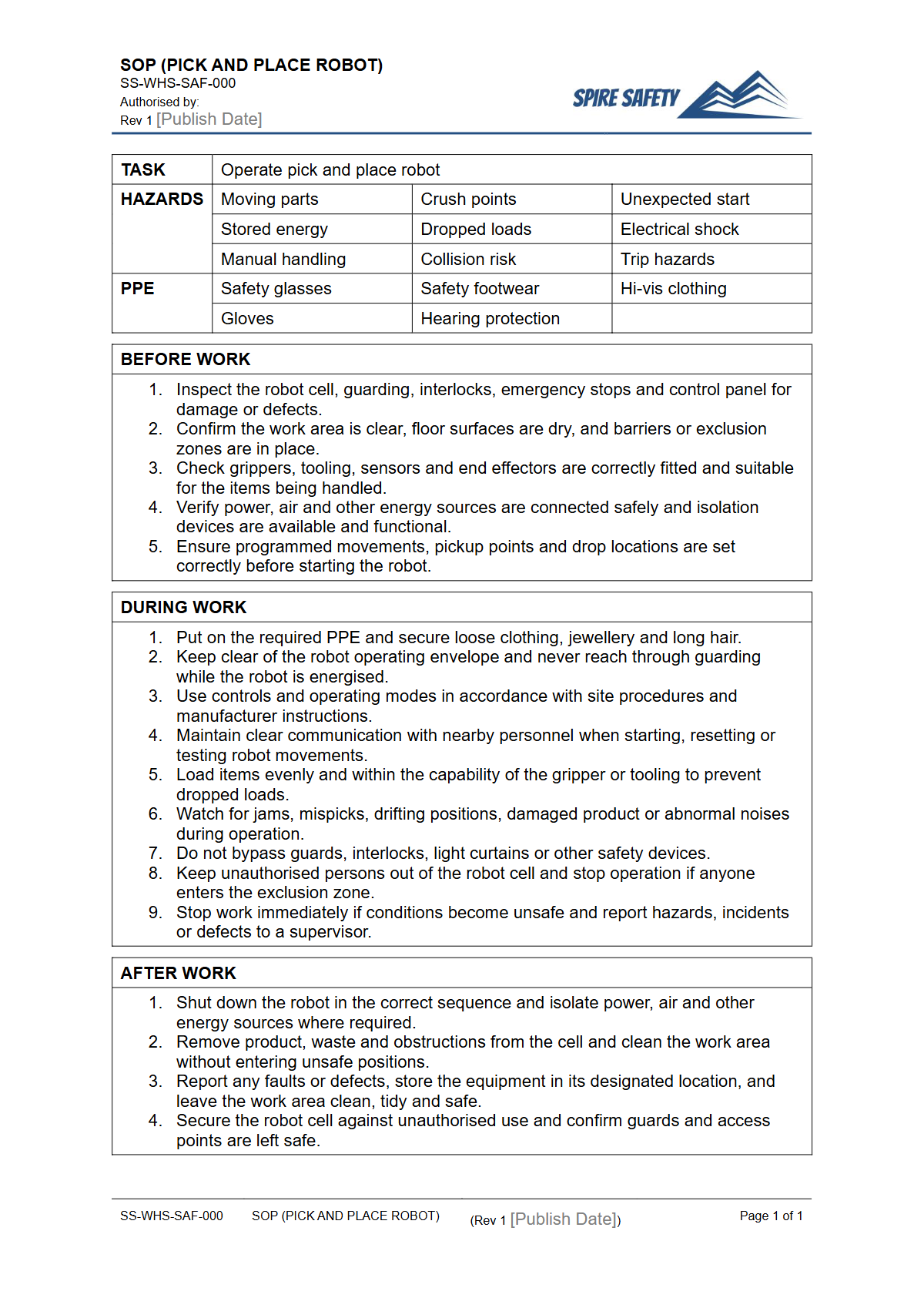
Download our free Safe Operating Procedure for pick and place robots to formalise your safety processes. This template helps you outline hazards and controls.
Free Safe Operating Procedure (Pick and Place Robot) Template
DOCX • 126 KB + PDF
Updated Oct 2026
No signup required
Purpose of the Free Safe Operating Procedure (Pick and Place Robot) Template
Integrating robotic automation into your workplace introduces significant efficiency gains but also specific safety challenges. This Free Safe Operating Procedure (Pick and Place Robot) Template provides a structured framework for documenting the safe use of pick and place robotic systems.
Using a standardised SOP helps ensure that all operators, maintenance staff, and supervisors follow a consistent, safe method for every task, from startup to shutdown. It formalises risk controls, clarifies responsibilities, and acts as a critical training tool for new and existing employees, minimising the risk of incidents related to human-robot interaction.
A well-developed SOP is a cornerstone of a proactive safety culture and demonstrates a commitment to meeting health and safety obligations. Formalising your procedures for robotic equipment is a key component of building robust WHS management systems that protect your people and your operations.
This document helps translate your risk assessment findings into practical, step-by-step instructions that workers can easily follow.
Video walkthrough
How to use the Free Safe Operating Procedure (Pick and Place Robot) Template
This template is designed as a comprehensive starting point, not a final document. It must be adapted to the unique context of your workplace.
Download the DOCX file and begin by consulting with the people who actually operate and maintain the equipment. Their direct input is essential for creating a procedure that is both practical and effective.
Walk through each step of the robot's operation, from pre-start checks to routine tasks and emergency procedures, and document the associated hazards and control measures specific to your environment.
Important: This is a template only. We have provided a structured guide, but you must customise this document with your site-specific information, including your company name, specific robot model, tasks performed, and the outcomes of your own risk assessment.
A generic procedure is not sufficient to ensure safety. For related processes, our free Conveyer System SOP provides a useful template for equipment often integrated with robotic cells.
Key Sections to Customise:
- Pre-Operational Checks: Detail the specific inspections required for your robot model, including checks for guards, emergency stops, sensors, and tooling.
- Operational Steps: Outline the exact sequence for starting, operating, and stopping the robot for its intended tasks. Be specific about operator positioning and interaction zones.
- Emergency Procedures: Clearly define the steps for activating an emergency stop, responding to faults or alarms, and safe restart protocols.
- Maintenance and Cleaning: Specify lockout/tagout (LOTO) procedures and any other safety requirements for personnel entering the robot's work envelope.
When to use a Safe Operating Procedure
A Safe Operating Procedure for a pick and place robot should be used as a daily reference tool and a core part of your safety framework. It is essential during the induction and training of any new operator or maintenance person.
It should also be readily available at or near the robotic cell for quick reference during operation. Furthermore, the SOP should be reviewed and updated whenever there is a change to the process, equipment, or environment, or following an incident or near miss.
Regular reviews ensure the document remains relevant and effective. In many manufacturing settings, these robots work alongside other automated equipment; consider documenting those processes with our free Injection Molding Machine SOP where applicable.
Who should use this Safe Operating Procedure
This SOP template is intended for use by Persons Conducting a Business or Undertaking (PCBUs), operations managers, supervisors, and WHS professionals. The finalised document is for anyone who interacts with the pick and place robot, including:
- Operators: To guide their daily work and ensure they follow safe, established procedures.
- Supervisors: To assist in training, monitoring work, and enforcing safety standards.
- Maintenance Personnel: To follow for safe access, servicing, and repair, particularly for implementing LOTO procedures.
- WHS Auditors: To use as a benchmark when conducting internal or external reviews of your safety practices. Regular WHS compliance auditing can help verify that documented procedures are being followed correctly.
By implementing a clear and specific SOP, you create a safer, more organised, and more productive work environment. Many robotic systems also rely on ancillary equipment, and having clear procedures for these is equally important; for instance, you might find our free Air Compressor SOP useful if your robot uses pneumatic actuators.
If you need other documents, you can explore our complete free WHS resources library for more templates.
Common mistakes
Common mistakes to avoid
- Failing to account for all operational modes, especially non-routine tasks like cleaning, maintenance, and programming.
- Inadequate training on emergency stop procedures and the correct, safe protocols for restarting the robot after a stoppage.
- Neglecting to clearly define and mark the robot's restricted space and safe interaction zones on the floor.
- Using a generic SOP template without customising it with a site-specific risk assessment for the exact robot and task.
Legal references
Legal considerations
The following legal requirements may be relevant to this type of work.
- Work Health and Safety Act (Harmonised) — Provides the primary duties for protecting workers and other people from work health and safety risks.
- Work Health and Safety Regulations (Harmonised) — Sets out requirements supporting the management of workplace hazards and risks.
The following codes may be relevant to this type of work.
- Managing WHS Risks Code of Practice — Provides practical guidance on identifying hazards, assessing risks and applying effective controls.
- Work Health and Safety Consultation, Cooperation and Coordination Code of Practice — Provides practical guidance on consulting workers and coordinating with other duty holders.
- Managing the Work Environment and Facilities Code of Practice — Provides practical guidance on safe work environments, workplace facilities and related controls.
Did you know
Robot Safety Standards
The primary Australian and international standard for the safety of industrial robots is the AS/NZS ISO 10218 series. This standard outlines comprehensive safety requirements for the design, manufacture, and integration of robotic systems.
Cobots vs. Industrial Robots
Collaborative robots, or 'cobots', are designed to work alongside humans without traditional safety fencing, using sensors to stop on contact. In contrast, traditional industrial robots like many pick and place models require physical guarding like fences and light curtains to isolate them from workers.
FAQ
Frequently asked questions
01What is a Safe Operating Procedure for a pick and place robot?
02Why are SOPs particularly important for robotic automation?
03Who is responsible for creating and implementing a robot SOP?
04How often should a pick and place robot SOP be reviewed?
Share this resource
Free Safe Operating Procedure (Pick and Place Robot) Template
Browse Categories
How To Use It
- 1Download and open in Word or PDF.
- 2Replace the placeholders with your business details.
- 3Get it reviewed by a WHS specialist before rollout.
Need it customised?
Our WHS consultants can adapt this template to your site, run a gap analysis, or audit what you already have in place.
Book a Free Consultation WHS consulting servicesor call 1300 156 382
Related templates
- Free Safe Operating Procedure (Picnic Area Cleaning) Template
- Free Safe Operating Procedure (Picnic Table Cleaning) Template
- Free Safe Operating Procedure (Pie Warmer) Template
- Free Safe Operating Procedure (Piezometer) Template
- Free Safe Operating Procedure (Pile Cropper) Template
- Free Safe Operating Procedure (Piling Hammer) Template