
Free Safe Operating Procedure (Pick and Pack) Template
Formalise your warehouse safety protocols with our structured Safe Operating Procedure for pick and pack tasks. Download your free DOCX template to get started.
Free Safe Operating Procedure (Pick and Pack) Template
DOCX • 126 KB + PDF
Updated Oct 2026
No signup required
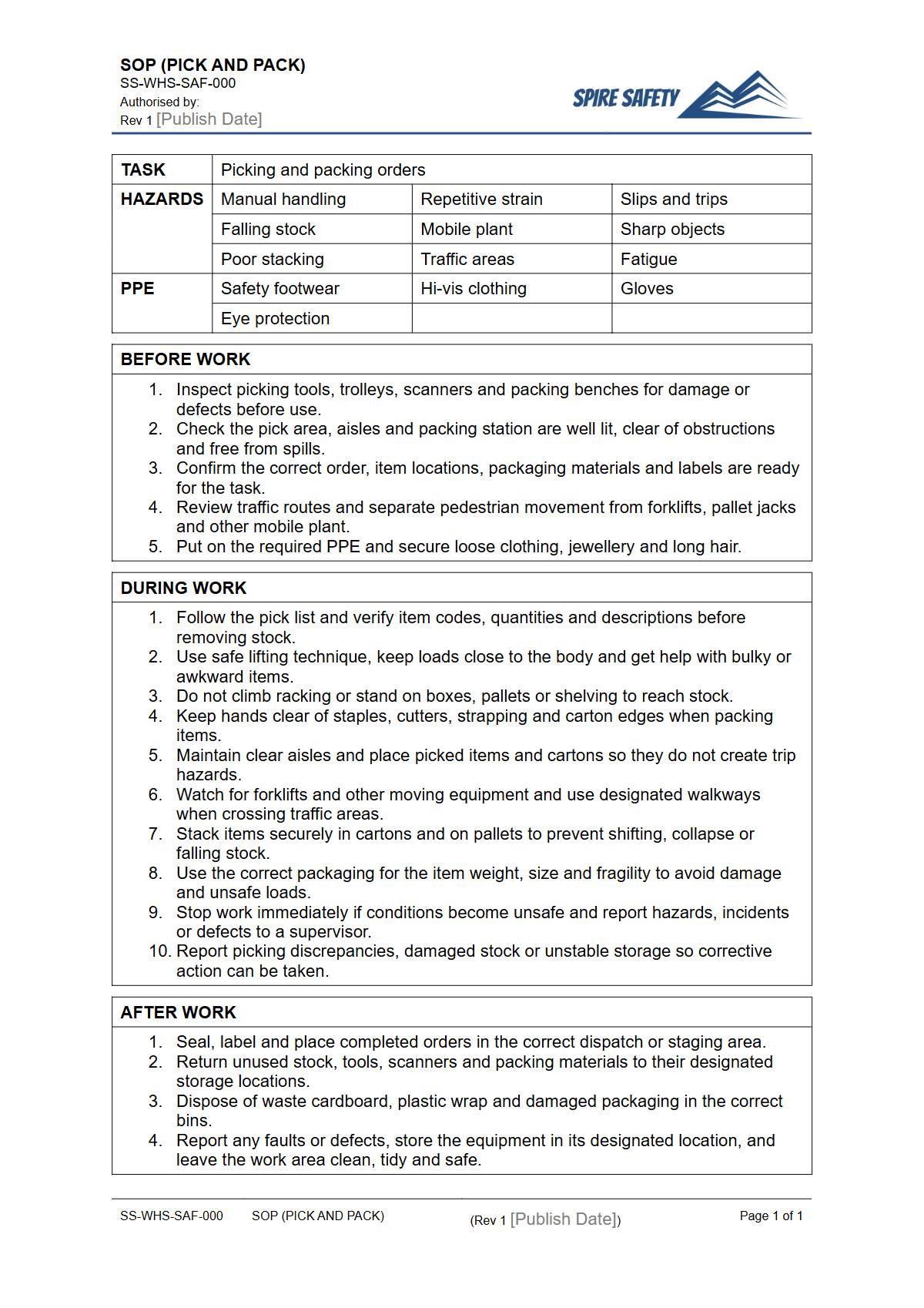
Purpose of the Free Safe Operating Procedure (Pick and Pack) Template
Pick and pack operations are fundamental to most warehousing, logistics, and distribution centres. While seemingly straightforward, these tasks carry inherent risks, including musculoskeletal injuries from manual handling, slips and trips, and interaction with mobile plant.
This Free Safe Operating Procedure (Pick and Pack) Template provides a structured framework for documenting the safest method to perform these duties. Using a standardised SOP helps ensure every worker understands the required steps, hazards, and control measures, leading to a more consistent and safer work environment.
A well-drafted SOP is a critical component of a proactive safety culture. It serves as an essential training tool for new employees, a reference for experienced staff, and a benchmark for performance.
By clearly defining the procedure, you minimise ambiguity and reduce the likelihood of incidents caused by unsafe shortcuts or variations in practice. This document forms a key part of your broader safety framework and can be integrated into your comprehensive WHS management systems to demonstrate due diligence and a commitment to worker safety.
Video walkthrough
How to use the Free Safe Operating Procedure (Pick and Pack) Template
This template is designed for ease of use and customisation. After downloading the DOCX file, you can edit it to reflect the specific realities of your workplace.
It provides a solid foundation based on Australian WHS principles, but requires your input to become a functional, site-specific document.
Follow these steps:
- Assess the Task: In consultation with workers who perform the job, walk through the entire pick and pack process from start to finish. Identify each specific action, the equipment used (e.g., trolleys, pallet jacks, scanners), and the associated hazards.
- Customise the Content: Populate the template with your findings. Detail your specific types of goods, warehouse layout, traffic management plan, and required Personal Protective Equipment (PPE) such as safety footwear and gloves.
- Review and Approve: Have a competent person, such as a WHS manager or supervisor, review the draft SOP. Ensure it is clear, accurate, and effectively controls the identified risks before approving it for use.
- Train Your Team: Induct and train all relevant workers on the finalised SOP. Store it in a location where it is easily accessible for reference during work.
Important: This is a template only. We have provided a structured starting point, but you must customise this document with your own site-specific information, including machinery, equipment, PPE, and emergency procedures.
A generic procedure is not sufficient to meet your safety obligations.
Key Hazards in Pick and Pack Operations
Effectively using this template requires a thorough understanding of the hazards involved. Your risk assessment should focus on identifying and controlling common dangers in your specific environment, which may include:
- Manual Tasks: Lifting, carrying, lowering, pushing, and pulling items are the most significant risks, potentially leading to sprains, strains, and chronic musculoskeletal disorders. Consider the frequency, weight, and posture involved.
- Repetitive Actions: High-volume picking and packing can lead to repetitive strain injuries (RSIs).
- Slips, Trips, and Falls: Obstacles in walkways, spills, poor housekeeping, and uneven flooring are common causes of falls.
- Mobile Plant Interaction: The movement of forklifts, pallet movers, and order pickers in the same area as pedestrians creates a significant risk of collision.
- Falling Objects: Improperly stacked pallets or items stored at height can fall and cause serious injury.
Regularly reviewing these hazards is a key part of maintaining a safe workplace. This review process can be formalised through scheduled WHS compliance auditing to ensure controls remain effective.
When to Use This Safe Operating Procedure
An SOP for picking and packing should not be a 'set and forget' document. It is a live document that should be used and reviewed regularly. Key times to use or refer to the SOP include:
- During the induction and training of new warehouse staff.
- As a refresher for existing workers, perhaps as part of a toolbox talk.
- When a process or piece of equipment is changed.
- After an incident, near miss, or hazard is reported, to review and improve the procedure.
It also serves as a baseline for other task-specific procedures in the warehouse. For example, if your pick and pack process involves staff operating specific machinery, you may need a separate Telehandler SOP template or similar document for that equipment.
Who Should Use This Document
This SOP is intended for a range of personnel within an organisation:
- Persons Conducting a Business or Undertaking (PCBUs): Use it to fulfil their primary duty of care by providing a safe system of work.
- Warehouse Managers and Supervisors: Use it to train workers, monitor performance, and enforce safe work practices on the floor. A supervisor might also need to reference a free Conveyer System SOP if one is part of their operational area.
- WHS/HSE Advisors: Use it as a tool for risk assessment, training development, and as evidence of risk management within the safety management system. They may also develop procedures for other equipment, such as an Air Compressor SOP used for cleaning in the warehouse.
- Workers: Use it to understand the correct, safe way to perform their tasks and the control measures in place to protect them.
Common mistakes
Common mistakes to avoid
- Using the downloaded template as-is without customising it for the specific workplace, equipment, and materials.
- Failing to consult with the workers who actually perform the pick and pack tasks when drafting the procedure.
- Not providing adequate training to all employees on the contents of the finalised SOP.
- Neglecting to review and update the SOP after an incident, near miss, or change in workflow.
Legal references
Legal considerations
The following legal requirements may be relevant to this type of work.
- Work Health and Safety Act (Harmonised) — Provides the primary duties for protecting workers and other people from work health and safety risks.
- Work Health and Safety Regulations (Harmonised) — Sets out requirements supporting the management of workplace hazards and risks.
The following codes may be relevant to this type of work.
- Managing WHS Risks Code of Practice — Provides practical guidance on identifying hazards, assessing risks and applying effective controls.
- Work Health and Safety Consultation, Cooperation and Coordination Code of Practice — Provides practical guidance on consulting workers and coordinating with other duty holders.
- Managing the Work Environment and Facilities Code of Practice — Provides practical guidance on safe work environments, workplace facilities and related controls.
Did you know
Manual Handling Risk
According to Safe Work Australia, serious claims for injuries resulting from muscular stress while lifting, carrying, or handling objects are among the most common in the country. Warehousing and logistics are key industries where these preventable injuries occur.
FAQ
Frequently asked questions
01What is the main purpose of a pick and pack SOP?
02How often should a Safe Operating Procedure for picking and packing be reviewed?
03Does this template include ergonomic risks like manual handling?
04Can I use this template for both manual and automated picking systems?
Share this resource
Free Safe Operating Procedure (Pick and Pack) Template
Browse Categories
How To Use It
- 1Download and open in Word or PDF.
- 2Replace the placeholders with your business details.
- 3Get it reviewed by a WHS specialist before rollout.
Need it customised?
Our WHS consultants can adapt this template to your site, run a gap analysis, or audit what you already have in place.
Book a Free Consultation WHS consulting servicesor call 1300 156 382
Related templates
- Free Safe Operating Procedure (Pick and Place Robot) Template
- Free Safe Operating Procedure (Picnic Area Cleaning) Template
- Free Safe Operating Procedure (Picnic Table Cleaning) Template
- Free Safe Operating Procedure (Pie Warmer) Template
- Free Safe Operating Procedure (Piezometer) Template
- Free Safe Operating Procedure (Pile Cropper) Template