
Free Safe Operating Procedure (Phase Rotation Test) Template
Establish clear safety steps for testing three-phase systems with our free Safe Operating Procedure (Phase Rotation Test) Template. Download the DOCX/PDF now.
Free Safe Operating Procedure (Phase Rotation Test) Template
DOCX • 126 KB + PDF
Updated Oct 2026
No signup required
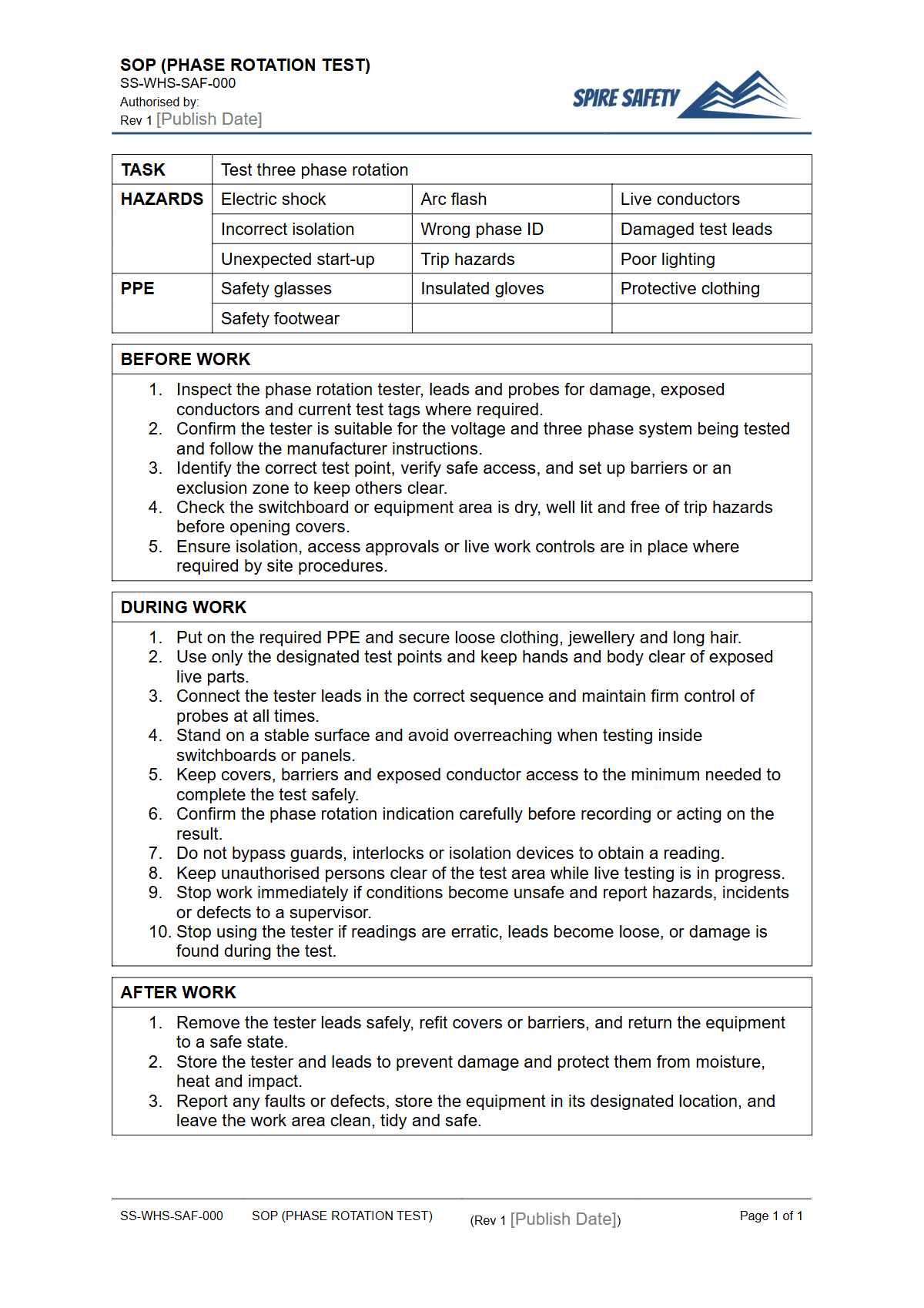
Purpose of the Free Safe Operating Procedure (Phase Rotation Test) Template
This Free Safe Operating Procedure (Phase Rotation Test) Template provides a structured framework for safely verifying the phase sequence of a three-phase electrical supply. This test is a critical safety and operational check for any workplace that uses equipment powered by three-phase motors, such as pumps, fans, conveyers, and large machinery.
The correct phase sequence determines the direction of the motor's rotation. An incorrect sequence can cause equipment to run backwards, leading to serious equipment damage, process failures, and significant safety hazards.
Using a documented procedure helps standardise the task and control the severe electrical risks involved, including electric shock and arc flash. An SOP ensures that every person performing the test follows a pre-approved, safe method that includes hazard identification, isolation, and the use of appropriate personal protective equipment (PPE).
The operational integrity of many machines, like those covered in our free Air Compressor SOP (Safe Operating Procedure) template, depends on the correct initial electrical setup confirmed by this test.
Video walkthrough
How to use the Free Safe Operating Procedure (Phase Rotation Test) Template
To use this Safe Operating Procedure template, simply download the file in your preferred format (DOCX or PDF) and adapt it to your specific operational context. The DOCX version is fully editable, allowing you to insert details specific to your workplace, such as equipment makes and models, site-specific hazards, and emergency procedures.
Integrating this SOP into your broader WHS management systems helps create a consistent approach to managing high-risk tasks across your organisation.
Important: This document is a template and must be customised to reflect the unique conditions and requirements of your workplace. We provide this as a starting point, but you must conduct your own risk assessment and tailor the controls accordingly.
We are not responsible for the implementation or compliance of your final document.
What's included in the template?
Our template is structured based on Australian WHS best practice and provides clear sections to guide the user. Key areas for customisation include:
- PPE Requirements: Specify the exact personal protective equipment needed, such as electrically-rated gloves, safety glasses, and flame-retardant clothing.
- Pre-Operational Checks: Detail the steps for risk assessment (e.g., a JSA or SWMS), inspection of the phase rotation meter, and confirmation of a full lockout/tagout (LOTO) energy isolation.
- Step-by-Step Procedure: Outline the precise actions for safely connecting the test leads to the de-energised source, re-energising for the test, interpreting the meter's results, and de-energising again.
- Post-Operational Tasks: List the required steps for disconnecting the test equipment, safely removing locks and tags, and completing necessary records or maintenance logs.
When to use it
A phase rotation test is not an everyday task but is essential at critical points in an equipment's lifecycle. This SOP should be used whenever the phase sequence of a supply needs to be confirmed before connecting equipment. Key scenarios include:
- During the initial installation and commissioning of new three-phase machinery.
- After relocating existing equipment to a new area with a different power source.
- Following any significant electrical maintenance, repairs, or modifications to circuits, switchboards, or motors.
- When connecting equipment to a temporary power source, such as a portable generator, where the phase sequence is unknown.
Proactively using this procedure ensures equipment will operate as designed from the moment it is energised, a fundamental check often verified during a formal WHS compliance audit.
Who should use it
This is a high-risk electrical task that must only be performed by trained, qualified, and authorised personnel. Untrained individuals must never attempt to perform a phase rotation test due to the extreme risk of electrocution, arc flash, and equipment damage. The appropriate users of this SOP are:
- Licensed Electricians
- Qualified Electrical Engineers or Technicians
- Competent Electrical Maintenance Personnel with specific training on the equipment and procedure
Verification of competency (VOC) is essential before any worker is authorised to undertake this work. This document is one of many specialised safety resources you can find in our complete free WHS resources library, designed to support skilled roles. The principles of energy isolation are also foundational for other high-risk tasks, such as those detailed in our FREE Conveyer System SOP.
For organisations needing assistance in developing and implementing robust electrical safety procedures, our expert team can provide specialised WHS consulting to ensure your safe work systems are practical and effective.
Common mistakes
Common mistakes to avoid
- Failing to perform a robust lockout/tagout (LOTO) procedure before connecting the tester.
- Using a phase rotation meter that is damaged, out of calibration, or not rated for the voltage being tested.
- Assuming the colour-coding of wiring is correct without verifying the phase sequence.
- Not wearing the appropriate electrically-rated personal protective equipment (PPE), such as insulated gloves and safety glasses.
Legal references
Legal considerations
The following legal requirements may be relevant to this type of work.
- Work Health and Safety Act (Harmonised) — Provides the primary duties for protecting workers and other people from work health and safety risks.
- Work Health and Safety Regulations (Harmonised) — Sets out requirements supporting the management of workplace hazards and risks.
The following codes may be relevant to this type of work.
- Managing WHS Risks Code of Practice — Provides practical guidance on identifying hazards, assessing risks and applying effective controls.
- Work Health and Safety Consultation, Cooperation and Coordination Code of Practice — Provides practical guidance on consulting workers and coordinating with other duty holders.
- Managing the Work Environment and Facilities Code of Practice — Provides practical guidance on safe work environments, workplace facilities and related controls.
Did you know
The Legacy of Three-Phase Power
Most industrial motors worldwide run on three-phase alternating current (AC) power, a system championed and largely developed by Nikola Tesla in the late 1880s. Its efficiency is why it remains the standard for heavy-duty power transmission.
A Simple Test, A Critical Outcome
Reversing the phase sequence on a large industrial pump can cause it to run backwards, potentially leading to a dangerous pressure build-up or catastrophic failure of the impeller and casing. This simple test prevents very expensive damage.
FAQ
Frequently asked questions
01What is a phase rotation test?
02Why is correct phase sequence so important for machinery?
03Is an SOP legally required for performing a phase rotation test?
04Who is considered competent to perform a phase rotation test?
Share this resource
Free Safe Operating Procedure (Phase Rotation Test) Template
Browse Categories
How To Use It
- 1Download and open in Word or PDF.
- 2Replace the placeholders with your business details.
- 3Get it reviewed by a WHS specialist before rollout.
Need it customised?
Our WHS consultants can adapt this template to your site, run a gap analysis, or audit what you already have in place.
Book a Free Consultation WHS consulting servicesor call 1300 156 382
Related templates
- Free Safe Operating Procedure (Pick and Pack) Template
- Free Safe Operating Procedure (Pick and Place Robot) Template
- Free Safe Operating Procedure (Picnic Area Cleaning) Template
- Free Safe Operating Procedure (Picnic Table Cleaning) Template
- Free Safe Operating Procedure (Pie Warmer) Template
- Free Safe Operating Procedure (Piezometer) Template