
Free Safe Operating Procedure (Pet Waste Cleanup) Template
Formalise your cleaning processes for animal waste with our customisable template. Download your free Safe Operating Procedure for Pet Waste Cleanup today.
Free Safe Operating Procedure (Pet Waste Cleanup) Template
DOCX • 126 KB + PDF
Updated Oct 2026
No signup required
Purpose of the Free Safe Operating Procedure (Pet Waste Cleanup) Template
Managing the cleanup of pet or animal waste is a common task in many industries, from local councils maintaining public parks to strata management companies overseeing residential complexes. This task, while seemingly simple, carries significant biological hazards.
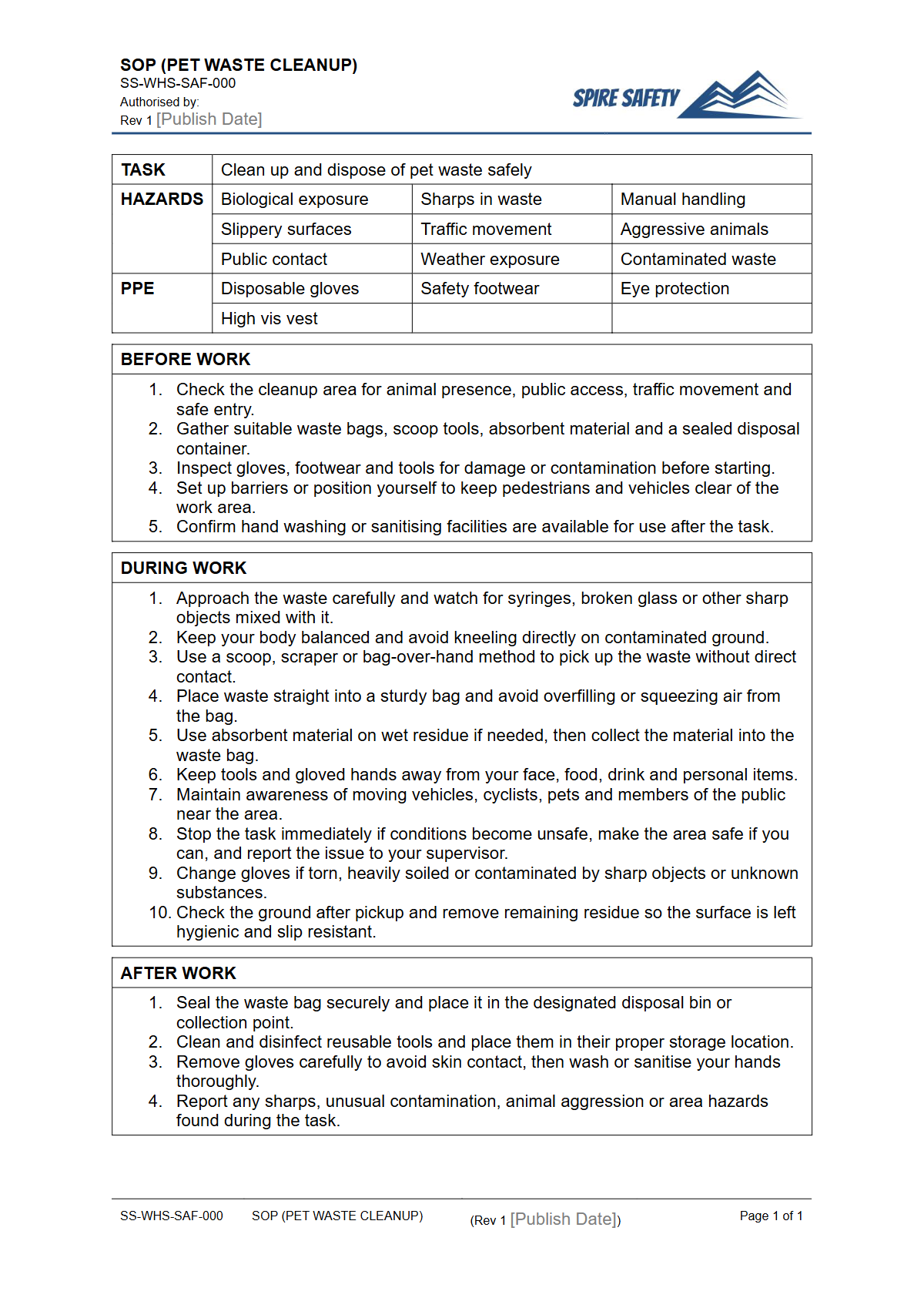
Our Free Safe Operating Procedure (Pet Waste Cleanup) Template provides a structured framework for documenting a safe system of work. Using this SOP helps ensure that every worker performs the task consistently and safely, minimising exposure to zoonotic diseases, bacteria, and parasites.
A documented SOP is a critical component of your safety management system. It clearly outlines the required Personal Protective Equipment (PPE), specifies the correct tools and methods for collection, and defines the appropriate disposal process.
Formalising this procedure helps meet WHS obligations to provide a safe work environment and serves as an essential tool for worker training and induction. Integrating specific procedures like this into broader WHS management systems creates a more robust and defensible safety culture within your organisation.
Video walkthrough
How to use the Free Safe Operating Procedure (Pet Waste Cleanup) Template
This resource is available for immediate download as a DOCX file, allowing for easy customisation in Microsoft Word or other compatible programs. A PDF version is also provided for straightforward printing and distribution.
The template is logically structured to guide you through defining the necessary steps and precautions for safe pet waste handling. You will find sections covering hazard identification, pre-operational checks, step-by-step cleaning instructions, and post-task cleanup requirements.
Important: This document is a template and must be adapted to your specific operational needs. We have provided a comprehensive starting point aligned with Australian WHS principles, but you are responsible for customising it.
You must add site-specific details, list the exact PPE your workers use, detail your emergency contacts, and reference any unique equipment or local council regulations relevant to your workplace. This process ensures the final SOP is a practical and effective tool for your team.
The principles of creating a task-based SOP are similar across many applications, as seen in our Safe Operating Procedure (Deep Fryer - Standard Operation) template for the food service industry.
When to use this Safe Operating Procedure
This SOP should be implemented in any commercial or public setting where workers are tasked with cleaning up animal faeces. It is not intended for domestic use by pet owners but for organisations with a duty of care to their employees, contractors, or volunteers. Its application is diverse, covering environments such as:
- Public parks, beaches, and recreational areas managed by local councils.
- Common areas in apartment buildings, townhouses, and housing estates managed by strata or body corporate services.
- Veterinary clinics, animal shelters, and kennels.
- Pet-friendly commercial properties, such as outdoor shopping centres or office parks.
- Mobile pet grooming and dog walking businesses.
For organisations like councils that manage diverse public spaces, this SOP can form part of a suite of procedures for grounds maintenance. While this document covers biological waste, your teams may also require procedures for machinery, such as those found in our free Trencher SOP template.
Who should use this SOP
The development and implementation of this Safe Operating Procedure is a collaborative effort. Initially, it should be drafted by a person with the right knowledge, such as a WHS Manager, a Team Leader, or a business owner (the PCBU).
This person is responsible for conducting the risk assessment and ensuring the procedure is comprehensive and reflects the actual tasks performed.
Once finalised, the SOP is a crucial document for all workers who perform the cleanup task. This includes groundskeepers, maintenance staff, cleaners, veterinary nurses, and kennel hands.
It should be used as a primary training document to ensure everyone understands the risks and the required control measures before they ever undertake the work. Regular reviews and toolbox talks referencing the SOP can also help reinforce safe work practices.
If your organisation requires more tailored support in developing a suite of SOPs, our general WHS consulting services can provide expert guidance.
Maintaining Hygiene and Equipment
A critical part of the cleanup process is what happens after the waste has been collected. Tools such as scoops, tongs, and collection bins must be properly cleaned and disinfected to prevent cross-contamination.
The SOP template includes a section for you to detail these specific steps, including the types of disinfectants to be used and the frequency of cleaning. This prevents the transfer of pathogens to storage areas, vehicles, or other workers.
For cleaning certain types of equipment, other procedures may be relevant; for example, our Free Air Compressor SOP Template can be adapted for tasks involving tool cleanup.
By formalising every step, from collection to tool sanitation, you create a closed-loop system that manages the risk from start to finish. You can find more templates and checklists to support your safety systems in our free WHS resources library.
Common mistakes
Common mistakes to avoid
- Not wearing or using inadequate PPE, especially disposable gloves.
- Improper disposal of waste, such as placing it in recycling bins or leaving it unsealed.
- Forgetting to wash hands thoroughly with soap and water after completing the task and removing gloves.
- Failing to clean and disinfect tools like pooper scoopers and collection bins after use.
Legal references
Legal considerations
The following legal requirements may be relevant to this type of work.
- Work Health and Safety Act (Harmonised) — Provides the primary duties for protecting workers and other people from work health and safety risks.
- Work Health and Safety Regulations (Harmonised) — Sets out requirements supporting the management of workplace hazards and risks.
The following codes may be relevant to this type of work.
- Managing WHS Risks Code of Practice — Provides practical guidance on identifying hazards, assessing risks and applying effective controls.
- Work Health and Safety Consultation, Cooperation and Coordination Code of Practice — Provides practical guidance on consulting workers and coordinating with other duty holders.
- Managing the Work Environment and Facilities Code of Practice — Provides practical guidance on safe work environments, workplace facilities and related controls.
Did you know
Zoonotic Risk
Zoonotic diseases are illnesses that can be passed from animals to humans. Toxocariasis, an infection caused by roundworm larvae found in dog and cat faeces, can cause serious illness and even vision loss in humans if ingested.
Waste Volume
Australia's dog population produces over 1,200 tonnes of waste per day. Properly managing this waste in public and commercial spaces is a significant logistical and public health challenge.
FAQ
Frequently asked questions
01What are the main hazards of cleaning up pet waste at work?
02What basic PPE is required for pet waste cleanup?
03How should pet waste be disposed of in a commercial setting?
04Why is a written SOP better than just verbal instructions?
Share this resource
Free Safe Operating Procedure (Pet Waste Cleanup) Template
Browse Categories
How To Use It
- 1Download and open in Word or PDF.
- 2Replace the placeholders with your business details.
- 3Get it reviewed by a WHS specialist before rollout.
Need it customised?
Our WHS consultants can adapt this template to your site, run a gap analysis, or audit what you already have in place.
Book a Free Consultation WHS consulting servicesor call 1300 156 382
Related templates
- Free Safe Operating Procedure (Petrol Decanting) Template
- Free Safe Operating Procedure (pH Meter) Template
- Free Safe Operating Procedure (Phase Rotation Test) Template
- Free Safe Operating Procedure (Pick and Pack) Template
- Free Safe Operating Procedure (Pick and Place Robot) Template
- Free Safe Operating Procedure (Picnic Area Cleaning) Template