
Free Safe Operating Procedure (Personnel Hoist) Template
Formalise the safe use of personnel hoists with our structured template. Download this customisable Safe Operating Procedure to improve workplace safety.
Free Safe Operating Procedure (Personnel Hoist) Template
DOCX • 126 KB + PDF
Updated Oct 2026
No signup required
Purpose of the Free Safe Operating Procedure (Personnel Hoist) Template
Operating a personnel hoist, also known as a builder's hoist or Alimak, involves significant risks, primarily related to falls from height, structural failure, and mechanical malfunction. This Free Safe Operating Procedure (Personnel Hoist) Template provides a structured framework for documenting the essential steps and safety controls required for their use.
A well-developed SOP is a critical tool for managing risk, ensuring workers understand their responsibilities, and demonstrating a systematic approach to safety. It formalises pre-start checks, operational steps, shutdown procedures, and emergency responses, creating a clear and repeatable process for all users.
Implementing a robust SOP for high-risk equipment like personnel hoists is a cornerstone of effective WHS management systems. This document helps a Person Conducting a Business or Undertaking (PCBU) fulfil their primary duty of care by providing clear instruction and training materials, ultimately reducing the likelihood of incidents and injuries on site.
Key elements covered in the template
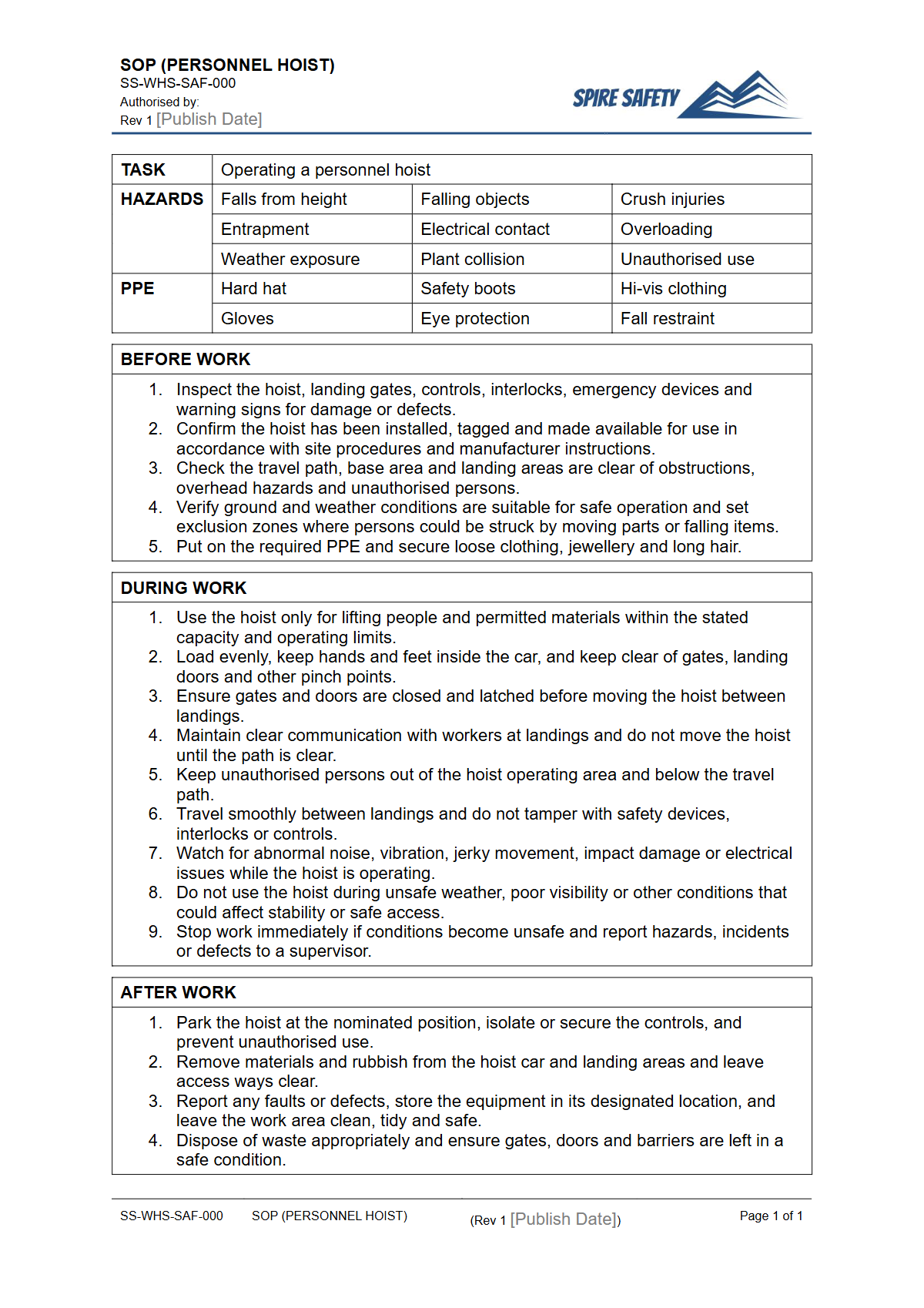
Our template is designed to be comprehensive, prompting you to consider all facets of personnel hoist operation. Key sections include:
- Associated Risks and Hazards: Identifies potential dangers such as falls, entanglement, crushing, hoist collapse, and electrical hazards.
- Required Personal Protective Equipment (PPE): Specifies necessary PPE like hard hats, safety footwear, and high-visibility clothing.
- Pre-Operational Checks: A step-by-step checklist to verify the hoist's condition, including controls, safety gates, emergency stops, and structural integrity before use.
- Step-by-Step Operating Procedure: Details the sequence for safely operating the hoist, from starting up to travelling and stopping at landings.
- Shutdown and Cleaning Procedure: Outlines the correct process for securing the hoist after use.
- Emergency Procedures: Critical instructions for responding to power failure, equipment malfunction, or medical emergencies.
Video walkthrough
How to use the Free Safe Operating Procedure (Personnel Hoist) Template
This document is available for immediate download in both DOCX and PDF formats. The DOCX file is fully editable, allowing for extensive customisation to reflect the specific conditions of your workplace and the particular model of personnel hoist in use.
The PDF version is useful for quick distribution and printing.
To effectively implement this SOP, you must adapt it to your unique operational context. We've provided this template as a solid foundation, but you must consult with your operators, supervisors, and safety personnel to ensure it accurately reflects your site's hazards and control measures.
Incorporating feedback from those who use the equipment daily is essential for creating a practical and effective document. This process is similar for other types of heavy equipment, such as when adapting our free Telehandler SOP template for your specific machinery.
When to use a Personnel Hoist Safe Operating Procedure
A Safe Operating Procedure for a personnel hoist should be a living document, used consistently throughout the equipment's lifecycle on a project. It is not a 'set and forget' tool. Its primary uses include:
- Worker Training and Induction: As a core training document for all new operators and workers who will use or work near the hoist.
- Pre-Start and Daily Briefings: To reinforce key safety checks and operational rules before work commences.
- Competency Assessments: As a benchmark for assessing an operator's understanding and practical ability to use the hoist safely.
- Incident Investigations: To review whether established procedures were followed in the event of a near miss or incident.
- Procedure Reviews: It should be reviewed regularly, and always after a change in equipment, location, or work process. This review process is a key focus during WHS compliance auditing.
Who should use this Safe Operating Procedure
This SOP is relevant to several roles within an organisation to ensure a coordinated approach to safety. The primary users and stakeholders include:
- PCBU/Management: To ensure a safe system of work is documented, implemented, and monitored as part of their due diligence.
- Supervisors and Foremen: To enforce the procedure on-site, conduct toolbox talks, and monitor compliance among workers.
- Hoist Operators: As a direct guide for their day-to-day tasks, particularly the pre-start checks and emergency protocols. All operators must be trained and competent in its contents.
- Maintenance Personnel: To understand the operational context and safety requirements when performing servicing, inspections, and repairs. Just as a grader operator needs specific instructions, a hoist operator needs a dedicated SOP. You can find similar resources for other machinery, like our free Grader SOP Template.
- Health and Safety Representatives (HSRs): To participate in the consultation process and verify that adequate controls are documented for the risks involved.
By defining clear procedures for high-risk plant, you standardise safe work practices across your site. Whether managing trenching equipment or vertical transport, a specific SOP is vital; for related guidance, consider our free Trencher SOP Template. You can explore our complete collection of documentation in our free WHS resources library to build out your safety management system.
Common mistakes
Common mistakes to avoid
- Using a generic, non-customised template without adding site-specific hazards and controls.
- Failing to conduct and document all pre-operational checks before the first use of each shift.
- Neglecting to train all operators and relevant personnel on the specific procedures outlined in the SOP.
- Not including clear, actionable emergency and rescue procedures for scenarios like power failure or entrapment.
Legal references
Legal considerations
The following legal requirements may be relevant to this type of work.
- Work Health and Safety Act (Harmonised) — Provides the primary duties for protecting workers and other people from work health and safety risks.
- Work Health and Safety Regulations (Harmonised) — Sets out requirements supporting the management of workplace hazards and risks.
The following codes may be relevant to this type of work.
- Managing WHS Risks Code of Practice — Provides practical guidance on identifying hazards, assessing risks and applying effective controls.
- Work Health and Safety Consultation, Cooperation and Coordination Code of Practice — Provides practical guidance on consulting workers and coordinating with other duty holders.
- Managing the Work Environment and Facilities Code of Practice — Provides practical guidance on safe work environments, workplace facilities and related controls.
Did you know
A Leading Cause of Fatalities
Falls from height consistently remain one of the leading causes of traumatic fatalities in the Australian construction industry. Properly maintained and operated personnel hoists are a critical engineering control to prevent these incidents.
FAQ
Frequently asked questions
01What is a Safe Operating Procedure for a personnel hoist?
02Is a specific licence required to operate a personnel hoist in Australia?
03How often should a personnel hoist SOP be reviewed?
04What are the main hazards associated with personnel hoists?
Share this resource
Free Safe Operating Procedure (Personnel Hoist) Template
Browse Categories
How To Use It
- 1Download and open in Word or PDF.
- 2Replace the placeholders with your business details.
- 3Get it reviewed by a WHS specialist before rollout.
Need it customised?
Our WHS consultants can adapt this template to your site, run a gap analysis, or audit what you already have in place.
Book a Free Consultation WHS consulting servicesor call 1300 156 382
Related templates
- Free Safe Operating Procedure (Pesticide Mixing) Template
- Free Safe Operating Procedure (Pet Bedding Cleaning) Template
- Free Safe Operating Procedure (Pet Cage Cleaning) Template
- Free Safe Operating Procedure (Pet Food Storage) Template
- Free Safe Operating Procedure (Pet Grooming Area Clean) Template
- Free Safe Operating Procedure (Pet Waste Cleanup) Template