
Free Safe Operating Procedure (Pet Bedding Cleaning) Template
Ensure safe and hygienic practices in your workplace with our detailed SOP template. Download this customisable guide to manage pet bedding cleaning risks.
Free Safe Operating Procedure (Pet Bedding Cleaning) Template
DOCX • 126 KB + PDF
Updated Oct 2026
No signup required
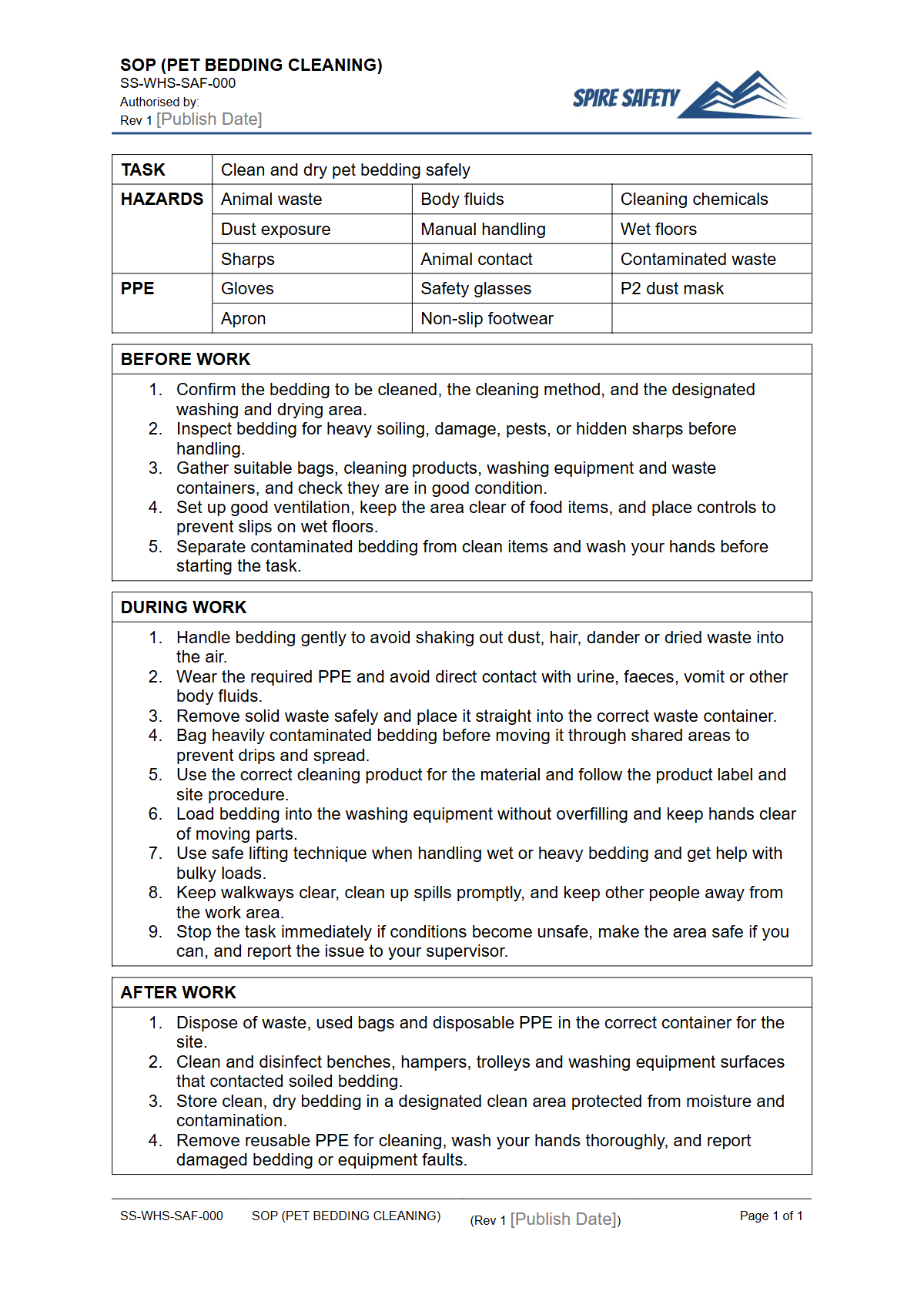
Purpose of the Free Safe Operating Procedure (Pet Bedding Cleaning) Template
This Free Safe Operating Procedure (Pet Bedding Cleaning) Template provides a structured framework for businesses to document the specific steps and precautions required for safely washing and handling animal bedding. Following a clear SOP is critical in environments like veterinary clinics, animal shelters, kennels, and pet grooming facilities to minimise the risk of injury and illness.
The primary goals are to prevent the transmission of zoonotic diseases, manage exposure to hazardous cleaning chemicals, and control ergonomic risks associated with manual tasks. By implementing a documented procedure, you establish a consistent, safe method of work that protects employees and animals.
This document forms a key part of your broader WHS management systems, demonstrating a commitment to proactive risk management.
Video walkthrough
How to use the Free Safe Operating Procedure (Pet Bedding Cleaning) Template
To use this template, download the DOCX or PDF file and begin customising it to match your facility's unique circumstances. The document includes sections for you to detail the specific machinery (e.g., washing machines, dryers), required Personal Protective Equipment (PPE), approved cleaning agents, and step-by-step instructions for pre-washing, washing, drying, and folding.
Ensure you conduct a risk assessment for the task and incorporate the identified control measures into the SOP. Staff must be trained on the finalised procedure before undertaking the task.
Important: This is a template, not a completed Safe Operating Procedure. It must be customised to your specific workplace.
We have developed this as a starting point, and you are responsible for ensuring it reflects the actual equipment, chemicals, hazards, and controls present in your operations. If you need assistance with this process, consider engaging expert WHS consulting services.
When should a Safe Operating Procedure be used?
An SOP for pet bedding cleaning should be used consistently for every cleaning cycle. It is particularly important when:
- Training new employees, volunteers, or casual staff to ensure they understand the established safety protocols from day one.
- Introducing new cleaning chemicals or equipment, as the SOP will need to be reviewed and updated to reflect these changes.
- Conducting refresher training to reinforce correct procedures and address any identified bad habits.
- An incident or near-miss has occurred, prompting a review of existing safety measures.
The need for specific, task-based procedures is universal across many industries. Just as a commercial kitchen requires a specific SOP for deep fryer operation to manage distinct hazards, animal care facilities need a dedicated procedure to manage biohazards in bedding.
Who should use this Safe Operating Procedure?
This Safe Operating Procedure is intended for all personnel involved in the cleaning and handling of pet bedding. This includes, but is not limited to:
- Animal Care Attendants
- Veterinary Nurses and Technicians
- Kennel Hands
- Grooming Assistants
- Cleaning and Maintenance Staff
Supervisors and managers should also be familiar with the SOP to ensure they can effectively oversee the work, enforce safety standards, and lead incident investigations if required. In larger facilities, where bedding might be moved via automated systems, procedures for all machinery are essential. For example, if a laundry conveyor is used, you should also develop a FREE Conveyer System SOP (Safe Operating Procedure) Template.
Furthermore, ensure any associated equipment has a corresponding SOP. For instance, if an industrial air compressor is used for cleaning filters or drying areas, workers must be trained on its safe use, which can be documented using a resource like our Free Air Compressor SOP (Safe Operating Procedure) Template. A consistent approach to procedural safety across all workplace tasks is a hallmark of a robust safety culture.
Common mistakes
Common mistakes to avoid
- Using the wrong cleaning chemicals or incorrect dilution rates, leading to ineffective disinfection or chemical hazards.
- Neglecting to wear or correctly use Personal Protective Equipment (PPE), especially gloves and eye protection.
- Failing to separate heavily contaminated bedding from other laundry, causing cross-contamination.
- Inadequate training for new staff on the specific procedures and the 'why' behind them.
Legal references
Legal considerations
The following legal requirements may be relevant to this type of work.
- Work Health and Safety Act (Harmonised) — Provides the primary duties for protecting workers and other people from work health and safety risks.
- Work Health and Safety Regulations (Harmonised) — Sets out requirements supporting the management of workplace hazards and risks.
The following codes may be relevant to this type of work.
- Managing WHS Risks Code of Practice — Provides practical guidance on identifying hazards, assessing risks and applying effective controls.
- Work Health and Safety Consultation, Cooperation and Coordination Code of Practice — Provides practical guidance on consulting workers and coordinating with other duty holders.
- Managing the Work Environment and Facilities Code of Practice — Provides practical guidance on safe work environments, workplace facilities and related controls.
Did you know
Zoonotic Risks
Many pathogens can be transmitted from animals to humans (zoonoses). Contaminated bedding is a primary transmission route for organisms like ringworm, Salmonella, and Giardia, making proper cleaning protocols essential for worker health.
FAQ
Frequently asked questions
01What hazards should an SOP for pet bedding cleaning address?
02How often should a Safe Operating Procedure be reviewed?
03Is an SOP legally required for cleaning pet bedding in Australia?
04What PPE is typically required for cleaning pet bedding?
Share this resource
Free Safe Operating Procedure (Pet Bedding Cleaning) Template
Browse Categories
How To Use It
- 1Download and open in Word or PDF.
- 2Replace the placeholders with your business details.
- 3Get it reviewed by a WHS specialist before rollout.
Need it customised?
Our WHS consultants can adapt this template to your site, run a gap analysis, or audit what you already have in place.
Book a Free Consultation WHS consulting servicesor call 1300 156 382
Related templates
- Free Safe Operating Procedure (Pet Cage Cleaning) Template
- Free Safe Operating Procedure (Pet Food Storage) Template
- Free Safe Operating Procedure (Pet Grooming Area Clean) Template
- Free Safe Operating Procedure (Pet Waste Cleanup) Template
- Free Safe Operating Procedure (Petrol Decanting) Template
- Free Safe Operating Procedure (pH Meter) Template