
Free Safe Operating Procedure (Pet Food Storage) Template
Manage hazards associated with storing pet food ingredients and finished products. Download our free Safe Operating Procedure template to get started.
Free Safe Operating Procedure (Pet Food Storage) Template
DOCX • 126 KB + PDF
Updated Oct 2026
No signup required
Purpose of the Free Safe Operating Procedure (Pet Food Storage) Template
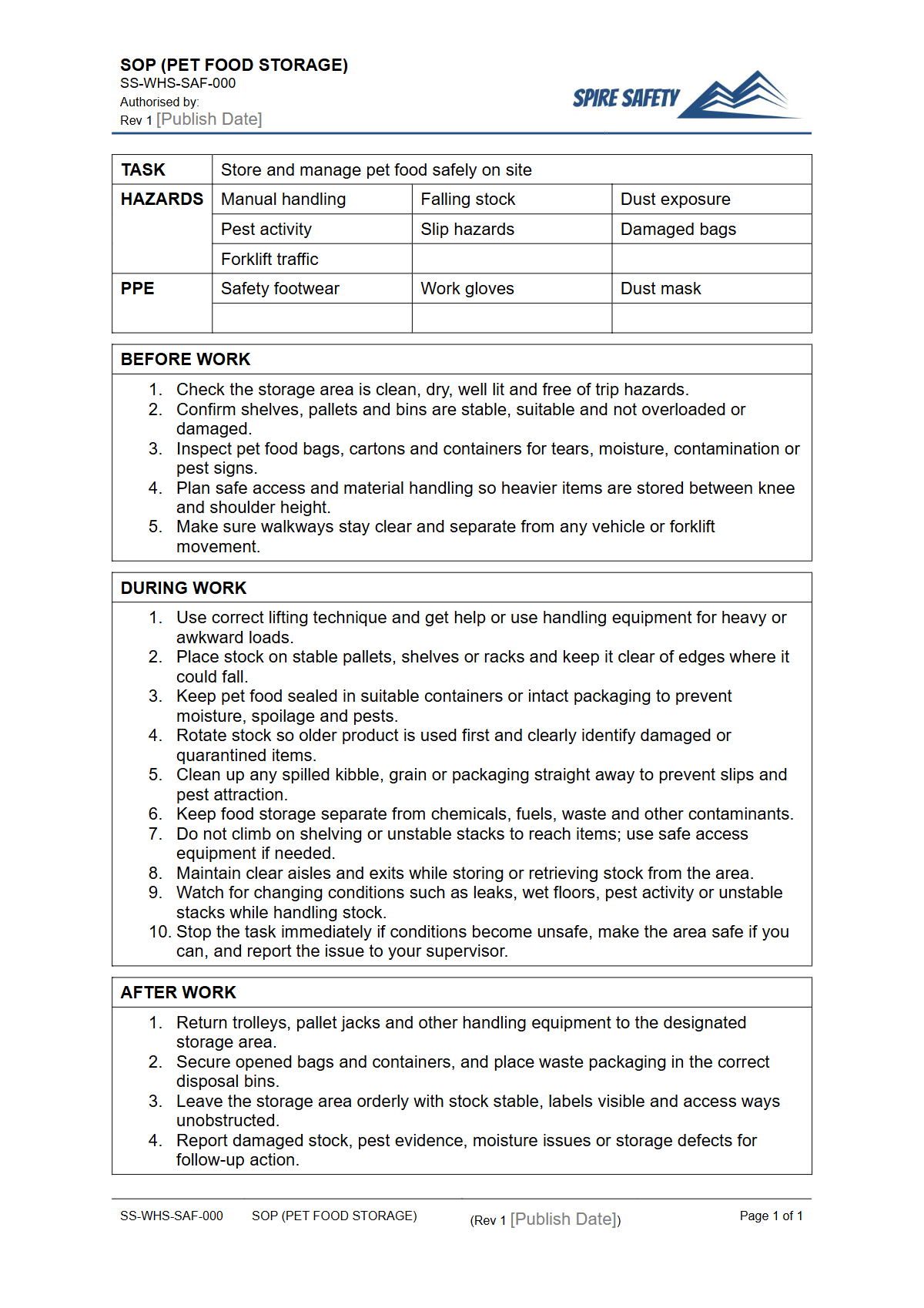
Handling and storing pet food, whether raw ingredients or finished goods, involves numerous workplace health and safety risks. This Free Safe Operating Procedure (Pet Food Storage) Template provides a structured framework for documenting controls to manage these hazards effectively.
Key risks in this environment often include hazardous manual tasks from lifting heavy bags, exposure to airborne contaminants like grain dust, and interactions with mobile plant used for moving bulk materials. A documented Safe Operating Procedure (SOP) is a critical tool for ensuring tasks are performed consistently and safely, forming a key component of a comprehensive WHS management system.
This template prompts you to consider specific hazards such as:
- Ergonomic injuries from repetitive lifting, carrying, or stacking.
- Slips, trips, and falls from spills or poorly organised storage areas.
- Risks associated with operating machinery like forklifts or pallet jacks, which can be addressed with specific documents like our FREE Telehandler SOP Template.
- Respiratory hazards from dust created by grains, flours, and other dry ingredients.
- Pest control and contamination prevention measures.
Video walkthrough
How to use the Free Safe Operating Procedure (Pet Food Storage) Template
This document is a starting point, not a final solution. To use it effectively, download the DOCX file and systematically work through each section, adapting the content to reflect the specific equipment, substances, and processes at your facility.
It is crucial that you consult with workers who perform the tasks daily; their direct input is invaluable for identifying practical risks and effective controls. The goal is to create a procedure that is not only aligned with WHS regulations but is also practical and understood by your team.
When customising, consider adding site-specific details such as:
- The types and weights of products being stored.
- Step-by-step instructions for decanting, bagging, or moving stock.
- Emergency procedures for spills or equipment malfunction.
- Required Personal Protective Equipment (PPE) for each task.
Important Note: We have provided a foundational template based on common industry practices. You must customise this document with your own site-specific information, including company details, equipment models, and identified hazards from your risk assessments.
If specific machinery like conveyors are part of your process, consider using our FREE Conveyer System SOP as a supplementary resource.
When to use this Safe Operating Procedure
A Safe Operating Procedure for pet food storage should be used as a primary reference tool for daily operations. It is essential for inducting new employees, providing refresher training for existing staff, and as a guide for supervisors monitoring work practices.
It should also be reviewed and updated whenever there is a change in process, equipment, or location, or following any incident or near miss. For agricultural or large-scale production facilities, integrating procedures for handling raw materials at their source is also vital; for these scenarios, our FREE Grain Drill SOP may be relevant.
This SOP also serves as a critical piece of documentation during safety audits. It demonstrates that the Person Conducting a Business or Undertaking (PCBU) has a formal system for managing identified risks.
It complements other equipment-specific procedures, such as a Free Air Compressor SOP, to build a complete picture of your site's safety management.
Who should use this Safe Operating Procedure
This template is designed for use by WHS managers, supervisors, and business owners responsible for health and safety in manufacturing, warehousing, or retail environments that handle pet food. It provides a clear and organised way to define and communicate safe work methods.
Workers and their health and safety representatives (HSRs) should also be actively involved in its development and review to ensure it is practical and effective. Having a well-developed and implemented SOP is a key element that would be examined as part of a routine WHS compliance audit.
Ultimately, anyone involved in the lifecycle of pet food storage—from receivals to dispatch—can benefit from this procedure. If you need more guidance on developing your WHS documentation, you can browse our extensive free WHS resources library for more templates and guides.
Common mistakes
Common mistakes to avoid
- Failing to properly customise the template with site-specific details.
- Neglecting ergonomic risks associated with lifting and stacking heavy bags of ingredients.
- Implementing inadequate dust control measures for fine powders and grains.
- Poor record-keeping for training and competency on the documented procedure.
Legal references
Legal considerations
The following legal requirements may be relevant to this type of work.
- Work Health and Safety Act (Harmonised) — Provides the primary duties for protecting workers and other people from work health and safety risks.
- Work Health and Safety Regulations (Harmonised) — Sets out requirements supporting the management of workplace hazards and risks.
The following codes may be relevant to this type of work.
- Managing WHS Risks Code of Practice — Provides practical guidance on identifying hazards, assessing risks and applying effective controls.
- Work Health and Safety Consultation, Cooperation and Coordination Code of Practice — Provides practical guidance on consulting workers and coordinating with other duty holders.
- Managing the Work Environment and Facilities Code of Practice — Provides practical guidance on safe work environments, workplace facilities and related controls.
Did you know
Manual Handling Impact
According to Safe Work Australia, manual handling injuries are a leading cause of serious workers' compensation claims. Procedures for tasks like lifting 20kg bags are not just best practice; they are critical for preventing long-term injuries.
Combustible Dust
Many organic ingredients used in pet food, such as grain, flour, and starch, can create combustible dust when suspended in the air. Proper ventilation and housekeeping are essential controls to prevent the risk of a dust explosion.
FAQ
Frequently asked questions
01What hazards should a pet food storage SOP cover?
02Is this template suitable for both raw ingredients and finished products?
03How often should a Safe Operating Procedure for pet food storage be reviewed?
04Can I use this SOP for staff training and induction?
Share this resource
Free Safe Operating Procedure (Pet Food Storage) Template
Browse Categories
How To Use It
- 1Download and open in Word or PDF.
- 2Replace the placeholders with your business details.
- 3Get it reviewed by a WHS specialist before rollout.
Need it customised?
Our WHS consultants can adapt this template to your site, run a gap analysis, or audit what you already have in place.
Book a Free Consultation WHS consulting servicesor call 1300 156 382
Related templates
- Free Safe Operating Procedure (Pet Grooming Area Clean) Template
- Free Safe Operating Procedure (Pet Waste Cleanup) Template
- Free Safe Operating Procedure (Petrol Decanting) Template
- Free Safe Operating Procedure (pH Meter) Template
- Free Safe Operating Procedure (Phase Rotation Test) Template
- Free Safe Operating Procedure (Pick and Pack) Template