
Free Safe Operating Procedure (Pesticide Mixing) Template
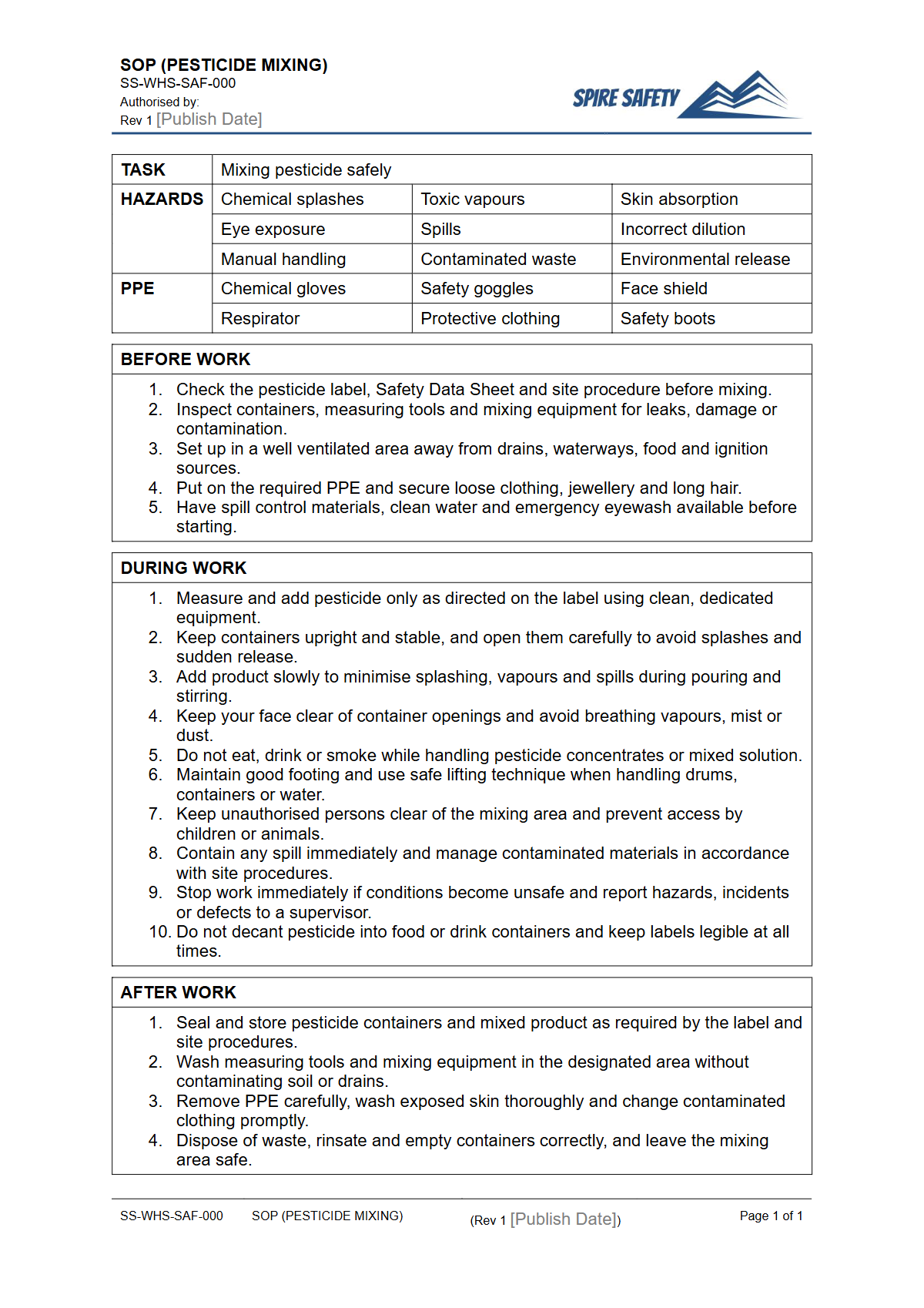
Handle pesticides safely with our free template. This Safe Operating Procedure for pesticide mixing helps you document hazards and control measures.
Free Safe Operating Procedure (Pesticide Mixing) Template
DOCX • 126 KB + PDF
Updated Oct 2026
No signup required
Purpose of the Free Safe Operating Procedure (Pesticide Mixing) Template
Handling and mixing pesticides introduces significant health and safety risks, from chemical exposure to environmental contamination. This Free Safe Operating Procedure (Pesticide Mixing) Template provides a structured starting point for your business to document and standardise the process.
Using a clear SOP helps ensure workers follow a consistent, safe method every time, minimising the risk of incidents. It formalises the risk assessment process by outlining known hazards and the specific control measures required to manage them, which is a fundamental requirement under Australian WHS legislation.
The template is designed to help you detail every critical step, from pre-operational checks and selecting Personal Protective Equipment (PPE) to the mixing sequence, clean-up, and waste disposal. A documented procedure is an essential tool for training new employees, conducting refresher courses, and demonstrating due diligence in your safety management practices.
It acts as a clear point of reference for both workers and supervisors, promoting a proactive safety culture within your organisation.
Video walkthrough
How to use the Free Safe Operating Procedure (Pesticide Mixing) Template
This resource is available as a DOCX file for easy editing and a PDF for straightforward printing and distribution. To use it, download the file and systematically work through each section, replacing the placeholder text with information that is specific to your operational context.
A generic procedure is not effective; it must reflect the actual chemicals, equipment, and environment at your workplace.
Please note: this is a template that we expect you to customise. You must add details specific to your workplace, including the exact chemicals used, required PPE based on Safety Data Sheets (SDS), emergency contacts, and site-specific procedures to ensure it is effective. Integrating this SOP into your broader WHS management systems ensures it works alongside your other safety policies and procedures.
Key Elements of a Pesticide Mixing SOP
A comprehensive SOP for pesticide mixing should cover several critical areas to be effective. When customising the template, ensure you address:
- Hazard Identification: List all potential hazards associated with the task. This includes chemical risks (inhalation, skin absorption), manual handling risks (lifting heavy containers), and environmental risks (spills).
- Personal Protective Equipment (PPE): Specify the exact PPE required, as dictated by the product's Safety Data Sheet (SDS). This often includes chemical-resistant gloves, coveralls, safety glasses or face shields, and respiratory protection.
- Step-by-Step Procedure: Detail the sequence of actions from start to finish. This covers reading the label and SDS, preparing the mixing area, measuring chemicals, the order of mixing, and correct application methods. For subsequent tasks, you may need a separate procedure, such as our FREE Spreader SOP Template.
- Emergency Procedures: Outline the immediate actions to be taken in case of a spill, fire, or chemical exposure. Include the location of first aid kits, emergency showers, eyewash stations, and relevant emergency contact numbers.
- Storage and Disposal: Describe the correct procedures for storing unused chemicals and disposing of empty containers and excess mixture in accordance with local environmental regulations.
When to use a Safe Operating Procedure
A Safe Operating Procedure for pesticide mixing should be a core document in your safety system. It must be developed and in place before any worker is permitted to undertake the task.
It serves as a primary training document for new and young workers and should be reviewed with them by a supervisor to confirm their understanding. The SOP should also be used for periodic refresher training and can be a valuable reference tool kept in the chemical storage or mixing area.
Furthermore, the SOP is a key document during safety reviews and inspections. Following an incident or near miss involving pesticides, the SOP should be formally reviewed to identify any gaps or areas for improvement.
Regular reviews are also a component of continuous improvement, often verified during a formal WHS compliance auditing process to ensure procedures remain current and effective.
Who should use it
This template is designed for any Person Conducting a Business or Undertaking (PCBU) whose workers handle and mix agricultural or horticultural chemicals. This includes businesses in farming, landscaping, grounds maintenance, and pest control industries. It should be used by:
- Workers: The primary users are the individuals who perform the mixing task. The SOP gives them clear, unambiguous instructions to follow.
- Supervisors and Managers: They use the SOP to train staff, supervise work, and ensure safety standards are being met consistently.
- WHS Professionals and Officers: They use the SOP as part of the overall risk management framework, ensuring that controls for identified hazards are documented and implemented.
Properly documenting procedures for high-risk tasks like pesticide mixing is a key responsibility for PCBUs. This applies to all hazardous tasks on site, and you should have similar SOPs for other activities, like using specific machinery detailed in our FREE Grain Drill SOP Template.
Developing a library of SOPs for all critical tasks ensures a consistent approach to safety across your entire organisation. Whether for chemical handling or operating equipment, standardising your procedures is key.
Having a documented method for common equipment, like the process outlined in our FREE Planter SOP Template, helps build a robust safety culture.
By implementing task-specific SOPs, you create a safer working environment and a more resilient organisation. You can explore our full range of document templates in our free WHS resources library to support your safety management efforts.
Common mistakes
Common mistakes to avoid
- Failing to read the chemical's Safety Data Sheet (SDS) and label before starting.
- Using incorrect, damaged, or poorly fitting Personal Protective Equipment (PPE).
- Mixing chemicals in a poorly ventilated area or an unsecured location.
- Incorrectly measuring or mixing chemicals in the wrong order, which can reduce efficacy or create hazardous reactions.
- Improperly disposing of empty containers and leftover mixture, leading to environmental contamination.
Legal references
Legal considerations
The following legal requirements may be relevant to this type of work.
- Work Health and Safety Act (Harmonised) — Provides the primary duties for protecting workers and other people from work health and safety risks.
- Work Health and Safety Regulations (Harmonised) — Sets out requirements supporting the management of workplace hazards and risks.
The following codes may be relevant to this type of work.
- Managing WHS Risks Code of Practice — Provides practical guidance on identifying hazards, assessing risks and applying effective controls.
- Work Health and Safety Consultation, Cooperation and Coordination Code of Practice — Provides practical guidance on consulting workers and coordinating with other duty holders.
- Managing the Work Environment and Facilities Code of Practice — Provides practical guidance on safe work environments, workplace facilities and related controls.
Did you know
SDS is Key
The Safety Data Sheet (SDS) for a chemical is not just a formality. It is a legal document that contains critical information on health hazards, handling, storage, disposal, and emergency measures that must be reflected in your SOP.
Exposure Risk
According to Safe Work Australia, agricultural workers have one of the highest rates of workplace injury and illness, with exposure to chemicals being a significant contributing factor. Proper mixing procedures are a critical control measure.
FAQ
Frequently asked questions
01What is a Safe Operating Procedure for pesticide mixing?
02Is this template suitable for all types of pesticides?
03Who is responsible for creating and implementing a pesticide mixing SOP?
04How often should a pesticide mixing SOP be reviewed?
Share this resource
Free Safe Operating Procedure (Pesticide Mixing) Template
Browse Categories
How To Use It
- 1Download and open in Word or PDF.
- 2Replace the placeholders with your business details.
- 3Get it reviewed by a WHS specialist before rollout.
Need it customised?
Our WHS consultants can adapt this template to your site, run a gap analysis, or audit what you already have in place.
Book a Free Consultation WHS consulting servicesor call 1300 156 382
Related templates
- Free Safe Operating Procedure (Pet Bedding Cleaning) Template
- Free Safe Operating Procedure (Pet Cage Cleaning) Template
- Free Safe Operating Procedure (Pet Food Storage) Template
- Free Safe Operating Procedure (Pet Grooming Area Clean) Template
- Free Safe Operating Procedure (Pet Waste Cleanup) Template
- Free Safe Operating Procedure (Petrol Decanting) Template