
Free Safe Operating Procedure (Pedestal Drill Operation) Template
Download our free Safe Operating Procedure (Pedestal Drill Operation) template.
Free Safe Operating Procedure (Pedestal Drill Operation) Template
DOCX • 152 KB + PDF
Updated Oct 2026
No signup required
Purpose of the Free Safe Operating Procedure (Pedestal Drill Operation) Template
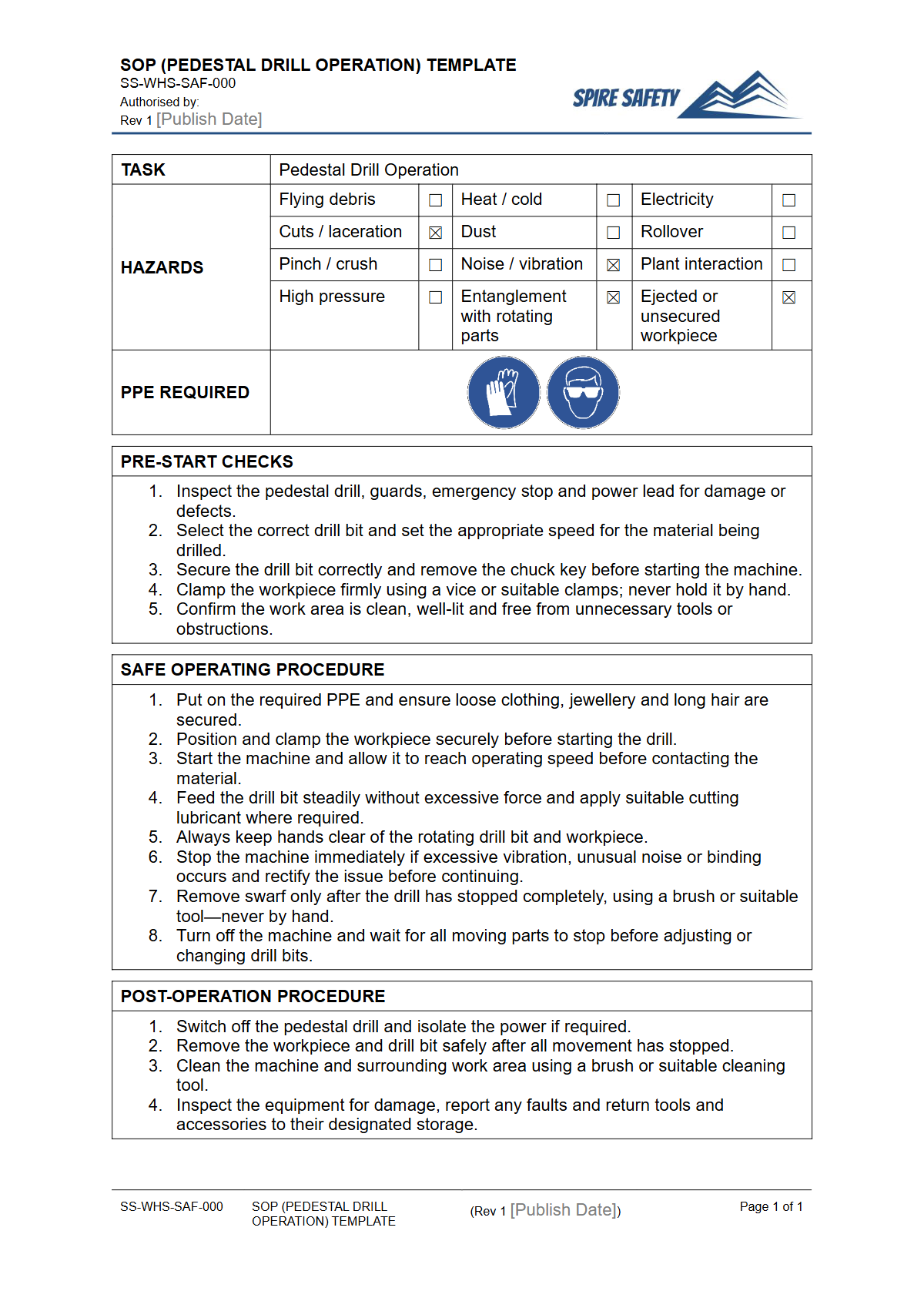
This free Safe Operating Procedure (Pedestal Drill Operation) template provides a clear, structured framework for documenting the required steps to operate a pedestal drill safely. Its primary purpose is to help Persons Conducting a Business or Undertaking (PCBUs) manage the risks associated with pedestal drill use, such as entanglement in the rotating chuck, eye injuries from flying debris, and electrical hazards.
By outlining pre-operational checks, step-by-step operating instructions, and post-operational tasks, a robust SOP helps standardise safe work practices and reduce the likelihood of incidents.
A well-defined SOP is a fundamental component of a safe system of work. It serves as a vital tool for worker training, induction, and competency assessment.
Formalising these procedures ensures that safety is not left to chance or memory, providing a consistent reference point for all operators. Implementing documented procedures like this is a key part of developing effective WHS management systems that protect workers and support organisational due diligence.
Video walkthrough
How to use the Free Safe Operating Procedure (Pedestal Drill Operation) Template
This resource is provided as a fully editable DOCX file and a print-ready PDF. To use it effectively, download the document and adapt it to the specific context of your organisation.
It is designed as a comprehensive starting point aligned with Australian WHS principles, but it requires customisation to be effective and relevant.
Important: This is a template, not a finished document. You must review and modify it to reflect your workplace's specific machinery, environment, tasks, and control measures identified in your risk assessments.
We strongly recommend consulting with the workers who actually operate the equipment during the customisation process to ensure the SOP is practical and accurate. Once finalised, the SOP should be used to train all relevant personnel before they are authorised to operate the pedestal drill.
Similar principles apply when creating a safe operating procedure for a brake press or any other piece of plant.
When to use a Safe Operating Procedure
A Safe Operating Procedure for a pedestal drill should be an active document within your safety management system. It is used in several key situations:
- Worker Training and Induction: Before any new or existing employee operates a pedestal drill, they must be trained on the contents of the SOP.
- Competency Verification: It serves as the benchmark against which a worker's competency to operate the machine safely is assessed.
- Pre-Task Reference: Operators can use it as a refresher before starting a complex or unfamiliar drilling task.
- Incident Investigation: Following an incident or near-miss, the SOP is reviewed to determine if procedures were followed and if they need to be updated.
- Audits and Inspections: The SOP provides evidence of a formalised safety process during internal or external safety audits. Having these documents prepared is a crucial step before undergoing WHS compliance auditing.
Who should use this Safe Operating Procedure
The development, implementation, and use of a pedestal drill SOP involves several roles within an organisation:
- PCBUs and Directors: To fulfil their primary duty of care by ensuring safe systems of work are in place for all plant and equipment.
- WHS Managers and Safety Officers: To develop, implement, and review safety procedures as part of the overall WHS management system.
- Supervisors and Team Leaders: To enforce the SOP, train their team members, and supports your compliance efforts on the workshop floor.
- Workers and Operators: As the end-users, they must follow the SOP for every task to ensure their own safety and that of their colleagues. Their input is also vital for keeping the procedure relevant and practical.
The same structured approach is essential for other common workshop equipment. If your workplace uses computer-controlled machinery, our CNC machine SOP template offers a similar starting point.
For portable tools, a dedicated circular saw safe operating procedure is equally important for managing risks.
This document is just one of many templates available to help you build out your safety documentation. You can browse our complete free WHS resources library for more SOPs, checklists, and forms to support your safety goals.
Common mistakes
Common mistakes to avoid
- Failing to securely clamp the workpiece, allowing it to spin and cause injury.
- Leaving the chuck key in the chuck after changing a bit, creating a projectile hazard upon startup.
- Using dull, damaged, or incorrect types of drill bits for the material being drilled.
- Not wearing appropriate personal protective equipment (PPE), especially mandatory safety glasses.
Legal references
Legal considerations
The following legal requirements may be relevant to this type of work.
- Work Health and Safety Act (Harmonised) — Provides the primary duties for protecting workers and other people from work health and safety risks.
- Work Health and Safety Regulations (Harmonised) — Sets out requirements supporting the management of workplace hazards and risks.
The following codes may be relevant to this type of work.
- Managing WHS Risks Code of Practice — Provides practical guidance on identifying hazards, assessing risks and applying effective controls.
- Work Health and Safety Consultation, Cooperation and Coordination Code of Practice — Provides practical guidance on consulting workers and coordinating with other duty holders.
- Managing the Work Environment and Facilities Code of Practice — Provides practical guidance on safe work environments, workplace facilities and related controls.
Did you know
Entanglement Hazard
The rotating chuck and drill bit of a pedestal drill are major entanglement hazards. Loose clothing, long hair, and jewellery can be caught in seconds, causing severe degloving injuries, fractures, or amputation.
FAQ
Frequently asked questions
01What should be included in a pedestal drill safe operating procedure?
02Is a Safe Operating Procedure a legal requirement for pedestal drills in Australia?
03Who is responsible for writing and implementing a pedestal drill SOP?
04How often should a pedestal drill SOP be reviewed?
Share this resource
Free Safe Operating Procedure (Pedestal Drill Operation) Template
Browse Categories
How To Use It
- 1Download and open in Word or PDF.
- 2Replace the placeholders with your business details.
- 3Get it reviewed by a WHS specialist before rollout.
Need it customised?
Our WHS consultants can adapt this template to your site, run a gap analysis, or audit what you already have in place.
Book a Free Consultation WHS consulting servicesor call 1300 156 382
Related templates
- Free Safe Operating Procedure (Pedestrian Route Setup) Template
- Free Safe Operating Procedure (Penetrometer) Template
- Free Safe Operating Procedure (Peristaltic Pump) Template
- Free Safe Operating Procedure (Personal Alarm Testing) Template
- Free Safe Operating Procedure (Personnel Hoist) Template
- Free Safe Operating Procedure (Pesticide Mixing) Template